

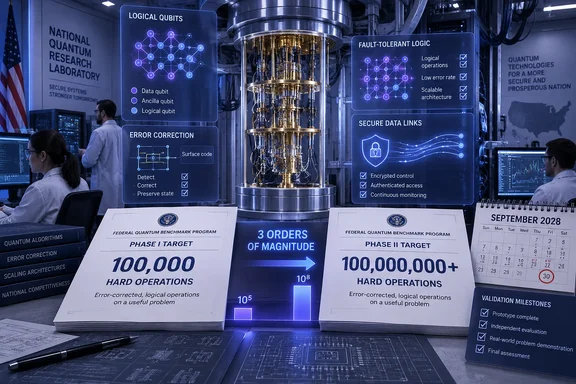
That is a gap of three orders of magnitude, not a wording quibble. The Register first highlighted the contest’s unusual milestone-based funding model and its 2028 objective. The underlying DOE paperwork shows that the agency has left itself substantial room to negotiate the actual benchmark with each selected company — and that the headline figure in the press release is not the number applicants can simply design against.
For developers, research IT teams and security planners, the useful takeaway is narrower than the rhetoric around “the world’s first” machine: this is a federal effort to purchase and independently validate an early fault-tolerant quantum capability, not a declaration that a generally useful quantum supercomputer will arrive in two years.
DOE’s two documents do not set the same operations target
DOE’s news release says applicants should propose systems with 100 logical qubits that can perform hundreds of millions of fault-tolerant operations and run scientific demonstration programs. The department separately says the competition can distribute up to $215 million through a mix of fixed early awards and performance incentives.
But the 48-page request for applications tells a more qualified story. Its table of “key performance metrics” sets out three device generations: a prototype with 10 logical qubits and (10^3) hard operations; a first-generation SRQC with 100 logical qubits and (10^5) hard operations; and a future next-generation machine with roughly 1,000 logical qubits and (10^7) hard operations.
DOE defines a hard operation as an operation that is expensive within a vendor’s chosen error-correction scheme but necessary for universal computation — for example, a non-Clifford operation in stabilizer-code systems. That makes it a more meaningful endurance measure than raw gate count. A system that can preserve and operate on logical information through many such operations has solved far more of the practical error-correction problem than a device that merely reports a large number of physical qubits.
Yet DOE explicitly labels the table’s numbers “illustrative.” The agency says a vendor with unusually low error rates but fewer logical qubits, or an architecture that does not map neatly to a logical-qubit total, may negotiate equivalent milestones. The agency will decide whether those alternatives are acceptable.
That flexibility is sensible for a field with fundamentally different hardware approaches, including superconducting circuits, trapped ions, neutral atoms and photonics. It also means the public release’s “hundreds of millions” figure should not be treated as a universal, fixed qualification requirement unless DOE reconciles it with the RFA or incorporates it into individual agreements.
The difference changes how ambitious the program looks. A 100-logical-qubit system capable of 100,000 hard operations would be a major achievement. A 100-logical-qubit system capable of hundreds of millions would be dramatically closer to the class of machine that industry roadmaps place later in the decade. IBM, for example, has publicly targeted 200 logical qubits and 100 million operations for its planned 2029 fault-tolerant system. DOE’s release language therefore appears to set a bar comparable to, or beyond, claims vendors are making for the following year, while its formal competition table defines a much lower illustrative floor.
The first federal money arrives after a validation plan
The $215 million headline also needs reading alongside the payment schedule. DOE expects to select at least three and up to ten companies. But the agency has allocated only $2.5 million in fiscal-year 2026 funding; the rest depends on future congressional appropriations.
Each selected participant can receive up to $1.5 million during Phase I. The initial $250,000 is not an unrestricted starting grant. Companies must first develop a detailed technical plan with DOE’s designated verification-and-validation team, win DOE approval for that plan, and only then receive the payment. DOE’s own schedule places that checkpoint about six months after project initiation.
A further $1.25 million follows only after the company delivers a validated prototype, expected roughly one year after the program starts. Applicants, not DOE, bear the cost of preparing their submissions and of the underlying development work before those milestone payments land.
That structure makes the Quantum Genesis Q Competition closer to an incentive prize backed by negotiated contracts than a conventional research grant. DOE plans to use Other Transaction Agreements, a contracting mechanism intended to be more flexible than standard federal grants or procurement contracts. The agreements will contain the specific technical milestones, access terms and validation procedures.
The arrangement favors firms that already have hardware, manufacturing, control software, error-correction research and financing in place. A startup with a promising qubit concept but no demonstrated multi-qubit system is specifically outside DOE’s stated interest. The RFA also excludes proposals centered on further research into a possible quantum-computing methodology, as well as machines relying only on error mitigation or error detection rather than genuine error correction.
In short, DOE is not financing a search for an unknown physics breakthrough. It is attempting to make existing contenders put their systems — including their control stack and scientific workflows — through independent federal testing.
“Scientifically relevant” is a workflow test, not proof of quantum advantage
The competition’s central phrase, “scientifically relevant quantum computer,” could be read as a claim that the selected system must beat the best classical supercomputers on an important scientific problem. DOE’s RFA does not require that.
For the prototype stage, companies are expected to demonstrate a simple scientific subroutine, such as phase estimation or Trotter evolution. For the first-generation system, they must run a complete scientific workflow tied to DOE priorities in areas including chemistry, materials, physics or applied mathematics.
Critically, the RFA says that workflow need not run at a scale that is classically intractable. It may also operate in concert with a classical computer. The much larger next-generation system envisioned for the 2030s is the one DOE associates with “production-level discovery science.”
That distinction is unusually important for enterprise readers because quantum marketing often blurs three different accomplishments:
- A processor can have many physical qubits while still being too noisy for deep, error-corrected computation.
- A machine can demonstrate logical qubits and error correction without executing a sustained, broadly useful workflow.
- A hybrid quantum-classical workflow can be scientifically informative without proving that the quantum component has outperformed conventional high-performance computing.
DOE is asking vendors to clear the second threshold and establish a credible path toward the third. It is not promising that the 2028 winner will replace a supercomputer for drug discovery, energy simulation or materials design.
Independent validation is the competition’s most consequential requirement
The notable operational element is not the prize pool but DOE’s verification model. Participating companies must give DOE National Laboratory personnel physical and virtual access to their systems, and permit them to operate the devices to verify performance. DOE may also enlist other federally funded research organizations, university-affiliated research centers or neutral third parties.
That is a harder commitment than a vendor benchmark performed solely on a company’s preferred workload and software stack. It puts pressure on several layers that can otherwise be hidden behind a headline qubit count: logical-state preparation, decoding latency, calibration stability, fault-tolerant gate implementation, control hardware and the reproducibility of the claimed scientific workflow.
DOE is also funding a separate $45 million Quantum High-Performance Computing Validation and Verification Testbed Lab Call for its National Laboratories. That program is distinct from the $215 million competition. Its purpose is to build the measurement, characterization and validation capability needed to assess systems across the quantum-computing stack.
The department has not yet identified which laboratories will run that infrastructure, exactly how raw performance data will be published, or whether external researchers will gain access to the contest machines. Those omissions matter. Independent validation is most valuable when the resulting methodology and evidence can be scrutinized beyond the agency and winning vendors.
The 2028 date is a target, not a hard stop
DOE says it expects final evaluations in September 2028, with final payments following after verification work is completed. Companies that clear the first-generation threshold share a $100 million general incentive pool. Separate $50 million pools are available for systems reaching 150 and 200 logical qubits.
Those pools are shared among all qualifying awardees, not reserved for a single winner. A company could therefore meet the nominal target and receive substantially less than $100 million if multiple systems qualify. Conversely, a sole company clearing the 200-logical-qubit level could claim the general pool and both bonuses, subject to the program’s funding and agreement terms.
The RFA also permits applications from companies proposing to reach the first-generation milestone no later than 2030. Those slower entrants risk seeing the available incentive money claimed by earlier performers, but their inclusion is an admission that 2028 is an aggressive preferred schedule rather than a universally expected outcome.
If nobody reaches the final milestone by September 2028, DOE may extend the agreements, alter their duration and potentially open the program to new participants. The agency can also end awards before Phase II if appropriations do not materialize.
Applications close October 19, 2026, and DOE says initial selections may be announced no earlier than November 13. The immediate milestone to watch is not a quantum-computing breakthrough but the selection list: it will show which hardware approaches DOE believes are mature enough to submit to independent testing, and whether any contenders are willing to compete on federal terms rather than on their own roadmap metrics.
References
- DoE seeking fault-tolerant quantum computer ... by 2028 The Register · 2026-09-17T20:09:45+00:00
