

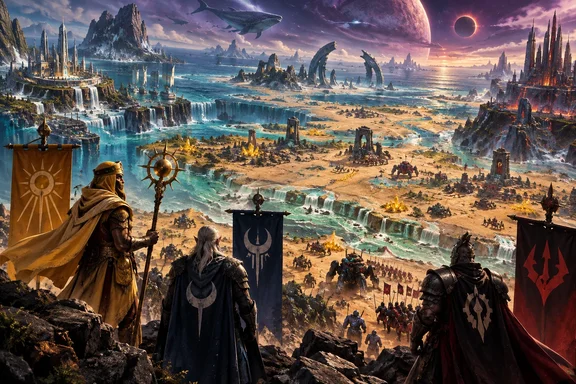
Microsoft’s Slovak Store listing surfaced the retail release with the familiar description of Saiadha, an ocean world whose retreating seas alter the map over a campaign. Xbox Wire separately listed ENDLESS Legend 2 (1.0) among the games released September 17, while Amplitude confirmed that version 1.0 arrived across Microsoft Store, Xbox Series X|S, Steam, Epic Games Store, and PlayStation 5.
For Windows and Xbox users who encountered the game during its original Xbox on PC Game Preview release, this is also a status change worth noticing. The game was previously promoted through PC Game Pass; it is now being sold as a $49.99 purchase on the Xbox Store, with a free trial listed alongside it. Xbox Game Pass subscribers should not assume that the 1.0 launch restores access: Microsoft officially listed Endless Legend 2 among the PC games leaving Game Pass on April 30, 2026.
Version 1.0 turns early-access additions into the retail baseline
Amplitude’s 1.0 announcement identifies the Sandshapers as the major new faction, with the Order of Zelavas and Severed Claws arriving as “Rogue Factions.” The studio says the two rogue groups are fully playable offshoots of existing factions rather than minor map opponents or paid add-ons, and that they are included in the base game.
That distinction is more substantial than it first sounds. A 4X game lives or dies by how different its factions make the same map, economy, and victory systems feel over dozens of hours. The developer describes the Sandshapers as expansionists who terraform claimed territory into desert tiles, while the rogue factions remix the affinities of the Kin of Sheredyn and Necrophage with their own leaders, traits, quests, units, technologies, and improvements.
Amplitude also says the faction content feeds into the game’s custom-faction creator. That makes the launch additions more than three isolated campaign choices: players building custom civilizations inherit additional traits, units, and population options. It is a meaningful expansion to the game’s replayability rather than a cosmetic launch-day bundle.
The studio says the full release also contains a large number of fixes, though it did not publish a concise platform-by-platform rundown in its announcement. Its immediate priority is addressing critical issues reported after launch, and it has declined to commit publicly to a detailed post-release roadmap until it has seen the initial player response.
That is a reasonable stance for a game exiting early access, but it leaves prospective buyers without a firm promise on the cadence or scope of future content. Players buying on Xbox should treat version 1.0 as the complete retail foundation, not as confirmation of a defined season pass or a scheduled sequence of major expansions.
Tidefall is the feature that changes the usual 4X rhythm
The core premise in Microsoft’s listing is familiar: establish cities, collect strategic and luxury resources, research technologies, recruit heroes, and resolve wars through tactical turn-based battles or auto-resolve. What separates ENDLESS Legend 2 from a conventional Civilization-style march across a fixed map is Tidefall.
As the oceans recede, new land opens up, creating fresh resources, ruins, paths between empires, and possible attack routes. Existing territory is not supposed to disappear, but cities that were safely separated by water can become exposed as land bridges form. The new geography can also make an earlier strategic decision—such as where to fortify a border—look very different later in the same match.
That design addresses a recurring problem in large-scale turn-based strategy games: exploration often peaks early, then gives way to a long period in which the map has been claimed and the leading empire simply optimizes toward victory. In a pre-release Xbox Wire feature, game director Derek Paxton described Tidefall as an attempt to introduce new phases of exploration after the opening turns instead of leaving players with a static political map.
PC Gamer’s review, published on September 16, found that the system does more than rearrange scenery. It reported that the receding shorelines can connect previously isolated territories, expose valuable deposits, open dungeons and reveal new minor factions. The publication praised the mechanic for returning players to the contest over expansion and resources several times in a campaign, rather than reserving it for the opening phase.
For console strategy players, the practical appeal is clear: Tidefall can prevent a comfortable early-game position from becoming an autopilot run. It also makes city planning more conditional. A coastal settlement, river economy, choke point, or isolated island can have a different military value after the next environmental shift.
Xbox buyers should separate the retail launch from Game Pass access
The original Xbox Wire announcement for the September 2025 Game Preview release explicitly described ENDLESS Legend 2 as coming to Xbox on PC, PC Game Pass, and Game Pass Ultimate. That early-access version carried Xbox Play Anywhere labeling in Microsoft’s weekly release post, which meant one purchase could span Xbox PC and compatible console hardware if and when the platform release arrived.
The current situation is less straightforward. Microsoft’s April 2026 Game Pass roundup listed Endless Legend 2 as leaving the service on PC. Then, in its September 2026 “Next Week on Xbox” post, Xbox Wire listed the finished game as a $49.99 title with a free trial—but did not label that listing as Game Pass or Xbox Play Anywhere.
This does not establish that Xbox Play Anywhere support has been removed from the final product. It does establish that Microsoft’s current launch post does not make that entitlement claim, despite the same game having been associated with it during the Game Preview period. The product uses the same Microsoft Store identifier that appeared on the early-access listing, but store identifiers alone do not guarantee that a prior entitlement label remains attached after a full-release transition.
That omission matters to Windows players deciding where to buy. The difference between Xbox Play Anywhere and separate PC/console purchases is not subtle: Play Anywhere games provide the console and Windows version through one digital purchase, while also carrying saves, achievements, and add-ons through the Xbox account. Microsoft’s own Play Anywhere policy says supported games are marked with the program badge in the Xbox and Windows stores.
Until the Store page explicitly shows that badge for the 1.0 listing, buyers who want to move between a Windows PC, handheld, and Series X|S should verify the product’s current entitlement details before purchase. Third-party Xbox tracking sites had expected Play Anywhere support ahead of launch, but they also acknowledged it had not been officially confirmed.
The full release has received an early vote of confidence on PC
The game arrives with more than a retail-store description behind it. PC Gamer reviewed the 1.0 version on a Ryzen 9 5900X system with a Radeon RX 6800 XT and awarded it an 85 out of 100, praising its faction design, worldbuilding, terrain presentation, and Tidefall system.
The review also flagged a practical criticism that may carry over to controller-focused play: it found the redesigned interface less immediately readable than the original game’s, particularly when symbols replace clearer text labels for cities and armies. That does not amount to an Xbox Series X|S performance assessment—PC Gamer tested the Windows release, not the console port—but it is relevant to anyone wary of dense strategy-game interfaces.
Microsoft’s store description promises direct control of individual units in battles, terrain-aware positioning, faction-specific combat abilities, heroes, and multiple victory paths. Those are genre-standard ambitions; the better evidence for the game’s identity is that its map is designed to redraw strategic assumptions as a campaign proceeds and its factions are intended to break common rules in different ways.
The first post-1.0 patches will now determine whether Amplitude can preserve that depth without making the Xbox experience cumbersome. For now, the concrete purchase decision is simpler: ENDLESS Legend 2 is no longer an Xbox on PC Game Preview title or a current Game Pass benefit. It is a full $49.99 Xbox and Windows strategy release with a trial available, three new launch factions, and no published long-term content schedule.