

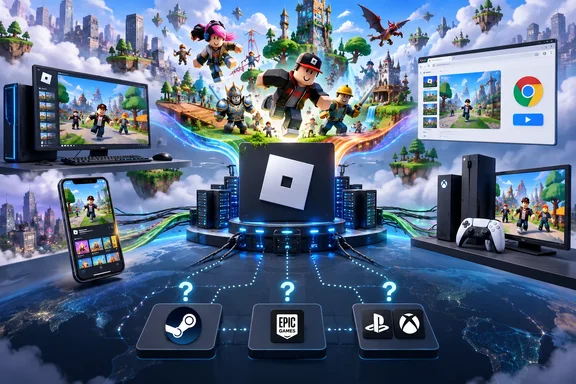
The announcement, made at the Roblox Developers Conference on September 11, was detailed by Roblox itself and subsequently reported by PC Gamer, Game Developer, and PocketGamer.biz. For Windows players and studios building in Roblox Studio, the potential upside is straightforward: a popular experience could eventually have its own installable PC presence and a direct route to its game, rather than requiring players to download the Roblox client, find the title in Roblox’s discovery system, and launch it from there.
But Roblox Everywhere remains a roadmap with a deliberately narrow first step. PC Gamer reports that Roblox will begin by testing with a select group of developers and storefronts. Steam, Epic Games Store, GOG, the Microsoft Store, and named console stores have not been confirmed. Treat any suggestion that a Roblox title is about to appear on Steam as speculation, not a release plan.
A standalone app still runs on Roblox
The consequential wording in Roblox’s own announcement is that standalone apps will be available “across mobile, PC, and consoles,” with Roblox providing the technology and services underneath. That leaves Roblox in control of the pieces that make a live-service game expensive and difficult to operate independently: its engine runtime, server infrastructure, account systems, social features, moderation tooling, payments stack, and likely the update and telemetry path.
PC Gamer reports that cross-play will be enabled by default between a standalone game and players using the main Roblox app. If that remains true in the rollout, a separate Windows storefront listing will be an alternate front door into the same service, not a forked PC version with its own population and backend.
That distinction changes how developers should read the announcement. Roblox Everywhere may remove the Roblox app from the player’s first interaction with a game, but it does not give creators the kind of platform independence associated with shipping a Unity, Unreal Engine, or custom-engine title on Windows. A studio will still be building on Roblox, while gaining the ability to package a particular experience as a more recognizable product outside Roblox’s central catalog.
For players, that could be welcome. A direct desktop shortcut, a Steam library entry, or a branded Microsoft Store listing is easier to understand than a link that opens a general-purpose client with millions of unrelated games. It could also make it easier for a successful Roblox experience to establish an identity beyond the platform’s frequently changing recommendation feeds.
For IT administrators, however, standalone distribution may create a familiar management tradeoff. A single Roblox client is one application to approve, deploy, update, and monitor. Multiple standalone Roblox-powered apps could mean more executables, more vendor storefront dependencies, and more titles requesting installation on managed Windows PCs. Roblox has not published enterprise deployment, MSI, Intune, update-channel, or support documentation for Roblox Everywhere.
Roblox has not disclosed the terms that will decide whether this matters
The largest unanswered question is commercial, not technical. Game Developer reports that a Roblox spokesperson said the first creators selected for outside-store distribution will receive the same revenue-share economics as the Roblox app, including the higher Developer Exchange, or DevEx, rate available to age-verified U.S. users aged 18 and older.
That statement confirms that a standalone storefront listing will not, at least in the initial program, replace Roblox’s financial relationship with the developer. It does not disclose the precise split on an external storefront, whether the storefront holder’s fee comes out before or after Roblox’s share, how subscriptions or platform-specific currencies will work, or whether creators will be allowed to set different prices by store.
Those omissions are significant. A game released through Steam, the App Store, Google Play, PlayStation, or Xbox can face different platform rules around payments, refunds, downloadable content, age ratings, parental controls, and user-generated content. Roblox has not explained how its virtual currency, in-game passes, subscriptions, advertising products, or DevEx cash-outs will be reconciled with those systems.
Roblox also has not published the eligibility criteria for its “select” first group of developers. That makes this a potentially powerful distribution option for established studios, but not yet a practical publishing route for the typical Roblox creator. The company has not said whether creators will need a separate legal entity, regional age ratings, additional moderation commitments, a minimum revenue threshold, or approval from the storefront owner before receiving access.
The original claim that developers can “escape” Roblox therefore overstates the change. They may gain a new distribution channel, a dedicated brand surface, and a direct acquisition path. Roblox still owns the rails.
Chrome web play may arrive sooner than a separate Windows listing
Roblox’s nearer-term change for PC users is its browser player. By the end of 2026, according to the company’s September 11 announcement, players should be able to open an Experience Details Page in Chrome and join a game without installing the Roblox application. Roblox says other browsers will follow, but it has not committed to a timetable for Microsoft Edge, Firefox, or other Chromium-based browsers.
For creators, browser launch links could prove more important in the short run than external storefront apps. They provide a direct route from a YouTube video, search result, social post, email, or creator site into a game, cutting out the install and discovery friction that has long separated a promotional link from actual play.
The company’s own framing makes the strategic connection clear. Roblox is trying to let creators reach people where they already are, while retaining the shared technology that makes Roblox games scalable and social. A direct Chrome session and a later standalone app both serve that goal: make a game easier to enter without making its developer responsible for rebuilding the platform beneath it.
Windows users should not assume browser support means browser-based Roblox Studio or a general-purpose replacement for the desktop client. Roblox announced a player path from an Experience Details Page, not a web version of its creator IDE. Similarly, Roblox has not said whether browser play will offer the same performance, voice features, input support, VR support, anti-cheat behavior, or parental-control enforcement as the installed client.
Offline play broadens the kinds of games Roblox can host
Roblox also said it plans to let creators enable offline solo play while retaining a live multiplayer mode, with early access coming before general availability targeted for mid-2027. That is a meaningful engine and product shift because traditional Roblox experiences have largely assumed an active connection to Roblox’s service layer.
The feature will suit puzzle games, turn-based titles, lightweight simulations, and other experiences that do not depend on a continuously synchronized multiplayer world. Roblox paired the announcement with engine work aimed at 2D development, including an orthographic camera, animated image containers, direct sprite-sheet import, and new interface effects.
This should not be read as evidence that every existing Roblox game will work offline. Offline support will require creators to design for it, and Roblox has not detailed how save files, progression conflicts, purchases, moderation, or later synchronization will operate. Games built around multiplayer economies, live events, server authority, or real-time social play are unlikely to become offline-friendly merely by enabling a setting.
The broader direction is nevertheless clear. Roblox wants to host more than always-online 3D social worlds: it is building for games that can be discovered on the web, launched through a dedicated storefront app, and played in limited circumstances without a network connection.
The business case is audience growth, not a retreat from the platform
Roblox’s second-quarter 2026 shareholder letter supplies the business context that the product announcement leaves mostly unsaid. The company reported revenue of $1.5 billion, up 36 percent year over year, while bookings growth came in at the low end of its outlook. Roblox attributed the shortfall to weaker monetization per hour, particularly among younger U.S. and Canadian users, after engagement shifted toward lower-monetizing new and evergreen games and after changes to its recommendation system prioritized retention.
A direct-storefront strategy could help Roblox find audiences who would not otherwise install its general client or browse its catalog. A standalone PC game can be marketed by name, searched for directly, reviewed in a conventional store, and placed in a player’s existing library. That is especially relevant for games attempting to reach older users who are accustomed to Steam, console storefronts, or mobile app stores rather than a youth-oriented platform hub.
Roblox does not need to surrender its infrastructure or monetization model to pursue that audience. The initial terms reported by Game Developer indicate the opposite: the company is seeking broader distribution while preserving the economics and systems that have made the platform valuable to it.
For now, developers should view Roblox Everywhere as an invitation to prepare for a pilot, not as a new universal publishing channel. The first concrete milestone will be Roblox naming the participating storefronts, the initial creators, the commercial terms, and the Windows distribution model. Until then, the only PC delivery promise with a firm timeframe is Chrome-based game access before the end of 2026.