

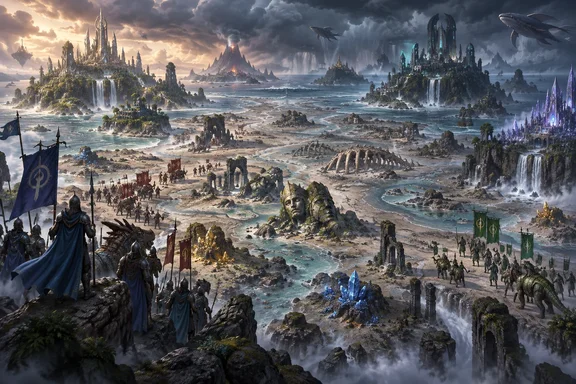
For Windows PC players weighing a $50 purchase, the important point is not that Endless Legend 2 has another handsome science-fantasy setting or another suite of unusually asymmetric factions. Amplitude has done both before. The practical change is that Tidefall turns the map into a recurring source of contested expansion, forcing armies, cities, and border plans to be reconsidered long after the familiar opening land rush would have ended in most 4X games.
That is a meaningful answer to one of the genre’s most persistent problems. Civilization, Humankind, and countless smaller 4X games can produce compelling early exploration, then settle into a period where the leading empire compounds its advantage while the rest of the match becomes administration. PC Gamer’s verdict is that Saiadha’s changing shoreline restores the game’s strongest phase several times over. If the launch build holds that pacing through complete campaigns, Tidefall is more than a map gimmick: it is the game’s argument for why this sequel exists.
Tidefall gives expansion a second and third act
Saiadha begins as a storm-lashed ocean world of islands. Monsoons arrive at intervals, and the seas retreat afterward, revealing formerly submerged regions. Amplitude has said Tidefall can uncover land through the fog of war and trigger events tied to the imprisoned force beneath the planet; its earlier development updates also place faction-specific Awakening quests after the second Tidefall.
The immediate mechanical result is straightforward. Places that were remote islands can become accessible overland, a defensible coast can become a porous frontier, and a mediocre city can suddenly sit beside exploitable deposits or a fresh colonization route. The practical result is more valuable: players cannot assume that a border established 30 turns earlier will remain strategically valid.
PC Gamer’s review stresses that the newly exposed land can bring strategic resources, dungeon-like sites for heroes, and minor factions as well as ordinary colonizable territory. That matters because it makes scouting units and armies relevant beyond the opening turns. A 4X army frequently becomes either a static deterrent or an instrument for a single decisive war; here, positioning a force near the next shoreline change can determine who gets the first claim on a newly exposed region.
The system also creates tension without requiring every match to become total war. Endless Legend 2 retains the series’ use of neutral regions and minor factions, according to the review, so an emerging frontier can be contested through camps, exploration, influence, quests, and opportunistic raids before the major powers formally collide. That is a better fit for players who want a lively map but do not want every campaign reduced to conquest.
There is a caveat in the design. Tidefall is a fixed central feature rather than an optional side activity, and Amplitude previously said it did not plan to let players adjust the number of Tidefalls. Players who prefer a stable, fully legible board may find the disruption intrusive. For everyone else, it appears to be a deliberate pressure against the predictable geometry that makes many late 4X campaigns feel decided before they are finished.
The 1.0 release adds content, but the design was already visible
The September 17 release ends nearly a year of Steam Early Access. Steam’s release information says version 1.0 adds the Sandshapers as the sixth major faction, two rogue faction variants, a new minor faction, expanded endgame material, and broader balance, AI, and interface work. Existing Early Access owners should receive the full release without having to buy a separate edition; this is an in-place version 1.0 transition, not a new product listing.
That distinction matters because the review’s strongest observations are about systems that have already been exposed to players during Early Access. Earlier coverage from DBLTAP also found the combination of monsoons, Doomwraith enemies, anomalies, and Tidefall-driven exploration compelling, while PC Gamer’s previous Early Access coverage praised the changing sea level but flagged diplomacy and AI as areas still needing work. The full review indicates that Amplitude has made a more convincing game of the central loop, but it does not suggest that every inherited Amplitude weakness has disappeared.
The Sandshapers should be the most revealing 1.0 addition. Amplitude describes them as ancient mineral constructs attempting to terraform Saiadha back toward its pre-ocean desert state. PC Gamer reports that they cannot farm conventionally, instead relying on rare resources and deliberate desertification to sustain population growth. This is exactly the kind of faction design that made the original Endless Legend stand apart: a civilization does not merely receive numerical bonuses but operates under altered assumptions about the map and economy.
The two rogue factions take a less expansive but still useful approach. Steam’s announcement describes them as alternate spins on existing major factions, while PC Gamer characterizes the defensive Children of Sheredyn offshoot as aggressive and the Necrophage counterpart as a cyborg enslaving swarm. They are not replacements for wholly new faction concepts, but they should add matchup variety without asking players to learn an entirely separate economic model.
Faction asymmetry remains Amplitude’s clearest advantage
Amplitude’s best 4X work has always been willing to make a faction feel inconvenient, strange, and occasionally unfair in a way that produces a distinct campaign. Endless Legend 2 appears to preserve that principle. PC Gamer highlights the fortress-oriented Children of Sheredyn, the one-city Necrophage hive, the treaty-imposing Aspects, the terrain-dependent Sandshapers, and the Tahuks’ ranged, chokepoint-oriented combat style.
This is where the sequel seems most likely to justify its place beside the 2014 original. Many mechanics that once made Endless Legend feel startling—region-based cities, terrain transformation, resource economies built around Food, Industry, Dust, Science, and Influence—have since been adopted or echoed across the genre. The sequel’s answer is not to discard those systems for novelty’s sake. It retains the FIDSI economy and expands the ways factions disobey its normal rules.
For administrators of multiplayer groups or friends starting campaigns together, that also raises a practical consideration: faction selection will probably matter more than raw difficulty settings. A Sandshaper economy, an Aspect influence game, and a Necrophage military campaign are unlikely to teach the same habits. Groups looking for a balanced competitive ruleset may need time with the 1.0 patch before treating every faction pairing as equally mature.
The review does offer one useful restraint on the praise. The factions are reportedly somewhat less extreme than those in the first game; no faction, for example, can relocate cities in the manner some original-game players will remember. That could reduce the most spectacular edge cases, but it may also make the sequel easier to balance and easier for new players to read.
Combat and interface are the launch build’s unresolved pressure points
PC Gamer calls tactical combat less rich than the exploration-and-expansion game surrounding it. Battles continue to take place on terrain drawn from the strategic map, preserving the value of approaching from favorable ground, exploiting chokepoints, and matching a faction’s unit strengths to a location. That is a real advantage over 4X combat systems that pull every engagement into a generic tactical arena.
But the review says combat can become a tight exchange of damage where meaningful advantages depend on having overwhelming numbers, stacking buffs, or finding terrain interactions that feel closer to system exploitation than clever maneuvering. On higher difficulty levels, AI bonuses rather than apparently smarter operational play remain the principal source of challenge. Players expecting the release build to solve the long-running 4X AI problem should temper expectations.
The interface presents a smaller but more immediate concern for PC players. PC Gamer praises the overall UI while criticizing its map symbols for cities, armies, and resources as less legible than direct text labels. In a game that repeatedly changes shorelines and opens new territory, visual clarity is not cosmetic. The player needs to assess a newly transformed border quickly, especially on a large monitor where dense strategic information competes for attention.
Amplitude explicitly promised UI and UX refinements as part of the move out of Early Access. The review suggests that work has produced a capable interface, not an unqualified improvement over the original. That is worth knowing before launch: expect a learning curve in reading the iconography, particularly during the first few games, rather than assuming that the visual polish automatically translates to faster decision-making.
A full release worth judging on campaign pacing
PC Gamer’s review rates Endless Legend 2 as an accomplished modern 4X whose setting, art direction, music, and faction design carry the recognizable Amplitude character. The more consequential finding is that the campaign map changes at the moment most 4X games begin losing momentum. Recurring land exposure creates new resource races, new invasion paths, and new reasons to move forces across the board.
The release is therefore best suited to PC strategy players who want an authored, highly thematic alternative to a conventional empire builder and are comfortable learning faction-specific exceptions. Players whose priority is an opponent AI that wins by superior planning rather than economic bonuses, or a minimalist tactical system with perfectly transparent outcomes, should wait for broader post-launch evidence.
On September 17, the real test will be whether the revised endgame lets Tidefall’s promise survive a full campaign rather than simply make the middle turns more exciting. The evidence available before release supports a narrower conclusion: Endless Legend 2 has already found a smart way to make the map matter again after turn 50.
Update: PC Gamer lists September 22 as the Early Access exit date (September 20, 2026)
Contrary to the earlier September 17 release date, PC Gamer’s September 20 report says Endless Legend 2 will leave Early Access on September 22. That makes the final launch still pending rather than already available, so prospective Windows PC players should treat launch-build assessments as pre-release until the updated date passes.
PC Gamer also adds practical detail on the Order of Zelevas rogue faction. Unlike the defensive Kin of Sheredyn, it reportedly rewards wider territorial control and recruits troops instantly with Dust, shifting its priorities toward economic output and aggressive expansion.
The report further reinforces that faction differences extend beyond unique units: Sandshapers must create deserts to support themselves, while the Order’s Dust dependence changes city planning and military timing.
References
- Endless Legend 2 review PC Gamer · 2026-09-16T23:12:07+00:00