

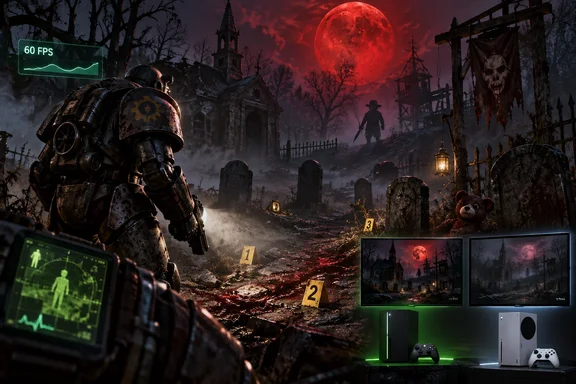
Bethesda released the update on September 15, alongside the horror-themed The Slasher questline and Season 26. The native application is a meaningful improvement over running the Xbox One build through backward compatibility, particularly because it gives Bethesda a platform-specific client it says can be tuned for both current and last-generation console hardware in future updates. But it is not a blank-check “4K/60” upgrade for every Xbox owner, and it requires more than accepting a normal patch.
A separate Series X|S download is required
Bethesda’s release notes say that players must redownload the entire game from the Xbox Store to access the native Xbox Series version. An Xbox Series X or Series S that retains the older Xbox One installation will not receive the native-client benefits merely by updating its existing copy.
That is the most practical detail omitted from many quick summaries of the rollout. The company repackaged Fallout 76 across platforms to reduce the eventual installed footprint, but warned that the update download would be unusually large. Bethesda lists the post-update Xbox installation at 101 GB, compared with 119 GB on Steam and 119.7 GB through the Microsoft Store on PC.
For Xbox players managing internal SSD space, that distinction matters. The cleanest path is to verify that the store listing identifies the Xbox Series X|S edition, then install that version rather than assuming the console has silently converted the older build. Bethesda’s support documentation also says disc owners must claim the appropriate disc upgrade through the platform store.
The game remains available through Xbox Game Pass, and Xbox Wire said during the August public-test period that Game Pass members with access to Fallout 76 could participate. Bethesda has framed the new native version as available to existing owners, rather than as a paid remaster or premium upgrade.
Bethesda’s specifications draw a hard line between Series X and Series S
The actual supported-output list is narrower than the “4K on Xbox Series X|S” shorthand suggests. Bethesda says the native release targets 60 fps across Xbox Series X and Xbox Series S, but lists 4K resolution on compatible displays for Xbox Series X, Xbox One X, and PlayStation 5 Pro. For Series S, Bethesda promises variable refresh rate support capped at 60 fps—not 4K output.
That makes the Series S story straightforward: expect the benefit of a native client and a 60 fps performance target, but do not buy or download the update expecting a new 4K rendering mode. Bethesda does not identify a Series S resolution in its launch notes.
Early footage analysis reported by Pure Xbox points in the same direction, though it is not a substitute for a formal technical test. The outlet said gameplay captured by Fuzion Xbox Testing appeared to run at 2160p and around 60 fps on Series X, with occasional drops near 50 fps. It described Series S footage as appearing to output at 1080p at roughly 60 fps, with dips to about 52 fps.
Those figures should be treated as preliminary observations from captured gameplay, not a Bethesda performance guarantee. The official language is deliberately “targeted 60 FPS,” which means the company is setting a performance objective rather than promising an unwavering 60 fps lock in every crowded event, combat sequence, or streaming-heavy area of Appalachia.
The VRR support is useful for compatible displays because it can mask small frame-rate fluctuations, but Bethesda has explicitly capped it at 60 fps. Players with 120 Hz televisions should not read the VRR bullet point as a path to a 120 fps mode.
This replaces an older 60 fps workaround with a native build
Fallout 76 players have been able to pursue near-60 fps on Xbox Series consoles since March 2021, when Xbox added the game to its FPS Boost program. That earlier solution worked through backward compatibility rather than a dedicated Series X|S application, and Xbox said at the time that Fallout 76 was among the titles where boosting frame rate required a resolution reduction. On Series X, FPS Boost was not enabled by default for the game.
The distinction explains why Bethesda’s update is worth more than a marketing badge even though “60 fps Fallout 76” is not entirely new on Xbox. FPS Boost was a system-level compatibility enhancement that traded image quality in some circumstances to lift a game designed around 30 fps. The Slasher introduces an application built for the newer hardware class, with Bethesda saying it can now tune the game more precisely for Gen 9 and Gen 8 platforms.
In other words, Series X players previously faced a choice: retain the original presentation or enable an FPS Boost mode that could lower resolution. The native build aims to remove that specific compromise by pairing a 60 fps target with Series X 4K support. Whether it consistently does so under the game’s most demanding conditions will need more thorough independent testing than the early video comparisons now available.
It also helps correct a misleading implication in the coverage surrounding the release. The new update is Fallout 76’s first native Xbox Series X|S version, not the first time the game has ever approached 60 fps on those consoles.
The Slasher update is also a live-service reset point
The performance update arrived as part of a broader Fallout 76 release rather than as a standalone technical patch. Bethesda says The Slasher unfolds over several weeks through in-game “Breaking News” broadcasts carried by The Debunker Radio station. Players investigate a wave of murders linked to the Pint-Sized Slasher legend, taking on Infestations, searching graves for clues, and eventually confronting the source of the attacks.
The staggered delivery is significant for returning players: finishing a single quest on patch day is not the end of the storyline. Bethesda says later broadcasts and tasks unlock as the event progresses, with rewards including a Power Armor set and the Super Slasher weapon.
The update also begins Season 26, Beware the Blood Moon, and launches Legacy Seasons. The first returning season is Armor Ace and the Power Patrol in Cold Steel, which runs alongside the current season for its full duration. Players use the same pool of season tickets for current and legacy rewards, so the new system is a choice of where to spend progression currency rather than an additional pool of rewards on top of normal seasonal advancement.
Bethesda has already named the next returning season: Season 10, Red Rocket ‘Across America’ Presents: The City of Steel, is scheduled to arrive with the winter update. Fall seasonal fish are due on September 22, with Captain Raymond providing location clues.
Crafting changes may matter more than the questline for regular players
For players already deep into Fallout 76’s build crafting, the mechanical change with the longest shelf life may be the new treatment of unique equipment. Bethesda now allows Legendary Mods on unique weapons and armor to be changed, and allows a fourth Legendary Mod to be added.
That widens the utility of named gear that might previously have been discarded because its fixed effects did not suit a particular build. Bethesda’s patch notes include revised effects for numerous unique items, while also changing workshop costs and addressing a long list of weapon, activity, UI, and quest issues.
The scope is substantial enough that Xbox owners should not treat The Slasher as a cosmetic Halloween event attached to a technical refresh. It is a sizable game-client replacement, a seasonal overhaul, a multiweek activity rollout, and a substantial equipment-system revision bundled together.
For Xbox Series X owners, the immediate payoff is clearer: install the native app and expect a 4K-compatible, 60 fps-targeted version with VRR support. For Series S owners, the upgrade still delivers a native client and the same 60 fps target, but the official record does not promise 4K. The first practical task is therefore simple: make sure the old Xbox One installation has actually been replaced before judging whether Appalachia has changed.
References
- Fallout 76 finally has Xbox Series X|S support with 60fps and 4K resolution - Windows Central Windows Central · 2026-09-18T17:47:23+00:00