

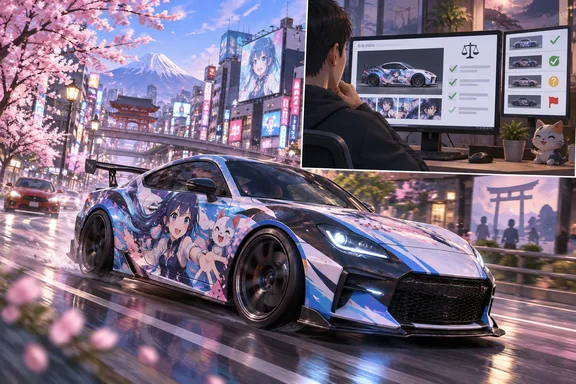
Forza Code of Conduct update targets the Forza Horizon 6 itasha dispute
Itasha are cars decorated with characters from anime, manga and video games. Forza Horizon 6 is set in Japan, where the style began, and that setting has made the moderation fight especially bitter. As AUTOMATON West reported, the game's official Code of Conduct was updated following reported "mass bans" of Forza Horizon 6 players, with the section on inappropriate user-generated content (UGC) expanded to give more detail about Forza's violation procedures.
The dates vary a little depending on who you read. The official Forza Support pages carry a September 23, 2026 timestamp. AUTOMATON West and DualShockers both give September 24, and DualShockers says Xbox and Playground Games published an updated policy on September 24 to clarify their moderation procedures in their Steam community. The gap is most likely a mix of time zones and separate announcements on different channels. Either way, the rules now in force are the ones posted on Forza Support.
The changelog on the official FAQ is short. It says the Inappropriate UGC section is clarified so players understand "the steps taken by a human moderator when reviewing content that has been reported by a player using the in‑game reporting tools." That describes a clearer explanation of the process. It doesn't describe a new set of rules, and nothing in the update suggests enforcement has been relaxed.
IGN credits the guidelines to Turn 10 Studios and says Microsoft recently merged Turn 10 with Horizon developer Playground Games as part of an Xbox studios reorganization. Other coverage attributes the policy to Playground. The Code of Conduct itself is written in Turn 10's voice, and it applies across Forza titles, Forza.net, Discord and other community channels, not only Horizon 6.
Human review and the mass-reporting theory in Forza Horizon 6
The clearest new statement is about how reports are handled. The Code now says that once content has been flagged using the in-game reporting system, it is added to a queue to be reviewed by a human moderator, and the number of reports on a piece of content does not affect its prioritization or position in the queue.
This speaks directly to the theory that has run through the controversy since summer. According to AUTOMATON West, popular itasha creators began taking down their creations and refusing to upload new designs two months ago, suggesting they had been banned from sharing their work in Forza Horizon 6. Liveries from car-parts manufacturers disappeared too, and though it was not confirmed, some fans speculated that a targeted "reporting campaign" was responsible for the mass banning of player-created content across several Forza titles.
The official wording covers one specific thing: report volume alone doesn't push content up the queue or trigger a ban automatically. The Code does not explain how content is found or routed apart from the in-game report button. It also says nothing about why any particular creator was penalized. A coordinated group could still file reports that lead a human moderator to review a design, but the design would then be judged against the written rules, not against how many people complained.
Players remain skeptical. TheGamer reports that players are accusing Playground Games of removing liveries and issuing bans automatically without warning, despite the studio's stated human review process. Some of the most serious claims are that entire accounts were banned immediately over false flags of distributing material harmful to children. All of these are player accounts. The Forza team has not confirmed any individual case, and Dot Esports notes that claims about flagged private drafts have not been independently verified.
"Itasha style designs are permitted", with a qualitative line on suggestive art
The Specific Iconography and Imagery page now covers itasha directly. It says: "Itasha style designs are permitted; however explicit sexual content and sexually suggestive content are forbidden." It then gives three categories of suggestive imagery: provocative poses, associated gestures and facial expressions, and attention to specific body parts. It also says it cannot show specific examples.
That makes Forza's official position narrower than a lot of the online reaction suggests. Anime characters on cars are explicitly allowed. What's banned is a way of depicting them, and moderators make that call using descriptions rather than a visual reference. In Pixeltwelve's words, human review answers the mass-reporting claim but does not show artists where the line sits; a costume one creator sees as harmless can be read as suggestive by a moderator, and the Code of Conduct gives categories, not a gallery of recent examples.
Japanese reaction quoted by IGN splits roughly in two. One commenter on X called the criteria far too vague, effectively "whatever I think is bad is bad." Another found the examples at least somewhat useful and guessed that raised-leg or legs-apart poses would now be off limits. That second comment is one player's reading. Nothing in the official text names any particular pose, swimsuit or character as automatically banned.
Forza's general standard is age appropriateness. The Driver's Code lets players customize liveries "however you wish" provided they follow the UGC rules and "are appropriate to be viewed by drivers of all ages." The Steam community post goes further. DualShockers reports it said that because Forza Horizon is rated E for Everyone (ages 6+), all custom creations, whether set to public or kept strictly private, must adhere to age-appropriate safety standards. If that "private" wording is accurate, it is the most practically important line in the whole dispute, because it would mean unpublished drafts in a player's library are held to the same standard as shared designs. The Forza Support pages do not include that sentence, and no other outlet has reported the "public or private" wording.
How Forza's UGC enforcement ladder goes from warning to hardware ban
The updated section also explains what happens once a moderator decides something breaks the rules. According to the Code, a human moderator determines the escalation path based on severity of the flagged content and past infractions; a first violation gets a warning message, additional violations receive suspensions escalating in time, and only when an image contains child sexual content, explicit sexual content, explicit nudity, or imagery in Forza's Zero Tolerance Policy will a permanent ban be issued without prior infractions.
That exception is the key to understanding the itasha fight. Most first-time livery violations should end in a warning. The zero-tolerance category, though, lists "sexual/nude imagery" and child sexual exploitative or abusive imagery alongside hate speech, credible violent threats and terrorism content. If a moderator decides a design falls into that category, the Code says the account, and any accounts associated with the same console or hardware, will be permanently suspended, "No exceptions!" The age of anime characters, real or perceived, can push a borderline design toward the most severe category. That would explain why some players report getting permanent bans with no warning first. It is an inference from how the policy is structured. No reported case has been confirmed on that basis.
Here is the enforcement ladder as the Code describes it:
| Situation | Documented outcome |
|---|---|
| First non-zero-tolerance UGC violation | Warning message |
| Subsequent violations | Suspensions that lengthen with each violation, from 24 hours up to one month |
| Content removal from features | Suspensions can remove access to specific features such as matchmaking or the Auction House |
| Child sexual content, explicit sexual content, explicit nudity, or other zero-tolerance imagery | Permanent ban without prior infractions |
| Permanent ban | Can include a hardware ban blocking all associated accounts on that device from Forza |
| Evasion via alternate accounts | Those accounts are also suspended |
The FAQ adds some history. It says earlier revisions brought in player warnings for low-severity first-time violations, replaced the old three-strike system with new categories of violations, and reduced suspension lengths for low-severity offenses so they start at one day. It also says accounts that were permanently suspended before will stay permanently suspended. The softer treatment of minor offenses does not reopen old bans.
The Rising Sun Flag and other Forza iconography bans predate Horizon 6
Some of the Japanese anger is about the ban on the Rising Sun Flag rather than about itasha. The same Forza Support page lists it among prohibited iconography, next to swastikas, the Confederate flag, SS runes (with an exception allowing SS badges recreating the SuperSport trim), the Wolfsangel, the Black Sun, the Arrow Cross, and the Iron Cross "with contextual clues."
This isn't new with Horizon 6. IGN notes that earlier Forza games banned similar imagery. Back in 2020, then-creative director Mike Brown explained that under Forza Horizon 4's moderation, an accurate depiction of Japan's imperial flag could get a player banned while more abstract designs would not, and IGN says that guidance was carried into the current iconography rules. What has changed is the setting. A game built around Japanese car culture brings more Japanese players, and more of them run into a rule that previous entries also enforced.
Steam reviews and the reputational cost for Forza Horizon 6 in Japan
The dispute is showing up in the numbers. Dot Esports reports that players have posted negative Steam reviews criticizing the treatment of itasha creators, with several claiming ordinary anime artwork is being removed alongside more suggestive designs, and that the game dropped to Mixed reviews in Japan. IGN independently describes the same fall in the Japanese-language review score. It also notes that even positive Japanese reviews praise the driving and the miniature Japan map while calling the online operation poor, citing season missions and credit collection alongside moderation.
The timeline follows two distinct waves. Per Dot Esports, complaints began with established itasha creators reportedly losing their shared artwork in July, and another wave appeared in September, with players reporting disappearing liveries and additional bans. The latest round of claims goes beyond creators. AUTOMATON West reports that players are describing enforcement against people who take photos of itasha designs and share them in-game, and reports of players being banned for possessing suggestive work-in-progress content that hasn't been uploaded.
The Forza team hasn't answered the screenshot or private-draft claims directly on its support pages. Its reporting instructions do list photos among reportable UGC alongside vinyl groups, liveries, blueprints, tunes, garage layouts, player estates and license plates. So a shared photo showing a car that breaks the rules is content that can be reported under the policy as written.
What this means for you
If you create or share liveries in Forza Horizon 6, treat the sexually suggestive clause as the thing that matters and hold private work to the same standard as published work until Forza says otherwise. Itasha as a style is explicitly allowed. The risk comes from poses, gestures, expressions and framing that a moderator could read as suggestive, and from anything that could land a design in the zero-tolerance category, which skips the warning stage.
If you've been hit with a suspension you think is wrong, the Code gives you a set process. You can submit a Ban Appeal through the Forza Support site ticket system; the Support & Safety team evaluates each appeal individually with the supporting evidence, and a different moderator reviews the appeal than the one who issued the suspension. Forza's appeal guidance says to file while the ban is still active, because support can't reverse an action after it has expired.
- Check your status first. Active suspensions appear in the in-game Message Center and on Forza's ban-information page.
- Open a Ban Appeal ticket on the Forza Support site. Include when the action happened, what you were doing, and why you think the decision should be overturned.
- Attach supporting evidence. On PC, Windows key + G opens the Xbox Game Bar, whose Capture widget takes screenshots and video. On Xbox, press the Xbox button, then Y for a screenshot or X for video.
- Submit one ticket and wait. The Code warns that repetitive or spam tickets can be treated as harassment of support staff, which can end in a warning and, if repeated, a suspension from the support site.
- Don't play on an alternate account while suspended. The Code says accounts used to get around enforcement will also be suspended, and a hardware ban covers every account on the device.
Reporting uses a separate path. For in-game UGC, select Creator Info, then Report, Report Offensive Content, and OK. For Auction House listings, select Auction Options, Report Auction, and OK. Reporting and appealing are separate processes, and filing more reports won't speed up a review, according to the updated Code.
- Forza officially allows itasha liveries in Forza Horizon 6. Explicit and sexually suggestive content is banned, and "suggestive" is defined only by categories, with no examples.
- Under the updated Code, a human moderator reviews every reported design, and the number of reports doesn't affect its place in the queue.
- Most first violations get a warning, but content a moderator puts in the zero-tolerance category can bring a permanent ban with no prior warning, including a hardware ban.
- Steam community messaging reportedly says private creations must also meet E-for-Everyone standards, so unpublished drafts should be treated as subject to enforcement.
- Appeals go through a Forza Support ticket, are reviewed by a different moderator, and should be filed while the suspension is still active.
- Permanent bans issued in the past stay in place. The FAQ's softer rules for low-severity offenses don't apply retroactively to them.
Forza's update settles the process question and leaves the judgment question open. Players now know a person reviews each reported design and that brigading can't game the queue by volume alone. They still don't know which anime artwork that person will count as suggestive. The Code says the parameters "will continue to evolve," and the Forza team has promised to update the list so players aren't caught off guard. With a PlayStation 5 version due later this year, per AUTOMATON West, more players will soon be working under the same rules. Until Forza publishes clearer examples, cautious creators will keep playing it safe, and some of the itasha culture the game was built to celebrate will stay out of it.