

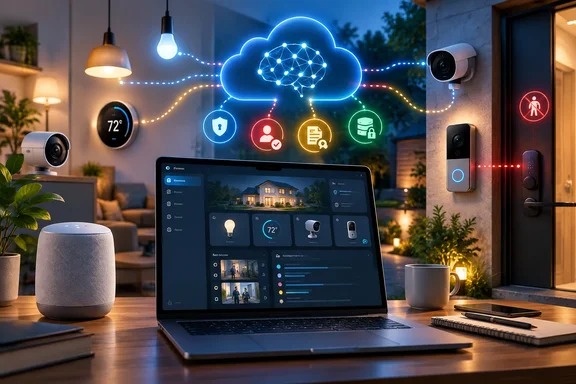
Google’s stated aim is broad: an MCP-compatible agent such as Claude, Hermes, Open Claw, or Google’s Antigravity could query the state and history of a connected home, create a dashboard, run tasks, and send a spoken message through a Google Home speaker when the work is finished. Google Home’s Gemini-based voice assistant remains the interface for speaking directly to speakers and displays; the MCP connection is a separate route through which an outside AI client can request data and actions.
That distinction turns a familiar smart-home feature into something more consequential. Google Home has already offered device control, automations, camera history and Gemini-powered search. Home MCP would give a separate agent a standardized route to combine those capabilities in one workflow, rather than forcing a user to ask a series of individual commands in Google’s own app.
Google’s existing public documentation does not yet describe the consumer service
The announcement arrives ahead of a corresponding public setup guide for consumer Google Home MCP. Google’s currently indexed MCP documentation for the Google Home developer site describes an MCP endpoint for searching the company’s Home developer documentation. Its listed capability is search_documents, not reading a household’s cameras, devices, or event history.
That does not disprove the planned service; documentation often trails an announced staged rollout. It does establish a practical limitation: the public developer record available on September 16 does not yet let a Google Home subscriber independently inspect the exact tools an agent receives, the data returned by each tool, or the full list of supported device categories.
For Windows users accustomed to installing an MCP server in Claude Desktop, VS Code, or another agent client, this is a meaningful difference. Google Home MCP is not being presented as a local package that exposes devices directly on a home network. According to The Verge, setup begins with Google Cloud. That means authentication, authorization, logging, limits, and likely much of the device interaction sit in Google’s cloud path rather than on a Windows PC or a local hub.
Google’s existing Home APIs already use OAuth 2.0 authorization to grant an app access to a selected Google Home structure. Its current permissions documentation says users can restrict sensitive device access on a per-device basis, such as allowing an app to control one lock but not every lock in the house. The MCP rollout appears to build a new agent-oriented layer over that established access model.
The real feature is historical context, especially camera-derived data
Turning on a light through an AI chatbot is trivial. The potentially useful—and privacy-sensitive—part of Google Home MCP is the claimed ability to let an outside agent reason across the data Google Home has accumulated.
The Verge reports examples including asking an agent what a child did after arriving home, determining how many laundry loads ran in a week, or calculating how long lights were left on. Those tasks require more than a live readout from a thermostat or bulb: they require a timeline, event records, and in some cases Google’s interpretation of camera footage.
Google Home Premium Advanced already monetizes much of that retained context. Google lists the U.S. Advanced tier at $20 per month or $200 annually, and includes 60 days of event-based video history, 10 days of continuous video history for eligible wired cameras and doorbells, searchable video history, event descriptions, and daily summaries. Existing Google AI Ultra subscribers receive that Advanced tier as part of their subscription, while Google AI Pro includes the Standard plan and can be upgraded.
The launch restriction therefore has an immediate product implication. Home MCP is initially aimed at households already paying for Google’s most data-rich Home tier, rather than at every person with a Nest Mini, a Matter bulb, or a Google TV Streamer. The data that makes an agent seem unusually capable—especially searchable camera history—is also data that is gated by the subscription.
This creates a difference in quality between simple device-control requests and contextual questions. An agent can only infer that lights were left on if it has sufficient event history. It can only answer a camera question as well as the recordings, retention period, camera placement, and Google’s event descriptions allow. A confident natural-language answer should not be mistaken for a comprehensive household record.
“Any agent” does not mean every agent is equally safe
MCP is a protocol for connecting AI applications to tools and data; it does not supply the model, define a client’s privacy policy, or guarantee that an agent will make good decisions. Once a user authorizes an MCP-compatible client, the agent’s own handling of prompts, credentials, transcripts, and retained data becomes part of the home-security model.
Google’s Home developer policies already require user consent before an app can interact with Google Home devices or related data. The policies also require developers to request only access needed for the stated purpose, disclose data handling, and protect user data. For sensitive devices, Google’s permissions system supports granular selection rather than an all-or-nothing home grant.
Those controls are necessary, but they do not remove the new risk created by delegating natural-language tasks to an agent. A conventional smart-home rule is narrowly defined: at 7:00 p.m., turn on a porch light. An agent can be asked to interpret a broad instruction, choose tools, retrieve household context, and act. That expands the chance of a poorly scoped request, an erroneous model inference, or prompt content from an external source steering an agent toward an unwanted action.
Google’s own Cloud security guidance identifies tool poisoning, prompt injection, session hijacking, rogue MCP tools, token theft, and sensitive-data exposure as risks in MCP deployments. Those are not theoretical concerns reserved for enterprise software. A smart-home agent with access to cameras, presence indicators, routines, and heating controls has a more intimate data set than most workplace connectors.
Google told The Verge that Home MCP will apply rate limits and safety protections and will not permit an agent to unlock doors. Google’s broader Home policies take a slightly more nuanced position: actions that move a device into a non-secure state—unlocking a door, disabling a camera, disarming a security system, or opening a safety-sensitive device—require secondary user verification. The policy allows an integration to offer an opt-out after verification in some cloud-integration cases.
For now, users should treat the reported no-unlock restriction as specific to the new MCP service, not as proof that all access-related actions are impossible across Google Home’s wider API platform. The final MCP documentation needs to say exactly which actions are denied, which require fresh user approval, whether controls differ by agent, and whether routines can indirectly reach a prohibited action.
Home Assistant shows the appeal—and the operational burden
Google is entering a category that Home Assistant has already explored. Home Assistant’s MCP Server lets compatible AI clients access the platform’s Assist API, read a real-time snapshot of exposed entities, and control only the devices and entities an administrator selects. It requires an authentication token, and the project explicitly notes that MCP authorization standards and client support are still evolving.
The contrast is instructive. Home Assistant can be local-first and lets an administrator determine exactly what entities an agent sees. Google Home offers a far larger device network and a consumer-friendly cloud platform, but its initial Home MCP setup appears to require a Cloud project and a Premium Advanced subscription. Google is trading some of the tinkerer’s local control for a managed service with access to Google’s device graph, camera intelligence, and data retention.
That may appeal to households that want an agent to create automations or explain device problems without learning YAML, writing scripts, or maintaining a home server. It will be less attractive to people who deliberately chose local smart-home infrastructure to keep camera metadata and household behavior off third-party cloud services.
For Windows administrators and developers, the sensible first use is read-heavy and reversible: inventory devices, summarize power or lighting patterns, identify recurring automation failures, or generate a dashboard for review. Avoid giving a newly connected agent authority over security systems, climate schedules, water valves, garage doors, or appliances until Google publishes the precise permission and confirmation model—and until the specific MCP client’s own data retention and tool-access behavior have been reviewed.
Google is selling an infrastructure role, not merely another assistant
Google has spent the past two years turning Google Home from a voice-command destination into an application platform. Its Home APIs expose device state, controls, automations, Matter setup, and Google Home infrastructure to Android and iOS developers. Google says the platform now reaches more than 750 million Google Nest, Works with Google Home, and Matter devices.
Home MCP extends that pitch to the rapidly growing universe of AI-agent clients. A developer could use Antigravity, Claude, or another compatible agent interface while Google remains the authorization layer, the device-data provider, and, for Premium households, the keeper of valuable camera and event history. The consumer may see an agent of their choice; Google still supplies the home beneath it.
The unresolved issue is durability. Google’s smart-home history includes Android @ Home, Weave, Project Brillo, Works with Nest, and the long transition from Google Assistant to Gemini for Home. Google Home MCP will need stable documentation, transparent scopes, predictable policies, and a route beyond a U.S.-only premium trial if developers are expected to build products around it.
Until those details appear, Home MCP should be viewed as an unusually capable bridge between AI agents and a real home—not an invitation to hand a chatbot the keys.