

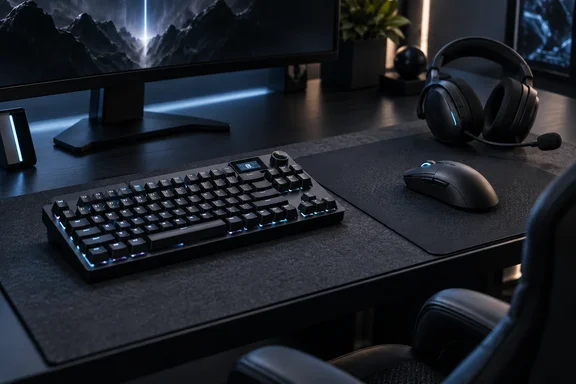
Logitech G Pro X3 Superstrike refines a mouse that is barely seven months old
The Pro X3 Superstrike was one of the products Logitech G showcased in a YouTube livestream as the annual Logitech G Play returned. It keeps the same design as the previous X2 model, with a lighter 59g weight, longer battery life, and an improved chipset. That timing is the source of the mixed feelings in PC Gamer's coverage. The writer describes the X3 as a strengthened version of an X2 that launched only a few months earlier and says the X2 launch "now stings a little."
The technology that made the X2 notable carries over. Logitech's HITS (Haptic Inductive Trigger System) replaces the traditional microswitches found in other gaming mice, and Logitech claims it cuts click latency by up to 30 ms through custom actuation and reset points. Instead of a mechanical click, the mouse pulses when it reaches a customized actuation point. According to Notebookcheck, players can choose from 10 actuation and 6 intensity levels for the vibrating feedback, and with rapid trigger, 5 selectable reset points reduce button travel.
Most of the changes are internal. Logitech says the new NxLOGI chipset halves power consumption compared with the Pro X2 Superstrike, which adds 45 hours per charge for a rated 135+ hours. Charging is over USB-C or the separately sold POWERPLAY system. The company also says the mouse reports at up to 8 kHz (0.125 ms intervals) over both wired USB-C and LIGHTSPEED wireless. Notebookcheck adds that the refined Hero 2 optical sensor now boasts up to 48,000 DPI, and that Bluetooth connectivity is once again not an option. It also notes that the European version weighs 61 grams, 2 grams heavier than the global version.
Independent testing already backs up both halves of PC Gamer's view. Club386 ran latency tests with the Open Source Latency Test Tool (OSLTT) and says the X3 posts the lowest click latency we've tested. The same review concedes that pitting the X2 and X3 against each other side by side, you'd struggle to feel these changes in action. The X3 is measurably faster and lasts longer on a charge, but it does not change the experience much. PC Gamer calls it fantastic while saving its excitement for February, when HITS was new.
The Pro X2 Rapid is where the hands-on enthusiasm landed
The keyboard is the surprise in PC Gamer's piece. The writer went in skeptical after a poor experience with an earlier Logitech keyboard's switches, but says they reacted out loud the moment they started typing on the Pro X2 Rapid and its large wrist rest.
On paper, the Pro X2 Rapid is Logitech's answer to the Hall effect keyboard trend. The company describes it as a wired, tenkeyless (TKL) analog gaming keyboard with an OLED display. It has 100% magnetic analog switches, rapid trigger, 8 kHz scanning and USB polling, adjustable actuation and Key Priority (SOCD). The switches are custom, factory-lubricated KS-20 POM units, and Logitech says every key can be set to actuate anywhere from 0.1 mm to 4 mm in 0.05 mm steps. It also lists swappable doubleshot PBT keycaps and screw-in stabilizers.
A few of those terms are worth explaining for readers coming from ordinary mechanical boards:
- A magnetic analog (Hall effect) switch detects how far a key has travelled, not just whether a contact has closed. This is what allows the actuation point to be adjusted.
- Rapid trigger, in Logitech's description, lets you set how far a key has to come back up before it resets and can register another press. The company pitches this for very small, fast movement inputs.
- Key Priority, or SOCD (simultaneous opposing cardinal directions) handling, decides what happens when opposing keys such as A and D are held together. Logitech markets it for strafing.
Configuration does not depend on software. The onboard OLED lets you change rapid trigger and actuation points, Key Priority and LIGHTSYNC lighting directly on the keyboard. Logitech says deeper customization and saved profiles live in G HUB, and that the board has onboard memory. For anyone who games on a locked-down work PC or a LAN rig where installing G HUB isn't practical, that on-device control is a real advantage.
The sound and feel are where PC Gamer's impressions and Logitech's marketing overlap. Logitech credits a six-layer dampening stack and an aluminium key plate housing for a "thocky" keystroke. The PC Gamer writer, speaking for themselves, describes a creamy, slightly muted thock, almost no key wobble apart from a slight movement in the spacebar, and keycaps with a rougher, more textured finish than most. The writer is deliberately holding back a full verdict until they have done more extensive testing and compared the board with rivals.
Logitech's Pro X Control mouse pad aims at low-DPI tactical shooter players
The Pro X Control is the new product type in the lineup, and PC Gamer's writer, who calls themselves the site's resident mouse pad connoisseur, is the target buyer. A control pad has a slower, higher-friction surface. The writer prefers that kind of pad for tactical shooters such as Counter-Strike 2 because of its slow, consistent movement. That is a play-style preference, not a universal advantage.
Logitech lists the pad at 400 × 460 mm (15.75 × 18.11 in) and designed for low-DPI gaming. The key design choice is the surface. Logitech argues that woven fabrics resist differently depending on the direction of the weave and weft, and says the Pro X Control's omnidirectional knit evens out that directional friction. Notebookcheck confirms the 400 mm x 460 mm size and the 6 mm thick material with a knitted cloth texture for controlled gliding. Logitech adds that the foam is its 6 mm SlimFlex material, that the edges are stitched below the contact surface so there is no raised border to catch your arm, and that a crosshatch non-slip base is meant to stop slipping and bunching.
PC Gamer's early impression comes with a clear limit. At the time of writing, the writer had used the pad for a couple of hours, all of it working rather than gaming. So far it seems decent, though not quite as slow as some other control pads, and the writer treats that as personal preference rather than a flaw. Cloth pads usually change as they break in, and the writer expects this one to as well.
The Pro X3 Lightspeed headset rounds out the lineup as an iterative step
Logitech also announced the Pro X3 Lightspeed headset, part of the latest-generation PRO Series designed in collaboration with top esports players. PC Gamer had not tried it and lists 70 hours of battery life, 20 more than the previous Pro X2 Lightspeed, along with 50 mm graphene drivers and a much better microphone. The writer heard the mic on a preview call with Logitech and says the improvement is impressive, but files the headset alongside the X3 Superstrike as an iterative upgrade.
Pro X3 Superstrike pricing disagrees across sources, and shipping starts in October
Prices need care right now. Logitech's US store lists the Pro X3 Superstrike at $199.99, which matches PC Gamer's $200 figure. CGMagazine, however, reports that the Logitech G PRO X3 Superstrike is priced at $179.99 USD and €179.99 on the official website. That would match the X2's price: the Pro X2 Superstrike launched in February at $179. Until the sources agree, check the price at checkout. The $20 gap is the difference between a like-for-like replacement and a price increase.
The other prices are simpler. The Pro X Control is $59.99 on Logitech's US store. PC Gamer lists the Pro X2 Rapid at $230 and the Pro X3 Lightspeed at $250. Logitech's Canadian store lists the keyboard at C$299.99, and no other outlet has confirmed the US price of the keyboard or headset. On timing, Notebookcheck says the Pro X3 Superstrike is in stock on October 6th, although Logitech's own product pages already show the mouse and the mouse pad as ready to ship.
| Product | Type | Headline claims | Price as listed |
|---|---|---|---|
| Pro X3 Superstrike | Wireless mouse | HITS, 59 g, 135+ hr battery, 8 kHz | $199.99 (Logitech US); $179.99 per CGMagazine |
| Pro X2 Rapid | Wired TKL analog keyboard | 0.1–4 mm actuation, rapid trigger, SOCD, OLED | $230 per PC Gamer; C$299.99 (Logitech Canada) |
| Pro X Control | Cloth control mouse pad | 400 × 460 mm, 6 mm foam, knit surface | $59.99 (Logitech US) |
| Pro X3 Lightspeed | Wireless headset | 70 hr battery, improved mic | $250 per PC Gamer |
What this means for you
The purchase decision comes down to what you already own. If you have a Pro X2 Superstrike, independent testing says the X3's gains are measurable but hard to feel, so battery life is the main reason to upgrade. If you are interested in a Hall effect keyboard or a control pad, those two products are the new additions and worth following into full reviews.
- Pro X2 Superstrike owners can wait. Club386 found the X3 has lower click latency but says the difference is hard to feel side by side, and the main gain is roughly 45 extra hours per charge.
- If you are buying a first Superstrike, check the live price. Logitech's US store shows $199.99, while CGMagazine reports $179.99.
- The Pro X2 Rapid offers per-key actuation from 0.1 mm to 4 mm, rapid trigger and SOCD, all adjustable from its OLED without G HUB. That makes it a reasonable shortlist pick for players on managed or shared PCs.
- The Pro X Control is a control-style pad for low-DPI play. Its only hands-on impression so far comes from office use before break-in.
- Nothing in the X3 Superstrike changes the mouse's connectivity. It still has no Bluetooth, so wireless use depends on the LIGHTSPEED dongle.
With the Pro X3 Superstrike, Logitech showed that it can iterate on HITS quickly. The early hands-on response, though, went to the Pro X2 Rapid and the Pro X Control, which bring analog switching and a purpose-built control surface to the Pro range. PC Gamer's full keyboard and pad reviews, and the October 6 shipping date, will show whether that first impression holds up.