

Microsoft's $10 Billion Gulf Framework Is Mostly Money Already Promised
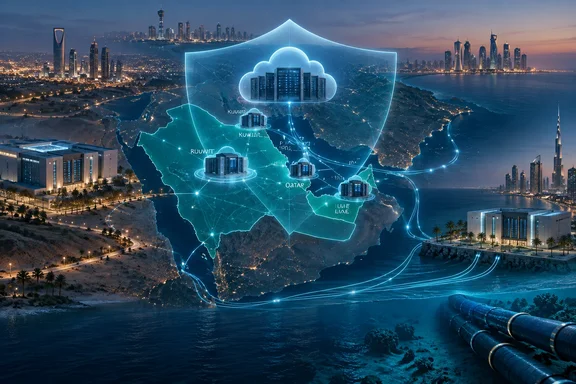
The primary record is a post on Microsoft's On the Issues policy blog. In it, the company says it will "invest more than $10 billion in capital and operating expenses between now and 2030 in the region." The same post says the framework is "focused initially on Kuwait, Qatar, Saudi Arabia, and the United Arab Emirates." The National reported that Microsoft announced it on the sidelines of the UN General Assembly where artificial intelligence has been a major topic of conversation.
The wording matters. Microsoft counts capital and operating expenses together. That means the total includes the cost of running and staffing existing operations, not only new data centres. Brad Smith, Microsoft's Vice Chair and President, said as much to Reuters: the investment reflects both its "ongoing build-out of infrastructure and also the expansion of operations in the region."
Bloomberg's reporting shrinks the headline further. According to Bloomberg, the $10 billion includes a $7.9 billion investment pledge Microsoft made for the UAE last year, which is why its headline puts the new spending at about $2 billion. No other outlet has broken the total down this way, and Microsoft's post doesn't allocate the money by country or project. If Bloomberg is right, most of the framework consists of UAE spending already announced, repackaged with smaller new commitments to the other three countries.
That doesn't make the announcement empty. It does mean the regional capacity story isn't the part that changes anything for customers. Microsoft names no new facilities, locations, capacity figures or dates. An IT team planning where to put workloads gets no new region-level information from it. The practical content sits elsewhere.
Sovereign Public Cloud and Project Digital Shield Come With an "Eligible" Asterisk
The most concrete commitment for enterprise and government IT concerns sovereignty. Microsoft says it will expand its existing commitments on data-protection sovereignty and business continuity to eligible governments and customers in Kuwait, Qatar, Saudi Arabia, and the UAE, complemented by its sovereign-cloud portfolio. The products named are Microsoft Sovereign Public Cloud, Sovereign Private Cloud and Project Digital Shield. The partnerships are supported by these capabilities where relevant and available.
Two limits run through the whole commitment: "eligible" and "where relevant and available." Microsoft doesn't define who qualifies or which workloads are covered. It gives no contractual terms or data-location guarantees, and doesn't say which sovereign-cloud products will be offered in which of the four countries. A Kuwaiti ministry, a Qatari bank and a Saudi retailer could get very different answers from Microsoft. No organization should read the announcement as a blanket promise covering every tenant.
The second new offering is a Middle East digital resilience initiative. It is described as providing assessments, reference architectures, readiness guidance, continuity planning and enablement programs. Their stated goal is to help organizations find vulnerabilities, protect critical data and build recovery capabilities that have been tested. Microsoft hasn't said when these become available, who can take part, or whether they're free, bundled with existing agreements or sold as services.
A resilience assessment and a reference architecture for continuity sound much like the planning work an Azure customer already does around region pairing and disaster recovery. What's new is a regional program with Microsoft's backing and a political framing. How much it adds beyond existing Azure guidance will depend on details Microsoft hasn't published yet.
Why a $400 Million Subsea Cable Bet Follows Attacks on Gulf Data Centres
This framework is more than a routine investment pledge because of the backdrop Microsoft itself describes. The National quoted Smith: "Conflict in the Middle East has reinforced the connection between digital resilience and digital sovereignty," he said, adding that Microsoft has supported business continuity with resilience options suited to different operational and regulatory needs.
Reuters is more explicit. It reports that Microsoft is making digital resilience a key part of its strategy for the region as the Iran war rumbles on. It also notes attacks on data centres such as Amazon cloud unit AWS's facilities in Bahrain and the UAE. Reuters adds that while the UAE has been largely spared attacks since May, several other Gulf countries have continued to face threats. Read against that background, the resilience program and continuity commitments respond to physical risks that hyperscale infrastructure in the region has already faced.
The network spending fits the same logic. Microsoft also plans to invest more than $400 million in subsea and terrestrial connectivity across the Middle East by 2030. The company says this will expand capacity, strengthen regional data flows, and support its growing cloud and AI infrastructure footprint in the region. Unite.AI's account of the blog post adds that Microsoft has invested in the SeaMeWe-6 subsea cable, which lands in Qatar, Saudi Arabia and the UAE. It also says Microsoft runs a global network of more than 275,000 miles of terrestrial and subsea fibre.
Microsoft also says that during past network disruptions it rerouted traffic through Middle Eastern corridors and kept services running with minimal impact on customers. That claim comes from Microsoft alone, with no outage data or routing figures attached. The inference is still fair: more diverse cable and terrestrial routes give traffic more alternative paths when one link is cut. For Gulf customers, that network spending may matter more to day-to-day availability than any new data hall.
HUMAIN, G42 and QAI Partnerships and Cybersecurity Champions Set the Government Channel
Most of the framework goes through governments and state-backed AI companies, not directly to enterprises. Microsoft says it will deepen strategic partnerships with governments and national AI champion organizations, naming HUMAIN, G42, QAI, and the Government of Kuwait. It points to digital-government initiatives including TAMM in the UAE, SDAIA's ALLaM in Saudi Arabia, TASMU in Qatar, and Microsoft 365 Copilot adoption across the Government of Kuwait.
Reuters clarifies how these partnerships differ financially. G42 is the Abu Dhabi company in which Microsoft invested $1.5 billion for a minority stake in 2024, giving the US firm a board seat currently filled by Smith. Saudi Arabia's HUMAIN and Qatar's QAI are a different case. Smith told Reuters that Microsoft works with them "in selected areas that are priorities for them," he said, noting that it does not plan capital investments in the firms. So the Saudi and Qatari partnerships are commercial and technical, with no equity stake behind them.
On security, The National reports that Microsoft will introduce "a network of dedicated Microsoft cyber-security champions" in the UAE, Kuwait, Qatar and Saudi Arabia, who would "help governments translate these resources into action and connect national priorities with expertise across Microsoft". Microsoft says it is also deepening partnerships with the cybersecurity authorities in the four countries. Neither account names the champions or explains how they will work. Neither gives them any incident-response role that a private-sector customer could call on.
The responsible-AI section follows the same government-first pattern. Microsoft will expand collaboration with the Responsible AI Future Foundation, which it co-founded with G42 and the Mohamed bin Zayed University of Artificial Intelligence, to support the development and sharing of responsible AI practices and evaluation tools for high-impact AI use cases. The National also highlights more investment in Microsoft's AI for Good Lab. Per Unite.AI's summary of the post, the Lab's regional work covers food security, low-resource language development, and climate and disaster resilience, including a language-technology program called LINGUA.
Skilling 4.2 Million People and Water-Positive Pledges Build on Earlier Programs
The "people" pillar is mostly continuity. Microsoft says it builds on existing commitments to help skill more than 4.2 million people across the four countries by 2030. The named programs already exist: Saudi Arabia's AI Global Leadership Program, AI Skills 4 Women in Saudi Arabia and Qatar, and the Women's Datacenter Academy in Saudi Arabia. The 4.2 million figure is presented as an existing target, not a new cohort. Microsoft gives no per-country split or completion measure.
The education commitments are broad. Microsoft says it is working with governments and educators on responsible-AI principles and AI literacy in primary, secondary and tertiary education. It also plans to work with employers and training providers on workforce readiness. For regional IT managers, the most relevant piece is probably public-sector capability building. A government workforce trained on Microsoft tools will find adopting products like Microsoft 365 Copilot easier, as Kuwait's government already illustrates.
The sustainability language is qualified at every step. Microsoft says it will work with the partners who lease it facilities on its water-positive ambitions, prioritizing zero-water cooling "where feasible." It will also work with regulators and utilities to help create the market conditions needed to buy more carbon-free electricity. That matters in a water-scarce region where data centres compete with other users for power. But the framework gives no water or energy targets for any country and names no facility.
What the Gulf Framework Means for Azure and Microsoft 365 Customers
For IT teams in the four countries, this announcement opens new conversations with Microsoft. It doesn't yet change any contract or configuration. The customers with the most to gain are government bodies and regulated organizations, including finance, energy, healthcare and critical infrastructure. They are the likeliest to count as "eligible" for the extended sovereignty and continuity commitments, and to benefit from a structured resilience assessment. Organizations with workloads outside these four countries, or without sovereignty requirements, have nothing to act on yet.
The questions to take to a Microsoft account team follow from the gaps in the announcement. Ask whether your organization qualifies for the extended data-protection sovereignty and business-continuity commitments, and what the contract language will say. Ask which of Sovereign Public Cloud, Sovereign Private Cloud and Project Digital Shield are actually available in your country today. Ask when the digital resilience assessments open and on what commercial terms. Until those answers are in writing, the framework shouldn't replace your own disaster-recovery design.
The security backdrop gives that design work some urgency on its own terms. Reuters' reporting on attacks against cloud facilities in Bahrain and the UAE is a reminder that a single region or country can be a physical point of failure. Microsoft's own framing, linking resilience with sovereignty, admits a trade-off. Keeping data inside national borders narrows the options for failing over somewhere else. An organization needs to decide deliberately which of those two goals comes first for each workload.
- Microsoft's framework commits more than $10 billion in capital and operating expenses across Kuwait, Qatar, Saudi Arabia and the UAE through 2030. Bloomberg reports that this total includes a $7.9 billion UAE pledge made last year.
- The extended sovereignty and business-continuity commitments apply only to "eligible" governments and customers, so confirm eligibility and contract terms before counting on them.
- Sovereign Public Cloud, Sovereign Private Cloud and Project Digital Shield are offered "where relevant and available," and Microsoft has published no country-by-country availability.
- The new Middle East digital resilience initiative promises assessments, reference architectures and continuity planning, but has no announced launch date or eligibility rules.
- The separate $400 million connectivity investment through 2030 targets subsea and terrestrial network capacity, which could improve route diversity during cable or regional disruptions.
- Regulated organizations should keep testing their own failover plans and weigh data-residency requirements against cross-border recovery options while the framework's details are pending.
Taken together, Microsoft's Gulf framework mostly repackages earlier spending, with genuinely new resilience and sovereignty commitments added at a time of real physical risk to cloud infrastructure in the region. The money and the Brad Smith headlines matter less to IT buyers than the fine print still to come: which customers qualify, which sovereign-cloud products ship in which country, and when the resilience assessments open. Those details will decide whether the continuity and sovereignty promises work as operational guarantees or stay as policy language.