

That proposition is more substantial than the usual “AI PC” label. The systems pair AMD’s high-memory mobile-derived platform with unusually capable networking and expansion on the workstation side, while the NAS design emphasizes a large local data pool. But the announcement is not yet a complete buying story. Minisforum has not provided firm pricing or shipping dates for the P495 versions, and there are no independent reviews or sustained inference benchmarks for either new model. The most important question—whether they deliver practical, reliable local AI rather than merely impressive specification-sheet numbers—therefore remains open.
What Minisforum announced
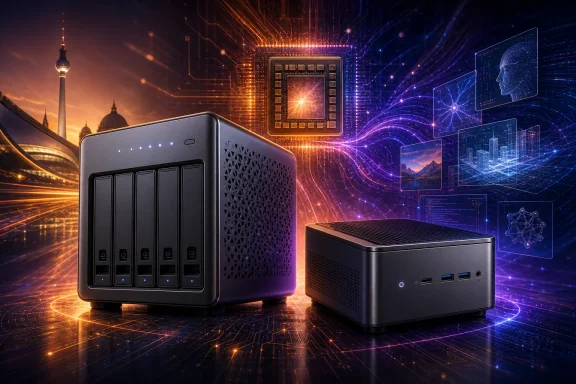
The MS-S1 MAX-P495 is the compute-centric member of the pair. Minisforum presents it as an AI mini workstation that can also be deployed in a 2U rack environment, with illustrations of four systems working as a scalable cluster. The N5 MAX-P495 is the storage-oriented counterpart, described as an AI Agent NAS intended to serve as a local backend for models, knowledge bases, data and persistent workloads.
Both use the Ryzen AI Max+ PRO 495, a processor AMD specifies with Radeon 8065S integrated graphics, support for up to 192GB of LPDDR5x-8533 memory, up to 131 overall AI TOPS and up to 55 NPU TOPS. Those are platform-level processor specifications, not proof that every Minisforum configuration will reach the same real-world performance or include the maximum memory capacity.
Minisforum says its P495 systems can be configured with up to 192GB of memory at 8533 MT/s and up to 160GB of graphics memory. On the MS-S1 specifically, the company calls this up to 192GB of unified memory and up to 160GB of allocatable VRAM.
That distinction deserves attention. This is not a traditional desktop with a discrete GPU carrying its own physically separate VRAM pool. Memory is shared across the system, and the amount allocated to graphics or AI workloads affects what remains available to the operating system and other applications. Still, a large pool of unified memory can be consequential for local-model users because model size, context length, multiple concurrent sessions and data-processing overhead all compete for memory.
Why memory matters more than the headline TOPS figure
AI TOPS has become a familiar marketing measure, but it does not answer whether a specific model will fit, run efficiently, or be useful in a particular application. AMD’s quoted 131 overall TOPS incorporates the processor’s broader compute capabilities, while the NPU portion is rated at up to 55 TOPS. A local LLM application may use a mix of CPU, integrated graphics and NPU resources depending on the model format and software stack; it should not be assumed that the NPU rating translates directly into chatbot generation speed.
For local inference, capacity can be as important as acceleration. A machine able to reserve a substantial portion of 192GB unified memory for graphics workloads may have more room for large quantized models, bigger context windows, retrieval data or several users than a conventional mini PC with less memory. It may also reduce the need to move certain work to a hosted model simply because local hardware runs out of memory.
That is an architectural advantage, not a performance verdict. Actual token generation speed, responsiveness under load, thermals, power draw, software compatibility and the trade-off between memory allocated to the GPU and memory left for Windows or Linux will determine the experience. None of those have been independently established for the P495 systems.
For Windows users in particular, the software detail matters. A powerful local model workstation is only useful if its preferred inference software, drivers, model runtimes, storage configuration and networking tools work reliably in the chosen OS environment. Minisforum’s announcement does not settle the operating-system experience, bundled software arrangement or out-of-box configuration for the P495 products. Buyers should not presume a turnkey Windows local-AI appliance solely from the hardware announcement.
The MS-S1 is more than a mini PC
The MS-S1 MAX-P495’s connectivity is one of its clearest differentiators. Minisforum lists two 10GbE ports, two 80Gbps USB4 v2 ports, two 40Gbps USB4 ports, two M.2 SSD slots and a physical x16-length PCIe slot electrically operating at PCIe 4.0 x4.
Dual 10GbE is meaningful for a small office or lab. One port could connect to a fast NAS or storage network while the other connects to client systems, a switch, or a separate network segment. It could also be useful for placing the system beside a storage server rather than forcing a large document collection through ordinary gigabit Ethernet. The availability of fast USB4 connections broadens options for external storage and selected peripherals, though real throughput will depend on the attached device and the software path.
The PCIe slot adds flexibility, but the electrical limitation is important. Its x16 physical shape makes a broad range of add-in cards mechanically plausible, yet PCIe 4.0 x4 supplies less bandwidth than a true x16 graphics-slot connection. That might be adequate for certain networking, storage or specialized expansion cards, but it is not evidence that the MS-S1 can substitute for a full desktop GPU workstation. Anyone considering an accelerator card should verify power, cooling, driver support, physical clearance and the impact of the x4 link before treating the slot as an upgrade plan.
The 2U rack positioning suggests a different audience from the typical desk-bound mini-PC buyer. Four compact nodes can offer redundancy, task separation or a way to serve multiple internal users. Minisforum has shown vendor-supplied multi-system model demonstrations, but those claimed results have not been independently benchmarked. A cluster can raise both capability and administration burden: networking, model deployment, monitoring, update policy and failure recovery all become part of the purchase.
The N5’s promise: local models next to local data
The N5 MAX-P495 combines the same new processor family with a NAS role and up to 200TB of local storage, according to Minisforum. The intended workflow is readily understandable: place models, an internal knowledge collection and the service that searches or processes it near one another, rather than uploading every file to a remote AI provider.
For a Windows-heavy small business, that could mean a locally hosted assistant that searches approved project files, technical manuals or internal documentation. For a homelab user, it could mean a private experiment with retrieval-augmented generation, document indexing, automation or a media-adjacent AI task. Keeping the data store on local equipment may give administrators more direct control over where data resides and how it is backed up.
However, “local” is not automatically private or secure. A model service can still be exposed to a network, plugins may make external calls, an agent may be given broad file permissions, and the underlying NAS still needs patching, account controls, encryption planning and tested backups. Local hosting may change the data path and reduce dependency on a cloud service, but it does not remove security and governance work.
The same caution applies to cost claims. Local hardware can make sense where workloads are sustained, data restrictions are important, or a team needs predictable access. It also carries an upfront hardware cost, electricity use, storage-expansion costs and the time needed to manage the software. Without a price for the N5 MAX-P495 or MS-S1 MAX-P495, a cost comparison cannot yet be made responsibly.
Agent workloads are demanding—but not by one universal multiplier
Minisforum frames the N5 around AI agents and cites local-agent examples including OpenClaw and Hermes. Agents can put more sustained pressure on a system than a single chatbot prompt because they may call tools, query documents, iterate through intermediate steps and maintain long-running tasks.
A recent research finding helps illustrate why that category needs careful planning, while also showing why simplistic claims are risky. The work found that agentic coding tasks consumed 1,000 times more tokens than code-reasoning and code-chat tasks in its comparison. That is a striking result, but it is not a universal measurement of all agentic AI. The same research reported substantial variation across repeated runs and models, including differences of up to 30 times between runs.
In practical terms, an automated coding workflow, a document-research pipeline and a simple local chat interface may impose radically different requirements. Prospective owners should size hardware around the exact model, expected concurrency, context lengths, storage dataset, response-time requirement and tolerance for manual intervention—not an all-purpose TOPS figure or a general claim about agents.
There is also a specific software uncertainty around OpenClaw. Minisforum’s earlier Ryzen AI Max+ 395-based N5 Max was presented with MinisOpenClaw capabilities, and reporting on that previous system said OpenClaw came pre-installed on its system drive. The new P495 announcement mentions OpenClaw and Hermes as local-agent scenarios, but it does not explicitly say OpenClaw will be pre-installed on the refreshed N5. That should be treated as unconfirmed until Minisforum publishes final software and configuration details.
The prior N5 offers clues, not a verdict
The earlier N5 Max offers relevant but limited background. An independent review of that Ryzen AI Max+ 395 model credited its strong performance and sound thermal management, while criticizing its operating system and high price. This is useful context for anyone evaluating Minisforum’s AI-NAS approach: the underlying idea has shown promise, but appliance polish and value were concerns.
It cannot be used as a review of the P495 refresh. The processor differs, the final P495 software configuration is not confirmed, and no independent assessment has tested the new model’s cooling, acoustics, networking behavior, storage performance or reliability under a prolonged AI workload.
That gap is particularly important for Windows users who want a dependable work device rather than a lab project. A local-AI box needs more than a fast processor: it needs predictable OS support, driver updates, clear recovery procedures, sane user management and a configuration path that does not compromise the security of stored data.
Wait for the information that makes these products comparable
The MS-S1 MAX-P495 and N5 MAX-P495 make a credible hardware case for local AI systems with more memory than many compact PCs can offer. The MS-S1’s dual 10GbE, USB4 connectivity, M.2 storage and expansion slot give it a potentially versatile role in a Windows lab, small office or rack. The N5’s blend of local compute and up to 200TB of storage could appeal to users who want to keep an AI knowledge base close to the files it uses.
But these are unveiled products, not yet fully evaluated retail recommendations. At the time of the announcement, firm pricing and availability were not provided, and Minisforum’s materials do not establish shipping dates for either P495 machine. There are likewise no independent performance, noise, power or long-duration reliability tests.
The sensible next step is to wait for final configurations, regional pricing and independent testing. Buyers should then compare not only model throughput, but also memory capacity, usable storage layout, network needs, operating-system support, power consumption, noise, security maintenance and the cost of keeping a local AI service running. For the right workload, these systems may offer a compelling way to move AI closer to local data. For everyone else, the unanswered implementation details matter as much as the unusually ambitious specification sheet.
References
- MINISFORUM Unveils Next-Gen Edge AI Computing Solutions Powered by AMD Ryzen AI MAX+ PRO 495 at IFA 2026 MINISFORUM
- AMD Ryzen AI Max+ PRO 495 AMD
- Minisforum launches local AI solutions at IFA 2026 — AI Agent NAS N5 and AI Mini Workstation MS-S1 use AMD Ryzen AI Max+ Pro 495 processors designed to run models locally Tom's Hardware