

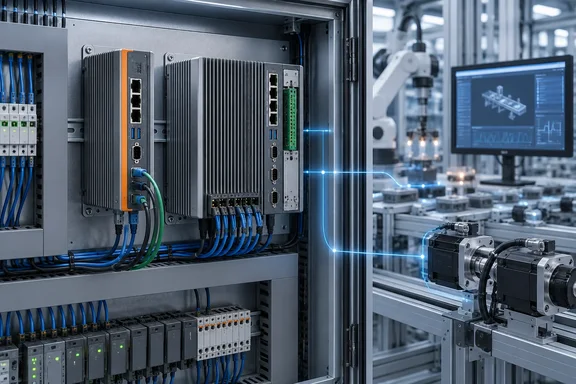
OnLogic's Helix 521-PLC and 524-PLC Turn a Core Ultra PC Into a CODESYS Controller
LinuxGizmos describes the pair as two SoftPLC-oriented industrial computers built around Intel Core Ultra processors and pre-configured CODESYS environments. A SoftPLC is a control runtime that runs on ordinary PC hardware in place of a proprietary PLC chassis. CODESYS is one of the most widely used vendor-neutral runtimes for this, and it is programmed with the IEC 61131-3 languages that automation engineers already know.
Both systems are part of OnLogic's EdgeLogic platform and are intended for machine control, industrial automation and edge workloads. The pitch is consolidation. One fanless box handles the control loop and can also run HMI software, data collection, or AI inference on the same silicon.
OnLogic's store listings back up the LinuxGizmos description. On its Helix product page, both PLC models are marked "Pre-configured and optimized for CODESYS". Each has 4x 2.5 GbE LAN, 4x RS232/422/485 COM, 8x Native Digital In/Out. The 524-PLC is listed as an Expandable SoftPLC Edge Controller with Available Hilscher netX Card.
That listing also clears up a hardware detail. OnLogic's documentation for the wider Helix family describes digital I/O as an add-in option. For older Helix systems, the Helix platform supports an optional Isolated Digital I/O add-in card (OnLogic ADP120). The PLC-branded SKUs are sold with eight native DIO channels, so the two PLC models include DIO that is optional elsewhere in the range.
Five Core Ultra Processors, DDR5 and a Full Set of Industrial Ports
The systems support Intel Core Ultra Series 1 processors including the Core Ultra 5 125H, Core Ultra 5 135H and Core Ultra 7 165H, as well as Series 2 options including the Core Ultra 5 225H and Core Ultra 7 265H. Series 1 is Meteor Lake and Series 2 is Arrow Lake. According to LinuxGizmos, all five chips have a 28W base power rating and an integrated NPU: 11 TOPS on the Series 1 parts and 13 TOPS on the Series 2 parts. Memory comes from two DDR5-5600 SO-DIMM slots, with up to 96GB supported.
Check Series 2 availability before you plan a build around it. OnLogic's page for the standard, non-PLC Helix 524 still says Core Ultra Series 2 coming soon. If you need the 225H or 265H, confirm the chip is actually orderable in the PLC configuration.
The shared I/O is generous for a fanless box. It has four Intel I226-based 2.5GbE ports, six USB 3.2 Gen 2 Type-A ports, and two Thunderbolt 4 USB-C ports. Two DisplayPort 2.1 outputs plus the two USB-C ports drive up to four displays. On the industrial side there are four RS-232/422/485 ports, which you configure per port, and the eight DIO channels. There is also a remote switch input, a grounding lug, a SIM slot, and several antenna mounting points.
Internal expansion uses M.2 slots:
- An M-Key slot takes PCIe Gen 4 x4 NVMe storage.
- A B-Key slot can hold storage, a cellular modem or other expansion hardware, and the front SIM slot maps to it.
- An E-Key slot is for wireless networking. OnLogic lists optional Wi-Fi 6E and Wi-Fi 7 modules with Bluetooth.
- The optional parts list includes 4G LTE and 5G modems and a Hailo 2242 M.2 AI accelerator.
- For the 524-PLC only, OnLogic lists upcoming M.2 modules for single-port 10GbE and dual PoE+. These are not shipping yet.
The base Helix 524 page also says the platform is vPro-capable (depending on the CPU selected), enabling remote KVM access and firmware updates. That matters for IT teams managing controllers spread across sites. It depends on the CPU you choose, and OnLogic has not said which of the five processors in the PLC line enable it.
The Sub-1ms CODESYS Claim Rests on Separating Real-Time Work From Windows 11 IoT
The headline performance number comes from OnLogic. According to OnLogic, the pre-integrated CODESYS SoftPLC environment is configured for sub-1ms cycle times with low jitter while separating real-time control tasks from other host operating system workloads.
That separation is the core design. A general-purpose OS like Windows schedules threads for throughput and responsiveness, not for guaranteed timing. A control loop that has to read inputs, run logic and write outputs every few hundred microseconds cannot wait behind a Windows Update scan or a GPU driver interrupt. CODESYS's real-time runtimes deal with this by reserving CPU resources for the PLC task so Windows can't preempt it. OnLogic's claim is that its pre-built image does this tuning for you.
Treat sub-1ms as a vendor figure. OnLogic has not published the runtime edition, OS build, task load or measurement method behind it, and no independent test has appeared. Your actual cycle time will depend on how many I/O points you scan, how complex your logic is, and what else runs on the box.
The OS situation is simple. CODESYS-optimized Windows 11 IoT is currently offered with the systems. OnLogic also states that Ubuntu and Ubuntu RT support are planned. Windows is the only supported option at launch. Teams that standardize on Linux and a real-time kernel will have to wait for Ubuntu RT, which has no date.
Hilscher netX in the Helix 524-PLC Moves Fieldbus Work Off the CPU
The two models share nearly everything, so the fieldbus approach is the main reason to pick one over the other. LinuxGizmos' spec table lists the 521-PLC's fieldbus as "software-based." That means industrial Ethernet protocols run on the host CPU through the standard 2.5GbE ports. The 524-PLC adds PCIe expansion with an available Hilscher netX fieldbus interface for industrial networking and real-time control applications.
The slot is PCIe Gen 5, x16 mechanical with x8 electrical lanes. OnLogic's card for it is called the Universal Real-Time Ethernet & Fieldbus interface, and it uses Hilscher's netX communication controllers. OnLogic says it provides hardware-timed determinism and takes fieldbus processing off the main CPU. It supports PROFINET, EtherCAT, EtherNet/IP, Modbus, DeviceNet and BACnet.
Offload makes the most sense for demanding fieldbus roles. Jobs like acting as an EtherCAT master for servo drives, or as a PROFINET device with tight timing, depend on hardware timestamping and consistent frame timing. A dedicated netX chip handles that on its own clock, whatever the x86 cores are doing. One card covers several protocols, and the netX firmware you load sets the protocol, so a single SKU can work in plants with different standards.
As general background, CODESYS's own documentation shows how Hilscher cards connect to its Windows real-time runtime. In CODESYS Control RTE SL, you open PLC Configuration and add the optional component CmpHilscherCIFX and click OK to confirm. The NetX firmware and NetX boot loader are supplied together with the installation package. OnLogic hasn't said which CODESYS runtime edition its image uses. So this shows how CODESYS integrates Hilscher hardware in general, not a confirmed description of OnLogic's setup.
The PCIe slot takes more than fieldbus cards. OnLogic's other listed options for the 524-PLC are NVIDIA RTX A400 and RTX A1000 GPUs, Intel Arc Pro B50, NVIDIA RTX PRO 2000 and RTX PRO 4000 SFF Blackwell GPUs, a dual-port Intel X710 10GbE adapter, and an eight-port USB 3.1 host adapter. There is only one slot. Choosing a GPU for machine vision means giving up the Hilscher card, or running fieldbus in software as the 521-PLC does.
Helix 521-PLC vs 524-PLC: Size, Power Input and Ingress Protection
Apart from expansion, the most important differences for installation are physical and electrical:
| Specification | Helix 521-PLC | Helix 524-PLC |
|---|---|---|
| Dimensions | 50.8 x 177 x 225mm | 106 x 177 x 225mm |
| Weight | 2.26kg | 3.77kg |
| PCIe expansion | None | 1x Gen 5 (x16 mechanical, x8 electrical) |
| Fieldbus | Software-based | Optional Hilscher netX card |
| DC input | 12–24V | 19–24V |
| Ingress protection | IP50 | IP20 |
| Operating temperature | 0 to 50°C | 0 to 50°C |
Two of these rows affect installation more than the others. The 524-PLC doesn't accept 12V, so a cabinet built around a 12V supply can only take the 521-PLC without extra hardware. The 524-PLC's IP20 rating also means it only has basic protection against fingers and larger objects. It belongs in an enclosed cabinet, while the IP50-rated 521-PLC offers dust protection. Both use aluminum-and-steel enclosures and share the same 0 to 50°C range. That's a normal indoor factory range, not an extended-temperature rating for outdoor or unheated sites.
For mounting, the standard Helix 524 page says the platform has been optimized for DIN, Wall, VESA and even rack mounting. It also says it has been tested for Electromagnetic Compatibility (EMC) in industrial, medical, in-vehicle, rail, and maritime applications. Those claims cover the base Helix 524. OnLogic hasn't published separate certification details for the PLC versions.
Helix PLC Pricing Depends on Configuration
LinuxGizmos reports that the Helix 521-PLC is currently listed starting at $3,121, including the default Core Ultra 5 125H configuration, 8GB of DDR5 memory and a 256GB NVMe SSD. The Helix 524-PLC is listed from $4,213.80 in the configuration shown with the Universal Real-Time Ethernet & Fieldbus option. Removing that PCIe fieldbus card reduces the configured price by $540.80. On those numbers, a 524-PLC without the card costs about $3,673. That's roughly $550 more than the 521-PLC for the bigger chassis and PCIe slot alone.
OnLogic's own category page shows different figures. The 521-PLC appears at $3,029.00 and the 524-PLC with the netX card at $4,121.80, both $92 below the LinuxGizmos numbers. The gap is probably down to configuration or recent repricing. Either way, treat both sets as starting points and get a quote on your actual build. Both systems carry a standard two-year warranty, with three- and five-year extensions available.
What this means for you
The decision comes down to fieldbus timing, the number of PCIe cards you need, and your cabinet's power and dust conditions. If your machine uses Modbus TCP, or EtherNet/IP and PROFINET at modest cycle rates over the onboard 2.5GbE ports, the 521-PLC costs less and fits more cabinets. If you're running a motion-heavy EtherCAT network, need several protocols from one controller, or want timing that doesn't depend on Windows, the 524-PLC with the netX card is the one designed for that. If you want a GPU for vision work in the same box, remember that the single slot forces you to choose between the GPU and the Hilscher card.
- Windows 11 IoT is the only supported OS at launch. Ubuntu and Ubuntu RT are planned but have no date.
- The sub-1ms cycle time is OnLogic's figure. Measure your own project's cycle time and jitter on the target hardware before committing a production line.
- Before ordering a Series 2 processor, confirm the Core Ultra 5 225H and Core Ultra 7 265H are actually available for PLC builds, since the standard Helix 524 page still says Series 2 is coming soon.
- Check your cabinet supply before choosing a model. The 524-PLC needs 19–24V DC, and only the 521-PLC accepts 12V.
- Put the IP20-rated 524-PLC in an enclosed cabinet. Pick the IP50 521-PLC where dust is a concern.
- Get a quote on your exact configuration. OnLogic's listed prices are $92 lower than the ones LinuxGizmos reported, and the fieldbus card adds $540.80.
OnLogic is effectively selling a pre-tuned CODESYS setup on Windows 11 IoT in two chassis sizes. The Hilscher netX option is what makes the 524-PLC a real alternative to a dedicated PLC for fieldbus-heavy machines. For plants that don't standardize on Windows, the next important step is Ubuntu RT support. Until it ships, these controllers suit sites that are already comfortable running real-time control on a Windows IoT image.