

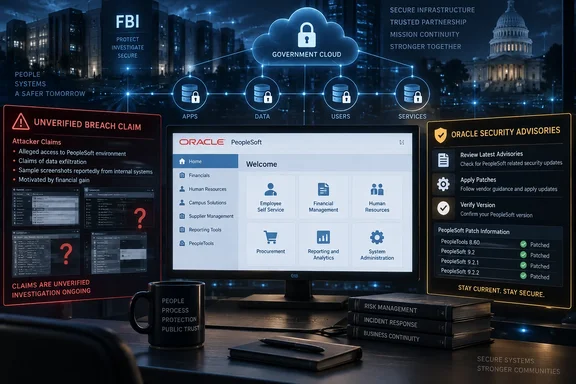
ShinyHunters’ PeopleSoft claim reaches beyond the FBI recruitment portal
According to BleepingComputer’s September 22 reporting, ShinyHunters said it exploited a new remote-code-execution vulnerability on Monday night, September 21. The group described PeopleSoft as the initial entry point, followed by access to additional systems, including an FBI-managed AWS GovCloud environment containing employee and applicant information. It also named Criminal Justice, human-resources, and Medlink services among its alleged targets. Those details describe the attackers’ account of the intrusion, not an established forensic reconstruction.
The distinction between the entry point and subsequent access is important to understanding the allegation. ShinyHunters is claiming a sequence involving an application compromise and movement into other infrastructure. The reporting supplies no authenticated technical explanation of how that transition occurred. Consequently, the AWS GovCloud reference should be understood as a claimed destination within the intrusion, not an announcement of a vulnerability in AWS itself.
ShinyHunters also claimed that it was exploiting the same newly discovered PeopleSoft flaw against other organizations, including Fortune 500 companies, after targeting the education sector. BleepingComputer explicitly said it had not independently verified the alleged zero-day, lateral movement, or stolen-data volume. Its report included no affected-version list, technical advisory, or vendor-supported mitigation for this alleged new flaw.
Reuters separately reported that ShinyHunters claimed to have breached the FBI and obtained information on thousands of employees. The bureau had not answered Reuters’ repeated requests for comment on Tuesday. That provides separate reporting of the claim, but Reuters’ brief account supplies no additional technical confirmation of the PeopleSoft exploit.
The FBI data samples provide narrower evidence than the theft claim
BleepingComputer received an attacker-supplied screenshot purporting to show the FBI Jobs application website defaced with ShinyHunters branding and a message asserting that employee and applicant information had been compromised. The group also supplied two purported personnel records. BleepingComputer withheld the personal information and said it had not independently authenticated the records or their source.
The strongest reported checking of the data comes from 404 Media. According to BleepingComputer’s account of its reporting, 404 Media received approximately 5,000 purported FBI employee records and verified some information, including phone numbers associated with matching names and numbers associated with Department of Justice personnel. That is meaningful checking of individual data points; it leaves the origin, collection date, and completeness of the claimed dataset unresolved.
These evidence categories answer different questions. A matching telephone number supports the accuracy of that particular field. A screenshot supplied by an attacker shows what the attacker is presenting as evidence. Neither, by itself, establishes the claimed 2–3 TB volume or the technical route through which the records were obtained. The useful reading is therefore that some purported sample information reportedly checked out, while the larger account still rests on ShinyHunters’ assertions.
The claimed shutdown also comes from the group. ShinyHunters told BleepingComputer that the FBI quickly detected the intrusion, disconnected affected systems, and terminated access to multiple networks simultaneously. The report attributes the recruitment site’s subsequent maintenance state to that account; it contains no FBI explanation of the operational response.
ShinyHunters’ ultimatum explains the publicity, not the exploit
ShinyHunters framed the alleged intrusion as retaliation for an FBI FLASH report published in May 2026. In a statement described by BleepingComputer, the group disputed allegations involving harassment, swatting, exaggerated access claims, and its association with the criminal community known as “The Com.” It gave the bureau one week to change or remove the report.
The group denied that its demand was financially motivated or constituted extortion. Asked whether it would release the purportedly stolen FBI data if the bureau refused, its representative declined to answer. The resulting uncertainty concerns the group’s intentions toward the data, in addition to the unresolved questions about the intrusion itself.
For administrators, this rhetoric has limited operational value. The statement supplies a claimed motive and a demand, but no affected configuration, detection method, or corrective action. Technical decisions should follow the evidence about systems and vulnerabilities, without adopting the attacker’s account of its conduct as fact.
Oracle’s September PeopleSoft fixes remain a separate security obligation
Oracle released its September 2026 Critical Security Patch Update on September 15, six days before the alleged Monday-night intrusion. PeopleSoft was among the product families included. The timing makes that release relevant to administrators reviewing their deployments, but Oracle’s announcement does not connect it to the FBI allegation.
The advisory lists PeopleSoft Enterprise PeopleTools versions 8.61–8.63 among affected products, along with several other PeopleSoft components. Oracle describes these monthly updates as targeted security fixes that complement its quarterly updates and directs customers to account for earlier advisories as well. It recommends staying on actively supported versions and applying security patches without delay.
Two distinct tasks therefore remain. Administrators can establish whether documented fixes apply to their installed products and whether those fixes have been deployed. They cannot use the September release alone to conclude that their environment is protected against the newly alleged exploit, because the available reporting provides no verified mapping between that claim and a published vulnerability.
The converse is equally important: the allegation supplies no basis for abandoning known patch work. Nor does it support a universal PeopleSoft shutdown procedure. An application-wide operational change needs a defensible basis in the organization’s own exposure, incident evidence, or authoritative guidance; the current report offers no configuration-specific instructions for this alleged flaw.
PeopleSoft administrators should verify patch status without inventing a fix
The defensible immediate decision is to complete established PeopleSoft security work while keeping the FBI allegation separate in incident tracking. The available evidence supports the following boundaries:
- Record the September 21 intrusion date, PeopleSoft entry point, GovCloud access, and 2–3 TB volume as attacker claims, not confirmed findings.
- Match installed PeopleSoft products and versions against Oracle’s September advisory and account for earlier applicable security updates.
- Do not label an existing patch as a fix for this allegation without a verified connection between the vulnerability and the reported attack.
- Treat the reported checking of sample records as evidence about some data fields, not authentication of the entire claimed dataset or exploit chain.
- Keep communications to employees and applicants within the established scope: the reporting contains allegations of exposure, but no authenticated affected-person list or FBI breach notification.
ShinyHunters has made a consequential claim involving sensitive personnel information and an enterprise application used beyond the FBI. The concrete decision point for defenders is a verified technical disclosure identifying the affected component, configurations, and response—not the group’s publication deadline. Until that information emerges, documented patch obligations remain actionable, while the alleged new PeopleSoft exploit requires careful tracking rather than a fabricated remedy.