

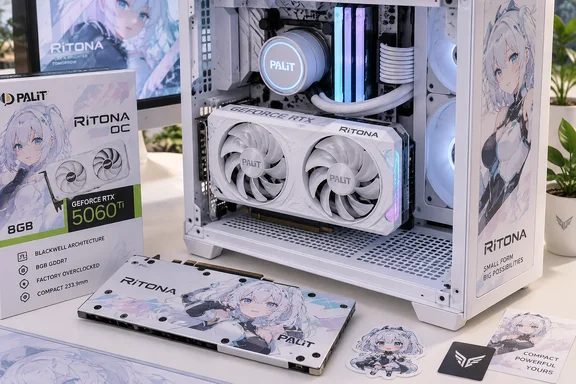
PALIT’s announcement, carried by TechPowerUp and independently reported by IT Home and ASCII.jp, centers on the company’s anime-style digital ambassador RiTONA and the card’s themed shroud, metal backplate, ARGB side lighting, and bundled waterproof stickers. The specification that matters more than the character art is the memory configuration: PALIT chose the 8GB RTX 5060 Ti, at a point when the 16GB version has become the safer long-term option for buyers who expect to use high texture settings, ray tracing, or newer games at 1440p.
PALIT has not published a price, retail date, regional distributor list, or a product page with the normal full specification sheet for the RiTONA OC as of September 18. That leaves prospective buyers unable to judge the only question that will decide whether this edition makes sense: how much extra PALIT expects them to pay for the cosmetic treatment.
A 15MHz overclock will not change buying advice
IT Home reports that the RiTONA OC runs at a 2,587MHz boost clock with a 180W total board power rating. Nvidia lists the reference RTX 5060 Ti 8GB boost clock at 2.57GHz, so the advertised OC amounts to 15MHz, or roughly six-tenths of one percent on paper.
That is a normal factory-bin bump rather than an indication of a substantially different board design. Several conventional RTX 5060 Ti 8GB partner cards also use a 2,587MHz boost clock. Buyers should therefore treat the RiTONA OC’s gaming performance as effectively that of any other RTX 5060 Ti 8GB operating at stock-class power limits, with ordinary variation from cooling, game engine behavior, CPU pairing, and driver version.
PALIT’s cooling claims are more plausible as a quality-of-life feature than the OC label. The board uses two 102mm fans, supports fan-stop operation at light loads, and has backplate cutouts intended to let heat escape through the card. In a desktop used for office work, video playback, or light browsing, 0-dB fan behavior can eliminate the low-level fan noise that cheap graphics cards sometimes add to an otherwise quiet machine.
The claimed 23.4cm length is also meaningful, especially for small-form-factor and compact mATX systems. Nvidia says most dual-fan RTX 5060 Ti designs can fit smaller ITX-oriented cases, but builders should still verify card thickness, power-cable clearance, and front-radiator or drive-cage interference. Length alone does not guarantee a fit.
The missing 16GB model is the real limitation
The RiTONA OC uses the same GB206 GPU as Nvidia’s 16GB RTX 5060 Ti, including 4,608 CUDA cores and Blackwell-generation features such as DLSS 4 and Multi Frame Generation. What it does not have is the 16GB model’s larger memory pool. PALIT’s themed design does not alter that constraint.
PC Gamer’s recent testing of a PALIT RTX 5060 Ti Dual 8GB found that the card can be a strong 1080p and reasonable 1440p performer, but that 8GB becomes a visible limitation in some games when settings are pushed upward. Its tests showed that average frame rates can look close between 8GB and 16GB cards while the 8GB model delivers weaker one-percent-low results in memory-heavy scenarios. Those lower lows are the stutters and uneven frame pacing users actually notice.
The issue is not that every 8GB RTX 5060 Ti suddenly becomes unusable. For esports titles, older games, less demanding releases, and 1080p gaming with sensible texture settings, it remains a capable GPU. The problem is the price premium a special-edition card can command. A buyer who pays extra for limited-run aesthetics but gives up 8GB of VRAM is making a deliberate visual trade-off, not securing a more durable configuration.
Nvidia launched the RTX 5060 Ti with 8GB and 16GB options, with suggested starting prices of $379 and $429 respectively. In theory, the $50 gap made the 8GB board a budget choice. In actual retail listings, the difference has often been distorted by stock and board-partner premiums. That makes PALIT’s absent RiTONA pricing particularly consequential: if its markup approaches the cost of a basic 16GB RTX 5060 Ti, the themed card will be difficult to recommend for a new build intended to last several years.
White builds gain a compact option, but availability is unproven
PALIT is positioning the card for anime-inspired and white PC builds. The hardware presentation is unusually complete for that audience: the white shroud is paired with integrated ARGB illumination, while the metal backplate carries full-color RiTONA artwork rather than a generic logo. The accessory sticker set reinforces that the launch is aimed at personalization rather than raw performance.
There is nothing inherently wrong with that strategy. Case-window builds routinely prioritize visual coordination, and a compact white card can be difficult to find in a market where many premium designs are oversized triple-fan products. PALIT’s 40mm thickness, reported by IT Home, suggests a roughly two-slot-class design, though users should wait for PALIT’s final compatibility drawings before committing to a densely packed ITX enclosure.
But the announcement calls the card a global debut without saying where the physical GPU will actually be sold. PALIT’s retail reach varies materially by country, and the company does not maintain the broad direct US retail presence associated with brands such as ASUS, MSI, Gigabyte, or PNY. As of publication, no US retailer listing for the RiTONA OC has surfaced in the available reporting.
That omission means US readers should not confuse a worldwide announcement with confirmed local availability. Importing a region-specific graphics card can complicate warranty service, returns, and replacement handling even where the card itself works normally in a standard PCIe desktop.
RiTONA is the product story, not a platform change
PALIT says RiTONA first appeared in Japan in 2022 and is now being presented globally with an updated character design inspired in part by the crystalline styling of the company’s GameRock cards. The card includes artwork of RiTONA and her cat-slime companion, Gelo, on its backplate.
For PALIT, this is a brand-building release in the same broad category as themed editions that vendors have used to stand out in a crowded board-partner market. The underlying Nvidia GPU, feature set, Windows driver support, and application compatibility are unchanged. Existing RTX 5060 Ti owners do not receive a new firmware feature, driver capability, or performance mode from this launch.
That distinction also applies to the word “OC.” The RiTONA OC’s reported 2,587MHz boost clock matches the modest preset found on numerous RTX 5060 Ti 8GB factory-overclocked cards. Manual tuning through PALIT’s ThunderMaster utility may allow further experimentation, but individual silicon quality and cooling headroom determine whether any particular card can hold higher settings reliably. A themed backplate does not imply an exceptional bin.
What buyers should wait to see
The RiTONA OC may be a sensible purchase for a 1080p-focused white build if PALIT prices it close to ordinary RTX 5060 Ti 8GB models and confirms local warranty coverage. Its compact body, large fans, fan-stop capability, and ARGB lighting are practical features alongside the character branding.
For anyone choosing a GPU primarily for 1440p games, demanding texture packs, local AI workloads, or a longer upgrade cycle, the decision should begin with the 16GB RTX 5060 Ti rather than the RiTONA artwork. The compact white design is real; the performance uplift is effectively negligible; and until PALIT discloses price and availability, the special edition remains a product announcement rather than a purchasable recommendation.