

What Panasonic announced
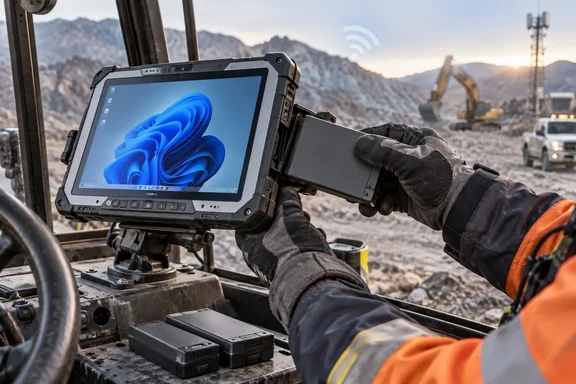
Panasonic Connect Europe announced the tablet from Wiesbaden. Panasonic says its new battery pack structure delivers "unrivalled longevity and choice," whilst its lightweight, agile, and modular design is engineered for mobile field users in defence; emergency services; utilities; surveying; manufacturing; logistics; and automotive. The same release also says the G3 is "the only choice" for critical field workflows. That is the issuer's marketing, not an independent finding. The EQS distribution notice says plainly that the issuer is solely responsible for the content.
Panasonic Connect Europe announced a lighter, larger TOUGHBOOK 34 on the same day. This piece covers only the G3 tablet.
Headline specs, as Panasonic states them:
- 10.1-inch display in a compact, modular rugged chassis
- Intel Core Ultra Series 3 platform, with dual-channel RAM on some configurations
- Windows 11 Pro with Copilot+ capabilities
- Wi-Fi 7, plus optional 4G or 5G standalone cellular
- Three battery options, hot-swappable, with an optional "bridge" battery
- Windows 11 Secured-core PC, with optional TOUGHBOOK Guard firmware security
Battery life: the real headline
Panasonic says its new battery technology in the G3 increases battery life by 39%, with users able to select three different batteries, delivering 8.5 hours, 17 hours, and 24 hours of usage per charge, respectively. The 39% figure is compared to the G2mk3 and tested to the MobileMark 30 benchmark. The runtimes themselves are also MobileMark 30 results.
The biggest pack is 99Wh, which Panasonic calls the largest-capacity battery in any TOUGHBOOK. That's a comparison within Panasonic's own range, not a market-wide ranking. 99Wh is also just under the 100Wh figure that frequent flyers know well. That's our observation, not something Panasonic says. The release doesn't say which capacity goes with the 8.5-hour and 17-hour options, so we won't guess.
The G3 supports hot-swapping. An optional new bridge battery lets you change packs without shutting the tablet down. It's sold as an option, so don't assume it's in the box.
Why this matters in practice: a MobileMark score is a standard lab benchmark, not a promise for your shift. Screen brightness, cellular radio use, cold weather, battery age and heavy local AI work will all cut runtime. A fleet manager should treat "24 hours" as a best-case ceiling and plan around their own workloads.
Panasonic's own announcement frames the three sizes as a trade-off between runtime, weight and budget. Crews that rarely leave the charger can take a lighter pack. Crews with little mains access can take the big one.
Section summary: the battery claims are specific and benchmark-based. They are still vendor figures, and the pack-to-capacity mapping hasn't been published.
Form factor and modularity
Panasonic pitches the G3 for use as a handheld tablet, docked in emergency-service vehicles, or mounted on warehouse forklifts. The TOUGHBOOK line already has this shape: Panasonic's North American catalogue describes an existing fully rugged 10.1″ 2-in-1 tablet, highly customizable with modular expansion areas. The G3 sits in that niche with newer silicon and the new battery design.
Panasonic's full announcement adds details the syndicated release leaves out:
- Expansion modules: user-replaceable modules for smart card, fingerprint and barcode readers, plus a quick-release SSD
- Input: five programmable buttons with up to 10 shortcuts (short and long press), plus touch, glove and pen input
- Keyboard and grip: a detachable keyboard option with an ergonomic grip handle. A footnote says the standalone ergo grip hard handle will only arrive later.
- Wired networking: a dedicated LAN port for when the tablet is back at base
- Accessory compatibility: Panasonic says most accessories and peripherals from earlier models work with the G3. That could be the most useful line for budgets if your fleet already runs on older TOUGHBOOK docks and vehicle mounts. Check your specific accessory before you believe it.
Panasonic hasn't given weight, dimensions, a full port list, pricing or regional availability.
Windows 11, Copilot+ and "edge AI"
Panasonic calls the G3 a TOUGHBOOK AI PC, built on the Intel Core Ultra Series 3 platform. Dual-channel RAM is limited to 32GB and 64GB models only, so smaller-memory configurations may not get the bandwidth benefit.
The release says that, with Copilot+ capabilities, the G3 can collect, store and analyse mission-critical data at the edge without a continuous cloud connection. That's the sensible reading of the claim: an NPU-equipped PC can run some AI work locally. It doesn't mean every Copilot or AI feature works offline. Panasonic doesn't list which features run on the device and which need the cloud. It also gives no NPU performance figures. If your field apps depend on local inference, test them yourself.
Panasonic also says TOUGHBOOK is the only rugged device range certified for Red Hat Enterprise Linux and Red Hat Device Edge. A footnote adds that RHEL installation, configuration and licensing are the customer's job. That matters for defence and utility buyers who standardise on Linux at the edge. For this audience, though, Windows 11 Pro is the main platform.
Connectivity
The G3 has Wi-Fi 7, with optional 4G or 5G standalone modems. Panasonic argues that standalone and private 5G networks are ideal for field workers that need instant connectivity in remote areas, and that in the defence sector this level of connectivity is essential for low-latency, high-speed communications.
Panasonic hasn't said which bands, modem models or carrier certifications the cellular options support. It also doesn't say whether every cellular configuration supports standalone 5G. A private 5G network is infrastructure you build or buy separately. It doesn't come with the tablet.
Ruggedness: read the footnotes
This is the section where the marketing and the fine print diverge. The headline says the G3 is designed to be benchmarked against IP66 standards for dust and water ingress, and has been vibration tested to MIL-STD 810H specifications. It also claims survival of 180cm drops and operation from -29°C to 63°C.
The footnotes say:
| Claim | Status per Panasonic's footnotes |
|---|---|
| IP66 dust/water | Currently certified against IP65 standards. IP66 results available in Q4 2026. |
| Previous model | G2mk3 certified to IP65 standards. |
| MIL-STD-810H / IEC 60529 testing | Will be tested by an independent third-party lab following MIL-STD-810H and IEC60529 in 2026 |
| Damage guarantee | None. Panasonic says the test does not guarantee against damage or malfunction. |
As of launch, then, the G3 is certified to the same IP65 level as the model it replaces. The IP66 improvement and the independent MIL-STD results are still to come. If your tender requires IP66 or third-party MIL-STD-810H test reports, ask Panasonic or your reseller for the finished documents before you sign. The "has been vibration tested" wording and the "will be tested" footnote don't sit well together, and a buyer is entitled to ask which is true.
Security for fleet administrators
The G3 is a Windows 11 Secured-core PC. That's Microsoft's hardware-backed security class, built around firmware protection, virtualization-based security and TPM-rooted identity. Panasonic describes it as protecting users with identity-first authentication.
On top of that is TOUGHBOOK Guard. This embedded firmware-based security continuously validates the device's hardware configuration against an approved baseline, and ensures only authorised components remain active before the OS loads. For defence and public-sector fleets worried about swapped components or tampered hardware, that's a useful control.
There's a catch for procurement: TOUGHBOOK Guard is only available when configured before manufacturing. You can't add it to a delivered fleet, so it has to be on the order form from the start. Panasonic hasn't published how baselines are created, managed or audited, so ask about the admin workflow early.
Our analysis: who should care
The G3 is an evolution, not a revolution. The G2 family already covered this 10.1-inch rugged segment, and hot-swap batteries have been standard in rugged tablets for years. Panasonic's older Android A3 tablet had them too. The new parts are the three battery sizes, the 99Wh top option, the bridge battery, a current Intel platform with Copilot+ labelling, and Wi-Fi 7.
Quick evaluation checklist for IT teams:
- Match the battery to the shift. Pilot the 17-hour and 24-hour packs under real brightness, radio use and temperature.
- Check memory. Choose 32GB or 64GB if dual-channel bandwidth matters to your workloads.
- Confirm certifications. Ask for the IP66 and third-party MIL-STD-810H reports once they're available.
- Order Guard up front. Specify TOUGHBOOK Guard at order time if you want it.
- Audit accessories. Check that your existing docks and vehicle mounts work with the G3 before assuming reuse.
- Test offline AI. Confirm which of your Copilot+ or local AI features actually work with no connection.
The G3 looks like a solid refresh for Windows fleets working away from the depot, especially where battery life has been the main complaint. What's missing so far is independent test data. Until the IP66 results and third-party lab reports arrive, the toughest claims are ones Panasonic has made, not ones anyone has verified.
References
- LONG-LASTING TOUGHBOOK G3 SETS NEW STANDARDS FOR RUGGED TABLETS | Corporate - EQS News EQS News · Wed, 30 Sep 2026 08:07:11 GMT
- Rugged Laptops & Tablets | Panasonic North America - United States connect.na.panasonic.com
- LONG-LASTING TOUGHBOOK G3 SETS NEW STANDARDS FOR RUGGED TABLETS | Panasonic Connect eu.connect.panasonic.com