

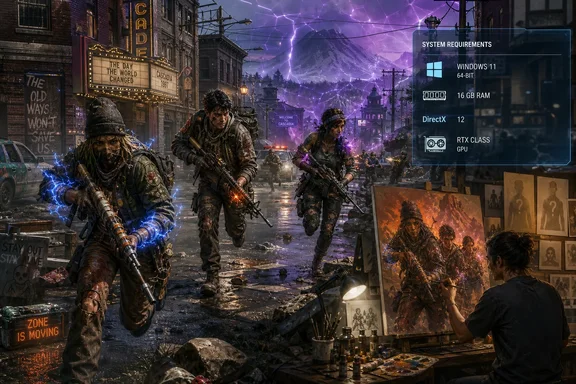
For Windows players, the immediate facts are concrete: PUBG: DED.NET is listed on Steam as an upcoming Windows 11 game requiring 16GB of RAM, DirectX 12, an SSD, and at minimum an RTX 2060 Super or Radeon RX 6600. Krafton has opened registration for a closed beta, but has not announced a beta date, final release date, or price.
The more consequential detail is how the new game changes the cost of losing. DED.NET is asking players to invest across several matches in a character build that can be improved, distorted by injuries, and eventually exhausted. That design makes technical reliability, cheating controls, and server stability more important than they are in a one-off battle royale match: losing a standard PUBG round is frustrating; losing a multi-match run to a disconnect, exploit, or cheat is a much more direct loss of accumulated time.
A PUBG game aimed beyond PUBG’s core audience
Krafton’s official DED.NET site calls the project a multiplayer FPS with roguelite progression across runs, set in a fictional 1990s Cascadia. The official announcement arrived at gamescom on August 23, and the site currently funnels prospective players toward a closed-beta waiting list through a Krafton account.
Curd told Wccftech that the project began roughly two and a half years ago and was created to reach an audience that does not naturally gravitate to the deliberate, tactical rhythm of PUBG: Battlegrounds. He framed the goal as extending PUBG’s broad survival theme into a different kind of game rather than trying to convert every existing PUBG player.
That is more than branding language. PC Gamer separately reported Curd’s explanation that DED.NET’s smaller, denser map and more athletic movement were reasons it became a standalone release instead of an alternate PUBG mode. Windows Central’s hands-on reporting similarly describes the game as an intentional attempt to split from the traditional PUBG formula, including 60-player lobbies organized around three-person teams.
The risk is obvious. PUBG’s identity has been shaped by tense positioning, scarce information, and the permanent consequence of a single death. DED.NET retains a last-player-standing structure, but it wants fights, traversal, and character experimentation to move much faster. Krafton is effectively betting that the PUBG name can support two incompatible player expectations at once: tactical battle royale purists in one product and a strange, build-heavy action shooter in another.
The run system makes every elimination carry forward
The central mechanic is what the studio calls a “multi-match journey.” A player starts a run by choosing one of nine narrative characters and a starter deck aligned with a broad playstyle, such as assault, support, or trickster. Character selection is reportedly narrative and cosmetic rather than class-based; the abilities come from the build, not the character.
During each match, the shrinking-zone phases present choices from the player’s deck. Those picks gradually assemble a powerful but unpredictable build. Wccftech’s interview describes the between-match layer as a “body shop,” where players select further upgrades and eventually take on injuries—penalties that might cause weapon fumbling or involuntary shouting that reveals a player’s location.
The run has a larger pool of career hit points. Early eliminations take away more of that pool, deeper finishes cost less, and winning can restore some of it. Players can pause between matches and resume later, but a failed career eventually burns out the character and sends the player back to a new run with some account-level progression preserved.
This structure explains why DED.NET cannot be assessed solely by its trailer’s weapons and body-horror gags. Its real test will be whether the run system creates meaningful adaptation instead of turning repeated matchmaking losses into a punishing grind. PC Gamer reported that Curd described more than 70 abilities and alterations, including dramatic trade-offs such as replacing hands with blades at the cost of using guns or driving. A large option pool can make runs distinct; it can also make balance, readability, and anti-cheat enforcement much harder in a competitive shooter.
Krafton has not yet publicly explained the game’s anti-cheat approach, its reconnect policy, its handling of server failures during an active run, or whether progress protection will exist for outages. Those omissions matter more here than they would in a disposable, single-match format.
Steam’s AI disclosure is wider than the interview’s example
The Steam page includes the platform’s AI-content disclosure: “Our team uses AI tools to help develop some in-game content.” That language does not identify the tools, name the affected assets, distinguish temporary development material from shipped material, or commit Krafton to updating the notice before release.
Curd offered Wccftech a much more specific example. He said the team used AI to quickly generate six fictional movie posters while establishing the look of a movie theatre, then said artist Brian Pelletier is hand-painting every poster as development proceeds. Curd characterized AI as a tool for setting a tone rather than a substitute for artists, and said every building and character has received multiple human-painted concept iterations.
That is a meaningful clarification, but it is not yet a complete accounting of what will ship. The public Steam disclosure still says AI tools help develop “some in-game content,” a phrase broad enough to cover material beyond the sample movie posters. Curd also mentioned ChatGPT in the context of artists writing annual reviews, which is not itself evidence of player-facing AI-generated material.
The difference is important because the popular shorthand—“the AI art is being fully replaced”—goes further than the current public record. The interview establishes that the movie-poster placeholders are being replaced by hand-painted art. It does not establish that every AI-assisted asset, document, reference image, or other item used during development will be absent from the final game. Krafton can resolve that ambiguity by revising the Steam notice with concrete categories before the beta or launch.
Players who avoid games with shipped generative-AI assets should therefore treat DED.NET as disclosed AI-assisted development with a stated human-art replacement process, not as a product that has already documented a zero-AI final asset pipeline.
The Windows version has a demanding baseline
Steam’s current PC requirements point to a modern baseline rather than a broadly scalable esports-style target. The minimum specification lists Windows 11 64-bit, an Intel Core i5-8400 or AMD Ryzen 5 2600, 16GB of RAM, an Nvidia RTX 2060 Super 8GB or AMD Radeon RX 6600 8GB, DirectX 12, and 50GB of SSD storage. Recommended hardware rises to an Intel Core i7-10700 or Ryzen 5 5600X with an RTX 3060, RTX 2070, or Radeon RX 6600 XT; an NVMe drive is recommended.
Those specifications are preliminary, but they show that DED.NET is not positioning itself as a lightweight successor to PUBG’s older PC profile. Windows Central reports that the developers are using Unreal Engine technologies including Nanite and Lumen, which helps explain the requirement for comparatively recent GPUs. It also puts performance pressure on the closed beta: 60-player online games with dense environments, rapidly changing character abilities, and high-speed traversal can be demanding before visual settings or network code are fully optimized.
Steam also lists full controller support and indicates that the game is still in a prerelease state. There are no player reviews, no finalized store price, and no published Windows performance targets. The listed English interface and subtitle support do not yet amount to a full language rollout plan.
Closed beta is the first meaningful checkpoint
Krafton has delivered the announcement, a Steam page, and a registration path, but much of the information players need before committing remains unannounced. There is no release window on the official site or Steam page, and Windows Central reports that the studio was not ready to discuss whether the game would be free to play.
For now, DED.NET’s strongest differentiator is also its most exposed system: a run can survive an individual defeat, but it relies on players trusting a competitive online game to preserve the value of the matches that came before. The closed beta will be the first opportunity to see whether that persistence produces inventive stories—or simply makes technical failures and unfair eliminations cost more.
References
- PUBG DED.NET Was Built to Reach People PUBG Never Could, and Its “Useful” AI Placeholder Art Is Being Fully Replaced Wccftech · 2026-09-14T19:00:00+00:00