

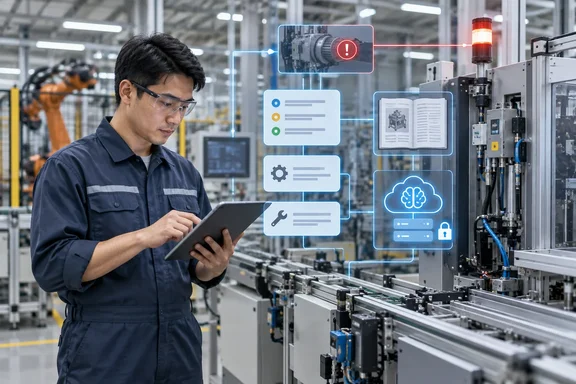
Rockwell's Maintenance Copilot runs on Azure OpenAI in Microsoft Foundry
The deployment was described in a Microsoft Source feature published September 24, 2026. Technicians looking after hundreds of machines at the Singapore site use the copilot. Microsoft describes it as trained on workers' expert knowledge, data from Rockwell's manufacturing software, and the machines' instruction manuals. It runs on Microsoft Azure, was built with Azure OpenAI in Microsoft Foundry, and, according to Microsoft, uses OpenAI's GPT-5.4-mini model.
Rockwell is an industrial automation company based in Wisconsin. Its customers range from airports that automate baggage routing to beverage plants that blend and bottle soft drinks. The company is headquartered in Milwaukee and says it employs approximately 26,000 people serving customers in more than 100 countries as of fiscal year end 2025. That matches the "more than 26,000 employees" in Microsoft's account. The Singapore plant makes controllers, networking components and other automation equipment for the pharmaceutical, automotive and semiconductor industries.
Patrick Dey, Rockwell's vice president for data, analytics and AI innovation, told Microsoft Source which Azure services his team used. Azure OpenAI Service and Azure AI Search handle the conversational side and the reasoning. Azure's security, identity and governance services provide what he called enterprise-grade protection and compliance. Here's the part that matters for IT readers: this is a custom application Rockwell built on Microsoft's platform services. It isn't Microsoft 365 Copilot or any other packaged Microsoft product.
Tribal knowledge becomes a symptom-cause-reaction index
The problem Rockwell set out to solve is familiar to anyone who has run a help desk. Before the copilot, engineering assistant Mangleswaran Mahalingam fixed a stalled machine by paging through manuals hundreds of pages long to find the error code and its fix. If that didn't work, he had to find a colleague who had solved the same problem before. He described it to Microsoft Source as slow and often trial-and-error. Now he types the question into the copilot on his tablet.
The system has three layers. When a machine error is detected, the assistant first searches a database of insights written by veteran Rockwell engineers, each with 20 to 30 years on the shop floor. It sorts what it finds by symptom, cause and reaction, so the technician immediately sees the most likely causes, such as a worn gear or a faulty sensor. Second, technicians can read what colleagues have said about the same issue and whether it has happened on other production lines. Third, the manuals are still there, but technicians query them in natural language and get back step-by-step instructions.
Singapore plant director Li Wang gave two goals. The first is keeping what he calls "tribal knowledge," the unwritten expertise that walks out the door when long-serving workers retire. The second is consistency, so a given problem gets the same standard approach no matter who is on shift.
The architecture choice follows from those goals. Microsoft doesn't publish the retrieval design. But pairing Azure AI Search with Azure OpenAI suggests the model draws answers from Rockwell's curated knowledge base and manuals, not from its general training data. That is our inference; Rockwell hasn't confirmed it. The most important asset here is the database of engineers' write-ups, and building it was knowledge-management work that came before any language model was involved.
The copilot is also used on more than tablets. Mahalingam joined the factory in 2021. He says it took him over a year to feel confident handling night shifts, when fewer colleagues are around. He now oversees about 50 machines and has learned to use the assistant through augmented-reality goggles. Microsoft doesn't name the headset or explain how it connects.
Rockwell's 33% downtime claim is separate from the WEF Lighthouse figures
It's easy to mix up two different sets of numbers here.
The first set is about the copilot, and it comes from Rockwell. Wang told Microsoft Source that the consistent, targeted troubleshooting approach cut machine downtime by 33%. Rockwell's internal tracking shows servicing and spare-parts costs down about 25%. Bob Buttermore, the chief supply chain officer, says new workers used to need nine months to learn to troubleshoot hundreds of machines and now need three. "AI was the catalyst for that," he said. Rockwell hasn't published a baseline period, a comparison group or how any of these figures were calculated.
The second set covers the whole factory, and it comes from the World Economic Forum. Rockwell announced in June 2026 that its Singapore manufacturing facility had been named a member of the WEF's Global Lighthouse Network, a designation that recognizes the facility for applying advanced technologies at scale to deliver measurable improvements in productivity, quality and workforce enablement. The site was recognized with distinction in the productivity category. The Singapore Economic Development Board notes that the recognition makes Rockwell's facility the seventh WEF Lighthouse factory in Singapore – the highest concentration of Lighthouse factories in Southeast Asia. The WEF citation that Microsoft quotes credits the site with a 43% increase in units per person-hour, a 35% reduction in defects and a 67% reduction in time-to-competency.
Those WEF results come from much more than the copilot. Rockwell says the facility deployed more than 50 digital and AI-enabled solutions, including intelligent automation, AI-driven quality control and predictive maintenance. Wang himself calls the copilot one of several AI capabilities behind the gains. He also names a multi-agent quality-assurance system that finds and fixes defects on the assembly line in real time, and a predictive maintenance system meant to prevent unplanned downtime on critical equipment.
The two sets don't contradict each other. The 67% reduction in time-to-competency is consistent with Buttermore's nine-to-three-month claim, since nine months to three is a two-thirds cut. But the WEF figure measures the whole program. The fair reading is that the WEF confirms Singapore is a highly automated, closely measured factory, while the copilot's own 33% and 25% figures rest on Rockwell's internal tracking.
The GPT-5.4-mini model postdates the October 2025 launch
Microsoft's account has a timing problem that anyone copying this architecture should notice. Microsoft Source says technicians have used the copilot since October 2025 and that it runs on GPT-5.4-mini. OpenAI's own announcement says GPT-5.4 mini and nano were released on March 17, 2026, about five months after the launch date Microsoft gives.
The simplest explanation is that the copilot launched on an earlier model and moved to GPT-5.4-mini later. Microsoft doesn't say that, though, and it doesn't name the original model or give a date for any switch. So "runs on GPT-5.4-mini" should be read as the current setup, not the one behind the whole period that produced Rockwell's numbers.
This has a practical consequence. If the model changed partway through, the downtime and cost results cover more than one model. Anyone planning a similar project should budget for model upgrades as a normal part of the work. OpenAI describes GPT-5.4 mini as built for high-volume, low-latency workloads and much faster than GPT-5 mini. It lists API pricing of $0.75 per million input tokens and $4.50 per million output tokens, with a 400,000-token context window. Those traits suit an assistant that many technicians query many times per shift. OpenAI's numbers are its own benchmarks and list prices, though, not measurements from Rockwell's plant.
Twinsburg, Poland and Mexico will test the Azure architecture at scale
Rockwell plans to spread the copilot. Buttermore told Microsoft Source that it will roll out at Rockwell's plant in Twinsburg, Ohio, and at sites in Poland and Mexico. That is a future plan. No dates or rollout order were given. Microsoft puts Rockwell's footprint at more than 25 plants worldwide.
Dey says the architecture will make that possible. He told Microsoft Source that Microsoft's cloud-native architecture can grow from one factory to global deployments, and that staying within Microsoft's stack connects data, AI, applications and collaboration tools. That is a customer endorsement in a Microsoft publication, and it should be read that way.
The harder part of expanding is likely to be content, not infrastructure. The Singapore copilot is valuable because of a database written by engineers with decades of experience on that site's machines. Twinsburg, Poland and Mexico will have their own equipment and failure histories, and presumably their own local experts. Rockwell hasn't said whether those sites will reuse the Singapore knowledge base, build their own, or merge the two. The comments feature, which shows whether an issue has appeared on other production lines, hints at the possible benefit: a fault seen once in Singapore could help a technician in Ohio. But that is a possibility for now, not something Rockwell has reported.
Rockwell also has a commercial reason to publicize this. Buttermore says the company wants its plants to be "a showcase for our customers," testing solutions internally before offering proven approaches to other manufacturers. When the Lighthouse designation was announced, he described Rockwell as applying advanced automation technologies "not just within a single site, but in ways that can scale across our global operations and for our customers." The copilot is part of Rockwell's sales pitch to its own customers, which is one more reason to wait for independent results.
What this means for IT teams building on Azure OpenAI
Whether this matters to you depends on your job. If you run enterprise IT or build internal tools, Rockwell's copilot is a useful reference design for a "knowledge copilot" on Azure. If you run a factory, the reported results justify a pilot, not a purchase decision based on the headline numbers.
The design is worth copying because it is modest. It's an assistant that answers questions from a knowledge base the company controls, used by a trained technician who makes the decisions. Nothing in Microsoft's account suggests it controls machines on its own. Of Rockwell's leaders, CIO Chris Nardecchia is the most down-to-earth about requirements: good data, a trained workforce and a culture focused on learning and outcomes.
Several details a careful buyer would want aren't public. Microsoft doesn't say how the copilot's answers were checked for accuracy, how often it gives wrong advice, whether a technician has to sign off before acting on a recommendation, or how access to plant data is controlled beyond Rockwell's general mention of Azure identity and governance services. For a tool that advises people working on production equipment, any team copying the idea will have to design those controls itself.
- The copilot is a custom application built on Azure OpenAI in Microsoft Foundry and Azure AI Search, not a packaged Microsoft product. Expect to build and maintain the knowledge base and the app yourself.
- Most of the value comes from a curated database of senior engineers' troubleshooting notes, organized by symptom, cause and reaction. Collecting that knowledge before experts retire is the first job, and it doesn't need AI.
- Rockwell's 33% downtime cut, roughly 25% cost reduction and nine-to-three-month onboarding figures are internal numbers with no published method. Use them as a reason to pilot, not as a forecast.
- The WEF Lighthouse figures of 43% productivity, 35% fewer defects and 67% faster time-to-competency cover more than 50 solutions across the whole Singapore site. They aren't a result for the copilot alone.
- GPT-5.4-mini came out in March 2026, after the copilot launched in October 2025. Plan for model changes during the project and re-check answer quality after each one.
- The planned rollouts to Twinsburg, Poland and Mexico have no published dates. Rockwell's results from Singapore are still the only operating evidence.
The Rockwell copilot works because the company treated veteran engineers' knowledge as an asset worth recording, then used Azure's standard AI services to make it searchable where the work happens. The next real evidence will come from Twinsburg, Poland and Mexico. Those plants will show whether a system built on one factory's accumulated expertise can deliver similar gains elsewhere, and whether Rockwell reports those results with more detail than the Singapore figures have.