

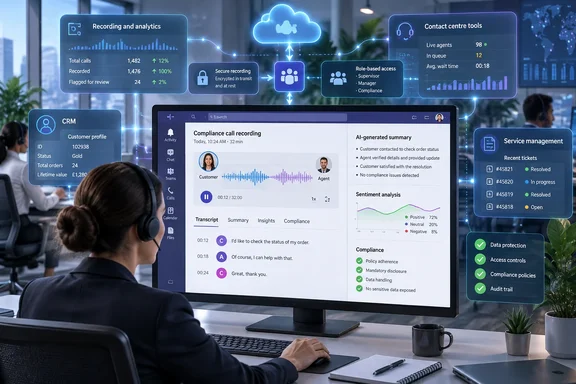
For Teams administrators, the important detail is that this is an integration already exposed in the products, rather than a promise of a future connector. ROGER365.io’s release notes show its Tollring Compliance Recording integration was added in version 2026.26.2081 on June 26, with a configuration adjustment following in the July 10 release. The public alliance announcement arrived later, on September 11, making the news primarily a commercial and channel partnership around a capability that had already begun shipping.
That timing changes the practical reading of the announcement. Customers evaluating the pair should be able to test a real integration now, but they should not mistake a “configured in minutes” claim for a complete Teams compliance-recording deployment.
Playback moves into the contact-centre workflow
The functional core is straightforward: a supervisor or other authorized user can open Tollring recordings from the Reporting tab of ROGER365.io’s native Teams app. This removes one of the persistent irritations of assembled Teams contact-centre stacks, where the agent and supervisor workflow sits in one application but the evidential call record sits in another vendor’s portal.
ROGER365.io’s own administrator documentation confirms that the Tollring connector requires the Analytics 365 API URL, application URL, and an authentication token created in the Tollring portal. The token must be assigned to the Playback Supervisor permission group and can have an expiry period of no more than one year. In other words, the integration is portal-configured rather than custom-built, but it still involves credential management, role design, and a renewal process that an IT team needs to own.
That is a meaningful distinction for managed-service providers. A reseller may be able to enable the connector rapidly for an already provisioned pair of tenants, but a customer still needs to decide who may search, retrieve, and listen to recorded communications. In a regulated environment, giving contact-centre supervisors access to recordings is not simply an application setting; it is an access-control and audit decision.
The shared workflow also extends beyond playback. Tollring and ROGER365.io say AI-created summaries based on call transcripts can be logged automatically to a CRM or service-management system, with the stated aim of removing manual call-note entry. ROGER365.io’s documentation confirms that its AI Flow tooling can take audio from Tollring and run transcription, summarization, sentiment analysis, classification, and quality-assurance actions.
There is one implementation detail the announcement leaves unclear. ROGER365.io’s technical documentation says its AI Flow can use Tollring’s transcription service if the Tollring licence includes it and the relevant option is enabled, but it can also use Microsoft’s transcription service. The companies have not publicly specified which transcription and summarization models are used in each combined deployment, where generated summaries are retained, or whether every advertised CRM and service-management destination is supported through a native connector rather than a customer-defined workflow. Buyers should get those answers in writing before treating automatic summaries as a compliance record.
Microsoft certification is real, but it does not eliminate admin work
The strongest independently verifiable claim in the announcement is Tollring’s Microsoft certification for Teams compliance recording. Microsoft’s current documentation lists Tollring among the certified third-party compliance-recording partners for Teams. That is more than a generic “Teams-compatible” badge: Microsoft says certified partners are tested and verified for the quality, compatibility, and reliability expected of a Teams recording solution.
Microsoft’s policy-based recording architecture is specifically intended for calls, meetings, and events that must be captured under corporate or regulatory policies. It supports scenarios associated with rules and obligations such as MiFID II, Dodd-Frank, FDCPA, HIPAA, and GDPR, though certification itself does not mean that a deployment automatically satisfies every sector’s or jurisdiction’s legal requirements.
The operational requirements matter. Microsoft requires an organization to create a compliance-recording application instance in its tenant, configure a Teams compliance-recording policy, associate the recording application with that policy, and assign the policy to the affected users or groups. The recording bot is then automatically brought into applicable new calls and meetings to enforce the administrator’s policy.
This also means there are boundaries that a contact-centre rollout plan must account for. Microsoft says policy-based compliance recording is unsupported for E911 emergency calling, users operating in Survivable Branch Appliance mode, and PSTN calls involving users in India. For call queues, Microsoft notes that inbound queue calls can be recorded through its call-queue compliance-recording capability, while outbound calls made by queue agents require an appropriate policy assigned to the agents.
The combined Tollring and ROGER365.io offering can simplify access to the captured material after the recording system is working. It does not replace Teams policy configuration, licensing checks, call-flow testing, user notification decisions, retention rules, or the need to understand exceptions in Microsoft’s recording platform.
Quality analytics has value only if the data controls keep up
Tollring is also putting Auto QA and CIQpilot at the centre of the alliance. Auto QA is presented as a way to assess every customer interaction rather than a manually selected sample; CIQpilot lets users query conversation data in natural language. For operations teams, the appeal is obvious: supervisors can find repeat problems, identify coaching opportunities, and surface patterns across more calls than a traditional review process can cover.
But recording, transcription, summarization, classification, and natural-language querying expand the number of places where sensitive call content can be surfaced. A customer conversation may contain payment details, health information, account data, or legally sensitive complaints. The more systems that receive transcript-derived notes or AI output, the more rigorously an organization must establish retention, access, export, and deletion controls.
The announcement does not disclose data residency options, the default retention behaviour for Tollring recordings, model-processing arrangements, or the controls applied when summaries are sent into third-party CRM and IT service-management systems. ROGER365.io’s documentation separately says contact-centre data has a default retention period of 180 days, configurable from one to 365 days, but that setting should not be assumed to govern Tollring’s compliance archive or records stored in a CRM.
The sensible deployment sequence is therefore to start with a small, policy-scoped group and validate the entire chain: Teams call, compliance policy, recording creation, playback authorization, transcription, AI output, CRM write-back, retention, and deletion. A successful demo of in-app playback does not prove that the organization’s recordkeeping obligations are met.
The partnership is aimed as much at resellers as end users
Tollring and ROGER365.io are explicit that the alliance is a channel play. ROGER365.io is strongest in the Netherlands, Belgium, and Germany, while Tollring has a stronger UK position, according to the companies and Dutch channel publication ITchannelPRO. Their claim is that the partner bases have limited overlap, letting resellers attach contact-centre capability to recording and analytics deals, or add recording and analytics to existing Teams contact-centre deployments.
The commercial logic is credible. Teams telephony has made it possible for organizations to standardize user calling on Microsoft while choosing specialist suppliers for attendant consoles, contact centres, recording, workforce supervision, and analytics. The difficulty for customers is not finding products; it is avoiding an estate of loosely connected applications where identity, recording access, support boundaries, and data retention are all handled differently.
This partnership tackles one visible seam: moving recordings and their derivative insight into the contact-centre experience. It does not create a single support contract or a single administrative plane. ROGER365.io’s documentation still directs administrators to both its own portal and Tollring’s Analytics 365 portal, and Microsoft remains clear that customers must first work with the recording partner when there is an enablement or operational issue involving a certified third-party recorder.
Tollring and ROGER365.io say they will run partner webinars covering licensing, enrolment, configuration, and use cases. Those sessions should be more useful than the alliance announcement itself if they clarify licensing combinations, supported CRM targets, regional hosting, escalation ownership, and the division of responsibility between a Teams administrator, the reseller, Tollring, and ROGER365.io.
For existing shared customers, the immediate opportunity is concrete: enable playback from the ROGER365.io Teams app and test controlled automation of call summaries. For new customers, the purchase decision should still begin with the less glamorous work—Teams recording policy design, data governance, and support ownership—because those are the controls that determine whether the combined system is merely convenient or actually fit for regulated customer communications.