

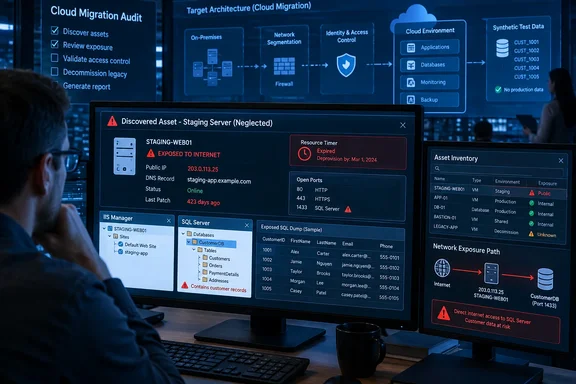
Richard Schut, now managing director and AI software researcher at SmartRepl, told The Register that he found the instance while working at an unnamed mid-sized company. The server had been created quickly to demonstrate an application and test a migration, then effectively became forgotten infrastructure. A SQL dump reportedly named master_test_final.sql was part of the exposure.
There is no public company name, incident response report, forensic evidence, or indication that customer data was accessed. The account should therefore be read as a near miss described by one participant, not as a confirmed breach. But the control failure is specific enough to deserve attention from Windows and enterprise administrators: if an environment can reach live customer records, it has crossed the line from “test” infrastructure to a production-grade security asset.
The staging label did not reduce the risk
The system’s temporary purpose appears to have driven the security decision. Schut told The Register that its creators did not expect it to be accessed by unauthorized users, so they did not apply production authentication and access controls. That expectation is precisely the vulnerability.
An externally reachable staging host can offer an attacker a softer version of the production attack surface: debug endpoints, older packages, permissive firewall rules, test credentials, verbose error messages, administrative tools, and often a less closely watched database connection. A production application may be well protected while the staging copy exposes the same business logic and access paths with fewer obstacles.
The live-data connection made the distinction largely academic. Whether an attacker reaches a customer database through a production hostname or a neglected test server, the resulting confidentiality failure is the same. The real question for administrators is not whether a workload is labeled development, QA, demo, staging, or pre-production. It is whether it is internet-accessible, whether it has a path to sensitive data, and whether that path is controlled and monitored.
NIST’s guidance on security testing has made the underlying principle clear for years: when testing could expose sensitive personally identifiable information to unauthorized people, organizations should use a non-production system with false data rather than actual records. OWASP’s newer DevSecOps verification material reaches the same conclusion, recommending realistic but non-sensitive test data and deliberately separated environments.
A cloud migration audit caught an inventory problem
The important detail in this account is that the issue surfaced during a security audit ahead of a cloud move. Cloud migrations tend to make forgotten systems visible because teams must identify servers, databases, service accounts, firewall rules, DNS records, and dependencies before recreating or moving them. That process can expose the infrastructure that ordinary operations no longer acknowledge.
It also illustrates a migration risk that often gets mislabeled as a cloud problem. Moving an unowned staging workload to Azure, AWS, or another provider does not correct the underlying exposure. It can preserve it, reproduce it through infrastructure templates, or make it easier to spin up again. The correct remediation starts with ownership and purpose: who is accountable for the environment, what data it needs, how long it is authorized to exist, and what event destroys it.
For Windows-centric organizations, the same sprawl can extend well beyond a web server and SQL dump. A “temporary” IIS application may retain a connection string to SQL Server. A test VM may remain joined to Active Directory, hold a cached service account, or have broad SMB access to a file share. A build agent or Azure DevOps pipeline may retain credentials that can deploy to a production subscription. The absence of a customer-facing hostname does not make any of those connections harmless.
Microsoft’s Defender for Cloud documentation treats internet exposure, sensitive data, and possible lateral movement as central inputs to risk prioritization. Its asset inventory is designed to show connected cloud resources across Azure, AWS, and Google Cloud, along with security posture, recommendations, and alerts. Those capabilities will not discover every rogue system automatically—especially unconnected, unmanaged, or on-premises hosts—but they reinforce the operational point: the inventory must include pre-production resources, not merely production subscriptions.
Treat expiration as a security control
The reported staging server had allegedly survived for six months after its short-term mission. That is an ownership failure as much as an access-control failure. A temporary server without an expiration date is a permanent server waiting to be rediscovered during an audit, a breach investigation, or an attacker’s reconnaissance.
The straightforward fix is to give every non-production environment a recorded owner, a business purpose, a creation date, and an automatic expiry or scheduled review. An approved renewal should be required before the expiry date; silence should result in shutdown and deletion. Teams should apply the same discipline to public DNS entries, TLS certificates, public IP addresses, cloud resource groups, database snapshots, storage containers, service principals, managed identities, and pipeline secrets.
Infrastructure-as-code helps because it makes replacement cheaper than preservation. OWASP’s DevSecOps material recommends moving away from manually assembled, long-lived test environments toward on-demand provisioning with prepared test data. The operational benefit is not merely consistency. It removes the organizational excuse that a neglected environment must stay online because no one is certain how to rebuild it.
A scheduled teardown also exposes hidden dependencies. If an unplanned outage of a supposedly disposable test system breaks a customer workflow, a reporting job, or a deployment pipeline, it was not actually disposable. That dependency can then be documented, redesigned, and placed under an accountable owner rather than surviving as tribal knowledge.
Realistic testing does not require raw customer records
Development teams often defend production copies in staging on practical grounds: anonymized data can break referential integrity, omit edge cases, or produce performance results that do not resemble reality. Those concerns are real. They do not justify leaving raw customer records available to every convenience environment.
The stronger pattern is a tiered one. Most development and functional testing should use generated or synthetic data. Integration and performance testing can use masked, tokenized, subsetted, or otherwise transformed data where there is a documented need, strict access controls, and an agreed retention limit. Full production data should be exceptional, restricted to tightly controlled systems, and treated with the security controls appropriate to the data classification.
Masking cannot be assumed effective simply because direct identifiers have been removed. Small datasets, unusual transaction histories, detailed timestamps, locations, internal account numbers, and combinations of attributes can still create re-identification risk. The data owner and privacy team should set the transformation standard; developers should not be left to decide whether a copied database is “safe enough.”
The immediate administrative test is simple: can a staging host authenticate to production data services? If the answer is yes, administrators should require a specific justification, a narrowly scoped identity, network restrictions, auditing, and an expiry date. A broad connection string protected only by the assumption that the staging URL is obscure is not a compensating control.
What administrators should check this week
A review modeled on the response Schut described—restrict access first, then examine every development and test environment—is more useful than a reminder to “be careful.” The first pass should focus on externally reachable systems and their data paths.
- Inventory every development, QA, demo, sandbox, and staging workload, including virtual machines, containers, test databases, storage accounts, public IP addresses, DNS records, build agents, and dormant cloud resource groups.
- Test reachability from outside the corporate network rather than trusting internal network diagrams or deployment labels. Public exposure can be created through a load balancer, reverse proxy, firewall exception, public IP, forgotten DNS record, or a route that bypasses the expected network boundary.
- Identify all non-production identities that can access production databases, file shares, APIs, message queues, or secret stores. Remove standing access where it is not demonstrably necessary, and narrow any remaining permissions to the minimum data and operations required.
- Search repositories, pipeline variables, configuration stores, and deployment logs for production connection strings, credentials, certificates, access keys, and exported database files. Rotating a secret is necessary if it has been exposed, but it does not address the unmanaged system that held it.
- Set a lifecycle policy for every short-term environment, with an owner and automatic shutdown or deletion date. Require an explicit review to extend it.
- Review logs before and after restricting access. The reported case describes immediate containment, but any real remediation should also determine whether the server was indexed, scanned, authenticated to, queried, or used to retrieve data.
The strongest lesson in The Register’s account is not that temporary systems require better passwords. It is that “temporary” cannot be a security classification. A server that remains reachable, retains credentials, and can access live customer data is part of the organization’s attack surface until it is isolated and destroyed.
References
- Test environment let anyone access live customer data The Register · 2026-09-17T11:28:00+00:00