

Notebookcheck reported that Ryu Ga Gotoku Studio used a September 16 livestream to show new footage and put a playable demo on the Tokyo Game Show floor. That account holds up on the main point, but its framing needs a correction: the broadcast was branded as a TGS 2026 Special Opening Night Live and ran the evening before the show opened on September 17. Tokyo Game Show 2026 itself runs through September 21, not September 20 as one follow-up report stated.
For PC players, the event did not bring system requirements, graphics settings, handheld-PC compatibility information, or confirmation of cross-save between Steam and the Xbox version. It did, however, make the game’s structure clearer: this is an RGG game built around a five-era story, an unusually deliberate two-sided combat system, and a separate show-production loop that appears to be much more central than a standard minigame.
The TGS Stream Showed the Opening, Then Stopped
Famitsu reported that the September 16 presentation opened with playable footage from the beginning of Stranger Than Heaven. Makoto Daito is pursued by police, fights through what appears to be an early tutorial sequence, misses a ship, and then swims toward another vessel before the demonstration cuts away.
The livestream itself hit a technical interruption shortly after it began. The game’s official Japanese social account said equipment trouble forced the broadcast to pause, with a planned restart about an hour later. That is a small but worthwhile distinction from the cleaner recap presented by Notebookcheck: the footage was shown, but the event did not unfold as a seamless opening-night reveal.
The playable demo was not newly announced on September 16. SEGA’s Tokyo Game Show site had already listed Stranger Than Heaven among its demo titles, and Siliconera reported that a hands-on station would be present when SEGA and Atlus published their TGS lineup in August. The livestream’s real value was the closer examination of the first three periods rather than the existence of the demo itself.
That leaves an obvious limitation for people outside Japan. SEGA has confirmed a show-floor demo, but has not announced a downloadable Steam demo, an Xbox PC demo, or a Game Pass trial. Until it does, the TGS build is evidence of how the game plays, not a chance for Windows users to benchmark it themselves.
Five Cities Are the Framework, Not a Background Gimmick
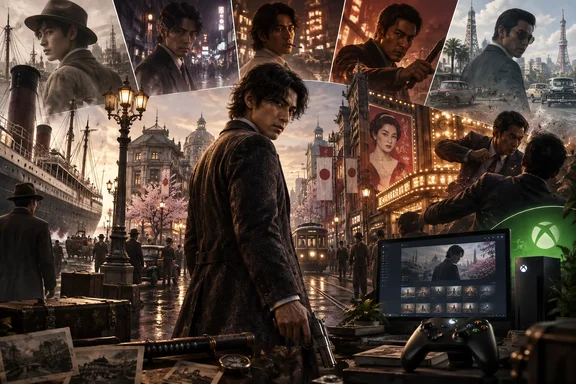
Makoto Daito’s story starts in 1915, after the Japanese-American teenager leaves San Francisco and stows away on a ship to Japan. Microsoft’s Xbox Wire, which published an extensive official recap in May, says the narrative follows him through five locations and 50 years: Kokura in Fukuoka in 1915; Kure in Hiroshima in 1929; Minami in Osaka in 1943; Atami in Shizuoka in 1951; and Shinjuku in Tokyo in 1965.
The September presentation concentrated on Kokura, Kure, and Minami. Reporting from the livestream described each as a different stage of Daito’s life rather than five maps with a different historical coat of paint. Kokura is the early industrial city where he is still young; Kure moves the character into adulthood; and wartime Osaka is where the game begins to emphasize entertainment, money, and public reputation alongside violence.
That approach is ambitious for RGG Studio. Its best-known games typically extract a great deal from a concentrated urban district, returning players to the same streets as side activities and stories accumulate. Stranger Than Heaven instead asks players to learn a new place, a new social environment, and a different version of Daito several times. The possible upside is a sense of personal and national change that a single-city game cannot offer. The risk is that none of the five cities gets enough uninterrupted time to become as familiar as Kamurocho.
SEGA has not yet shown Atami in 1951 or Shinjuku in 1965 in comparable depth. Xbox Wire has described Shinjuku as the story’s concluding setting and says RGG Studio is withholding a major revelation there. For now, those final two chapters remain largely marketing descriptions rather than demonstrated gameplay.
The official Steam listing also adds an important qualifier to expectations about historical fidelity. It describes the game as taking place in a version of Japan that “may have existed in another life,” with areas inspired by real locations and eras. These are historical settings, then, but not a promise of documentary reconstruction.
Combat Has Moved Away From RGG’s Familiar Button-Mashing
The strongest mechanical departure is Daito’s combat control scheme. Xbox Wire’s June hands-on report says LB and LT operate his left-side light and heavy actions, while RB and RT operate right-side attacks. That lets the player throw combinations tied to separate limbs, block with one side, or strike with the other when an enemy grabs an arm or weapon.
RGG has made combat systems more technical before, but this is a more consequential redesign than adding a new stance or a heat-action variation. The usual action-game shorthand—light attack, heavy attack, dodge, repeat—does not neatly describe a system that assigns different inputs to each half of a character’s body. The accessible version of the idea is straightforward: a restrained arm should not mean Daito is helpless. The harder part will be whether the game can teach the timing, directional parries, grapples, and recovery mechanics without making basic street fights feel like controller homework.
The available footage and official descriptions suggest the game expects players to use weapons persistently rather than as disposable pickups. Xbox Wire’s demo coverage described knives, crowbars, hammers, and swords, while SEGA’s Steam page says weapons can be enhanced and lists knives, hammers, and katanas among the arsenal. That makes the combat economy more important than in an RGG title where the nearest bicycle is often the immediate answer to a difficult encounter.
For Windows players using a controller, the game’s design is clearly built around Xbox-style shoulder controls and triggers. SEGA has not stated whether keyboard-and-mouse controls will receive an equally tailored layout, whether remapping will be supported, or how the game will handle Steam Input. Those are details worth waiting for before assuming the Steam version will be best played without a gamepad.
SHOWBIZ Is a Second Progression System, Not a Rhythm Game
The other major feature from the TGS broadcast is SHOWBIZ, introduced in 1943 Minami. Daito becomes a promoter and producer who recruits performers, creates songs from sounds found around the city, chooses performers and stage effects, and spends money to mount larger productions.
Reporting from the presentation says the system is not a rhythm game. Its emphasis is preparation: finding talent, arranging songs, building a bill, advertising shows, and investing in the production before the curtain goes up. A weak turnout can require a different strategy next time, including more promotion around the city.
That is more significant than it may sound. RGG games have long used karaoke, cabaret management, real-estate systems, and business simulations to break up combat, but SHOWBIZ appears tied to Daito’s livelihood in one era. The reported feedback loop—successful performances produce money for food, weapons, and other needs—could make the entertainment system a core route to progression instead of an optional distraction.
SEGA’s Steam listing reinforces that direction. Its Deluxe Edition bundles performers and stage-production items alongside weapons, an outfit, a record player, and an electronic camera. The package makes clear that SHOWBIZ has enough mechanical and cosmetic surface area to support paid add-ons, though SEGA has not explained how much of the base system is available without that upgrade or whether any story content is involved.
PC Release Details Still Trail the Marketing
The January 15 date is official, but storefront presentation already illustrates why regional timing should be treated carefully. SEGA’s official site and Xbox Wire use January 15, while Steam has displayed January 14 in at least one regional storefront. That is consistent with a global launch crossing time zones, not evidence of separate PC and console release dates.
The more useful platform distinction is ownership. Xbox Wire explicitly calls Stranger Than Heaven an Xbox Play Anywhere game and says it will be available on Xbox on PC and Game Pass on day one. Steam remains a separate purchase channel, with its own standard and Deluxe editions. Microsoft and SEGA have not announced cross-buy between Steam and Xbox, cross-save between those versions, or a PC Game Pass preload date.
Most importantly, no PC requirements are listed on the public Steam page yet. There is no CPU, GPU, memory, storage, operating-system, ray-tracing, ultrawide, frame-generation, or Steam Deck guidance to evaluate. With release roughly four months away, that absence is normal—but it means the TGS footage cannot answer the questions that matter most to Windows players choosing hardware or deciding where to buy.
The immediate consequence is simple: Stranger Than Heaven is now a confirmed Windows release with a Game Pass option and a hands-on demo at TGS, but its PC version remains specified as a storefront promise rather than a technical product. The next meaningful update needs to be requirements, PC features, and confirmation of whether RGG’s demanding new control system works as well on keyboard as it does on an Xbox controller.
References
- Stranger Than Heaven at TGS 2026 Notebookcheck · 2026-09-17T12:25:00+00:00