

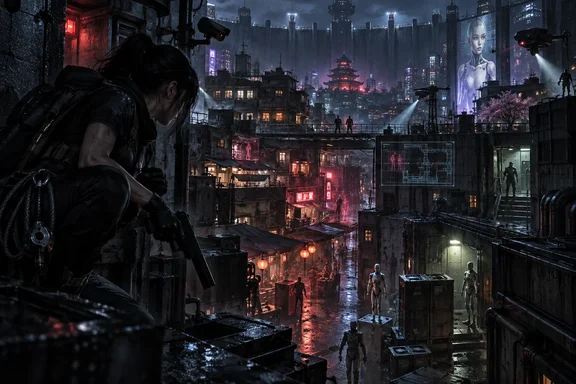
PC Gamer first framed the reveal as an answer to the long absence of a new Deus Ex, while Japanese outlets Game*Spark and Indiebase independently confirmed the September 17 announcement and the PC Early Access plan. The premise is easy to recognize: neon noir, hostile augmented enemies, ventilation routes, surveillance systems and a protagonist navigating a sealed city whose cause of isolation is unclear.
What the announcement does establish is that Tokyo Walled City is a Windows PC game with a public Steam presence, an official reveal trailer and, according to Indiebase, a playable Tokyo Game Show 2026 demo. What it does not establish is whether the game’s systems will interact with the depth that makes an immersive sim work rather than simply appear in a trailer.
Steam’s Early Access plan is longer than the initial report suggests
One detail in the original PC Gamer report needs correcting. Grim Ronin has not announced a “public alpha of 18–24 months.” Its Steam Early Access questionnaire says the game is expected to remain in Early Access for roughly 18 to 24 months after it becomes available.
That distinction is consequential for anyone deciding whether to follow or buy the project. There is no announced Early Access launch date, no announced full-release window, and no price. The developer says the price may gradually increase as content is added, but has not stated a starting price or the size of any increase.
Steam’s page also says the intended Early Access build will include one “fully realized” area with core stealth, survival and combat systems. The completed version is planned to add districts, locations, weapons, enemies, implants and further mechanics. In practical terms, the initial purchase—whenever it arrives—will be a slice of the city rather than the full walled metropolis shown in the pitch.
That is a normal enough structure for a small independent game, but it should temper the comparison with Deus Ex: Human Revolution or Deus Ex: Mankind Divided. Those games shipped as large, authored RPGs with completed campaigns, whereas Tokyo Walled City is being positioned as a live-in-development project whose scope will expand with player feedback.
The promising feature is interaction, not the cyberpunk imagery
Grim Ronin describes Tokyo Walled City as a “stealth action retro-cyberpunk immersive sim with survival horror and RPG elements.” The category label is broad, but the Steam description identifies the part that could separate the game from a conventional stealth shooter: visibility and noise propagation are supposed to shape how enemies react.
The announced toolset includes silent pistols, blades, improvised gadgets, high-tech traps and grappling equipment. The developer also promises environmental interactions including climbing, hiding, peeking, hacking, throwing objects and improvising. The trailer, as PC Gamer noted, leans heavily into familiar genre shorthand: vent routes, camera hacking, lights that can be disabled and corner-peeking.
Those elements make for a persuasive Deus Ex-adjacent trailer. They do not, by themselves, prove that Tokyo Walled City has the systemic flexibility fans are looking for. An immersive sim earns that name when separate systems create alternatives: a camera can be hacked, avoided, disabled, distracted, bypassed through architecture or turned into a liability for an enemy. A grappling tool matters more when it opens routes that meaningfully change risk, resources or mission outcomes.
Grim Ronin’s language about sound and visibility offers the clearest sign that it understands that requirement. Yet the announcement provides no detailed explanation of enemy alert states, resource economy, save structure, mission failure conditions, progression balance or how implants will alter play. Those are the details that determine whether a stealth game sustains experimentation or funnels players toward the obvious route.
For now, the footage supports the narrower conclusion: Tokyo Walled City has the visual vocabulary and apparent mobility of an immersive sim, along with a survival-horror layer built around gangs, augmented adversaries and androids. Its systemic depth remains untested outside the developer’s own demonstration.
A vertical city is the project’s most demanding promise
The most ambitious claim on the Steam page is not the reference to cyberpunk classics. It is the promise of a hand-crafted, vertical city designed for freeform exploration.
Game*Spark describes the planned spaces as abandoned markets, residential blocks, neon alleys and slums, while the Steam listing names rooftops and hidden passages as routes through the environment. The trailer’s rooftop traversal and drop attacks suggest that Grim Ronin wants players to move above street level rather than treat ventilation shafts as the only alternative path.
That approach suits the setting. A walled city can be compact without feeling small if it has layered floors, sightlines, locked doors, interior passages and routes that connect spaces in unexpected ways. It is also where small teams can get into trouble. Verticality requires navigation clarity, AI that can cope with multiple elevations, encounters that remain readable from several directions, and enough meaningful destinations that movement is more than scenery.
The developer’s Early Access roadmap implicitly acknowledges that workload. It plans to build outward from one realized area, then add districts and improve the core mechanics over 18 to 24 months. That is more credible than promising a finished open city at launch, but it leaves players unable to judge the eventual scale of the game today.
The trailer also references a lineage that is difficult to satisfy on a limited budget: Deus Ex, Dishonored, Blade Runner, survival horror and retro-futurist anime. These influences are useful signposts for tone, but they raise expectations for controls, AI behavior, level design and art direction simultaneously. A game can borrow the look of all of them; making their play systems work together is the real test.
PC players should treat the Steam page as a watchlist, not a buying decision
Tokyo Walled City is currently listed only for Steam on PC. Its Steam page confirms English interface and subtitle support, but it does not announce a release date, price, supported controller configuration, hardware requirements, alternative PC storefronts or console versions.
That missing information is expected at the announcement stage, but it means there is no basis yet for judging how demanding the game will be on a Windows gaming PC—or whether its dense lighting, vertical environments and AI-driven stealth will scale well across lower-end systems. The project’s visual style may be deliberately retro, but that does not reveal its eventual CPU, GPU or memory requirements.
The more immediate question is how much of the advertised design will be present when Early Access starts. Grim Ronin says the first build will include a single complete area and the foundations of stealth, combat and survival. Players who want to contribute feedback and tolerate major changes may find that useful; players waiting for a finished campaign should not mistake the reveal for an imminent successor to Mankind Divided.
For now, Tokyo Walled City has cleared the first hurdle: it is a real, announced PC project with a Steam page, a trailer and a stated Early Access structure, rather than another vague invocation of cyberpunk nostalgia. The next concrete milestone is an Early Access date—and, with it, proof that its cameras, sound, tools, routes and enemies produce more than a stylish imitation of the games it invokes.