

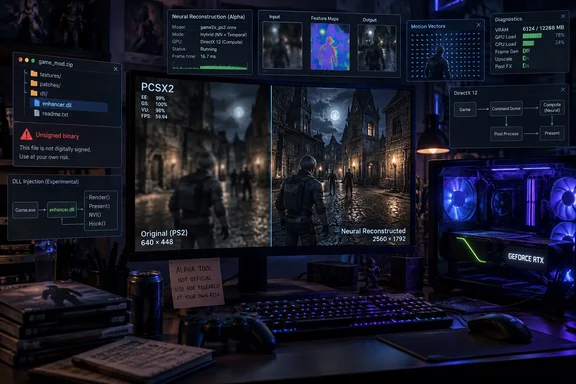
Wccftech first highlighted the project after its creator, posting as imissanyway in the GameUpscale subreddit, announced a public test build on September 16. NVIDIA’s own DLSS 5 documentation establishes that its 3D-Guided Neural Rendering is now a real-time, final-stage rendering technology for GeForce RTX 50-series hardware. But UNCANNY is neither an NVIDIA product nor an approved way to bring DLSS 5 to arbitrary games; its repository explicitly says it is independent and unaffiliated with NVIDIA.
That distinction is the difference between an interesting modding experiment and a universal upgrade path for old games. UNCANNY may be worth watching, particularly for controlled PCSX2 testing, but the public evidence does not yet support claims that it broadly turns classic and modern games into convincingly remastered titles.
What UNCANNY Actually Installs
UNCANNY’s public release is Windows-only and targets NVIDIA RTX systems. Installation is not a conventional plug-in workflow: users extract a ZIP archive, drag a game or emulator executable onto INSTALL-NATIVE.cmd, then launch the target normally. The project says it creates a backup and provides rollback options, but the method still works by placing runtime components into a game directory and attaching them to its rendering process.
That is a familiar technique for ReShade-style injectors, upscalers, overlays, graphics wrappers, and mod loaders. It also means UNCANNY is interacting at a layer where API differences, existing DLL mods, launchers, anti-cheat services, and custom render paths can all matter. The project’s own security guidance calls it “low-level modding/injection software” and tells testers not to combine DLLs from unrelated builds.
The current build is identified as UNCANNY v0.19.0-alpha.1, “Alpha RC2 Hotfix 2,” with runtime tag release-alpha.rc2.hotfix.2 and ABI 140. The developer publishes a SHA-256 checksum for the Windows ZIP, which is useful for verifying that a download matches the stated release. It does not make the executable independently auditable: the repository contains documentation and release information, while the full development workspace is private.
That is an unusually important caveat for a tool that asks users to run scripts and inject binaries into other executables. The GitHub repository is public; the code that produces the shipped runtime is not.
The “Universal” Claim Stops at the Graphics API
UNCANNY’s stated goal is one runtime that can be dropped into PC games and emulators instead of relying on individual remaster mods. Its project page lists DirectX 9, 10, 11, and 12, plus PCSX2. The support table tells a more constrained story:
- DirectX 12 is the primary PC test path.
- DirectX 11 is still under active testing.
- PCSX2 is the primary emulator test path.
- DirectX 9 and DirectX 10 neural execution are experimental.
- Vulkan and OpenGL are not at DirectX feature parity.
That makes PCSX2 and selected DirectX 11 or DirectX 12 single-player games the credible early test targets. It does not make UNCANNY a drop-in solution for the wide range of Windows games that use Vulkan, OpenGL, unusual wrappers, older fixed-function APIs, middleware renderers, or protected multiplayer clients.
The project also warns that a loaded DLL or a visible overlay is not evidence that neural rendering has actually reached the presentation stage. Testers are instructed to run UNCANNY-STATUS.cmd after a session and check whether its feature creation, evaluation, and output-to-presentation checks succeeded.
That admission deserves more attention than side-by-side screenshots. A tool can hook a process successfully, display controls, and even alter an image without proving that the advertised neural-rendering path is active. UNCANNY’s documentation is candid on this point; Wccftech’s account did not explain how much verification the project itself says is still required.
DLSS 5 Is Designed for Game Engines, Not Generic Injection
NVIDIA released DLSS 5 on September 1 with 3D-Guided Neural Rendering, initially in NBA 2K27 for GeForce RTX 50-series PCs and laptops. Unlike prior DLSS features that reconstruct a higher-resolution frame, create frames, or improve ray-traced denoising, NVIDIA says DLSS 5 generates the final displayed appearance using input from the game engine, including the rendered frame, motion data, scene attributes, and developer-defined artistic controls.
Those inputs are central to the product. NVIDIA says developers can choose model variants, tune structural and tonal intensity, and use semantic or engine-level masks to limit the effect to particular scene elements. Its official materials also say output quality depends on the fidelity of the base frame and becomes more accurate with better foundational data from ray tracing or path tracing.
UNCANNY cannot assume it has access to all of that engine-level information in every game it hooks. Its creator says the runtime includes DLSS 5 integration, multipass reconstruction, Motion Guard, Ghosting Guard, and a diagnostic layer. But there is no public code, independent benchmark suite, or published compatibility dataset demonstrating that it feeds equivalent information into the neural-rendering pipeline across every supported game.
The likely result is that the tool’s behavior will vary sharply by title and rendering path. In a best-case game, it may have enough usable motion and frame information to produce a convincing image uplift. In a difficult title, it may fall back to less reliable screen-space reconstruction, show temporal artifacts, or attach successfully without contributing neural output at all. The developer’s own status checks and experimental labels acknowledge that uncertainty.
This is also why direct visual comparisons need restraint. A stronger light shaft, smoother skin, sharper face, or altered material response may look impressive in a still frame while introducing flicker, detail invention, changing textures, unstable silhouettes, or inconsistent identity during gameplay. NVIDIA’s official DLSS 5 pitch rests heavily on deterministic output and temporal stability. A third-party injector has to prove those properties title by title.
REVENANT Does Not Yet Prove Asset-Level Remastering
UNCANNY’s most ambitious component is called REVENANT, described as experimental persistent asset reconstruction and currently focused on PCSX2. This feature is where the “real-time remastering” label could eventually become meaningful: a system that recognizes, reconstructs, stores, and reliably reuses higher-fidelity versions of game assets would go beyond post-processing a completed frame.
But UNCANNY’s usage guide says that capturing or generating an asset does not prove it was rendered as a replacement. It specifically says rendered use and persistence are still being validated. In plain terms, REVENANT is not yet demonstrated as a dependable asset replacement system, even according to its developer.
That means screenshots from 007: From Russia with Love or BLACK should be read as visual demonstrations of a work in progress, not proof that those PlayStation 2 games have gained a stable remaster layer. PCSX2 is a sensible first target because its rendering paths and content are more consistent than the enormous variety of native Windows PC engines. It is still a demanding problem: the runtime needs to identify what it is seeing, maintain consistency across camera movement, distinguish true detail from aliases and texture noise, and avoid rewriting the game’s intended image.
The creator’s multipass “Clean” modes—1, 1.5, 2, 2.5, and 3—are meant to increase reconstruction depth without simply rerunning the same full DLSS pass. The repository says the first pass does most of the work and later stages refine the remaining image. Higher modes, however, cost more GPU time and are still being tested on broader hardware.
The useful early-setting advice is therefore unusually conventional: start at Clean 1, keep Motion Guard and Ghosting Guard enabled, compare the same scene with the feature disabled and enabled, and only try deeper modes after confirming that the game is stable. That is testing guidance, not a recommendation to deploy the runtime widely.
Treat the First Build as a Test Artifact
The project’s own security page says the current alpha binaries are unsigned and have not received broad antivirus certification. It explicitly advises users to investigate security warnings rather than bypass or suppress them. That is the right instruction, and Windows users should follow it.
For enthusiasts who do test UNCANNY, the safe scope is narrow: use a backup or disposable game installation, stick to offline single-player software or PCSX2, record the exact GPU driver and UNCANNY version, and verify rollback before investing time in comparisons. Do not stack it with other graphics injectors on the first run, because the developer says those combinations can complicate diagnosis. A tool that installs into a game directory should also stay far away from competitive or anti-cheat-protected games unless the game publisher and anti-cheat vendor explicitly permit that modification method.
UNCANNY’s release is a notable demonstration of how quickly DLSS 5 experimentation is escaping the developer-integrated path NVIDIA designed. It is also a reminder that generative graphics needs more than a striking before-and-after frame: it needs reproducible behavior, clear compatibility limits, stable motion, measurable performance, and a security posture that lets users inspect what they are installing.
For now, the project has released a promising but opaque alpha for RTX-equipped Windows testers. Its next meaningful milestone is not another screenshot. It is a public compatibility record showing which DirectX 11, DirectX 12, and PCSX2 titles actually deliver verified neural output without breaking the games they are meant to improve.
References
- NVIDIA DLSS 5 Neural Rendering Fuels UNCANNY Remastering Engine, And Both Classic and Modern Games Suddenly Look Like New Titles Wccftech · 2026-09-16T15:21:39+00:00