

Microsoft's "Generative Narrative Game Experience" patent is older than this week's headlines
The TechSpot report described the filing as an application "published in July and titled 'Generative Narrative Game Experience With Player Feedback'". The patent documents give a different timeline. Google Patents lists the U.S. application as US18/213,868, filed on June 25, 2023, by Microsoft Technology Licensing LLC. It was published as US20240424405A1 on December 26, 2024, and granted as US12589308B2 on March 31, 2026. Justia's patent database confirms the March 31, 2026 issue date for patent 12,589,308.
There is also an international version. Microsoft filed a Patent Cooperation Treaty (PCT) application, PCT/US2024/034565, on June 19, 2024, and WIPO's PatentScope search tool lists it as WO2025006277A1, published January 2, 2025. A Chinese counterpart, CN121263238A, appears in the same patent family. Google Patents gives an adjusted U.S. expiration date of November 17, 2043.
Because there are two documents, outlets have described the patent's status in different ways. Gadget Review, working from the international filing, says Microsoft Technology Licensing filed patent WO2025006277A1 in June 2024 and calls it "a pending patent application, not a confirmed Xbox feature." That fits the PCT document, since a PCT filing does not become a patent on its own. The U.S. version, however, is already granted. Dork reports that Microsoft has patented a generative AI game concept shaped by player actions, vocal comments and facial expressions, which matches the U.S. record. Every outlet agrees on the key point: no product has been announced.
The patent lists seven inventors: Sudha Rao, William Brennan Dolan, Christopher John Brockett, Weijia Xu, Nebojsa Jojic, Gabriel A. desGarennes and Yun Hui Xu. Its classifications put it with video game patents on generating or changing game content while a game runs, adapting to player actions, and branching storylines.
How the narrative state graph and a "co-pilot" for designers fit together
The patent opens by describing game creation as "an extremely labor-intensive artisanal process". It notes that game engines render worlds and simulate physics but do not by themselves define the game world and game narrative needed to provide a playable experience. Most of the patent is about that design and writing work.
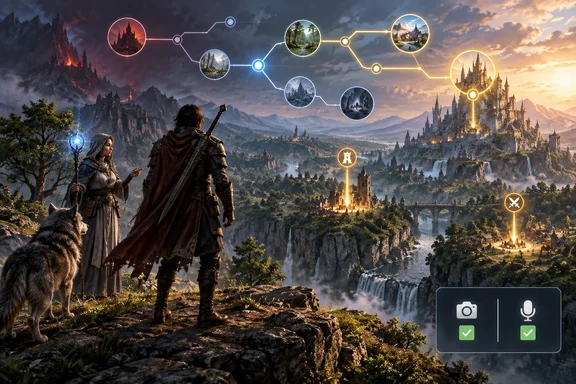
The main structure is a narrative state graph, which TechSpot describes as a map of game events, choices, and outcomes. In the patent, each node is an event point such as a quest stage or sub-goal, and the connections between nodes are possible routes through the story. In a typical game, developers build those branches in advance. Microsoft's proposed system would track a player's progress through that map and use generative models to add new paths or alter existing ones.
The patent describes two stages. At design time, generative AI works as what the patent calls a "co-pilot" for designers. A designer writes a short natural-language description of a game, possibly with images or audio. The model then fills in characters, plot lines, important objects, goals and sub-goals, and details of the world. The designer can edit a visual version of that output, such as the graph, and the edits go back to the model as a new prompt. They repeat this until the designer is satisfied. The patent says the model could also generate code "suitable as input to a game engine."
After release, the patent turns NPCs and interactive objects into "grounded computer-controlled agents." These are parts of the game that pass player input, along with context such as the current game state and the player's history, to a generative model. The patent's examples of large language models include GPT-3, GPT-4, BLOOM and LLaMA. Dork notes that one example has NPCs answering natural-language questions using details of a player's location, previous conversations and route through a story. Those agents could create more than fresh dialogue, potentially producing assets, rules or locations connected to a suggested sidequest. Objects are covered too. In the patent's own example, a player who tries to kick in a door or break a box, instead of unlocking it as designed, could have that action handled by the model.
The patent does not tie the idea to Xbox hardware. It mentions building the narrative layer into an existing sandbox game with no storyline and names Minecraft as an example, with the story connected to the game through API calls. It also says the ideas could apply to text-based games and "other forms of current or future computer-implemented interactive entertainment."
The engagement metrics behind the patent, including camera and microphone signals
The patent spends much of its length on engagement metrics, meaning measures of how interested a player is in each part of the game. These drive most of the "rewrite" behavior the headlines focus on. It lists behaviors that could count as implicit feedback:
- How long a player talks with an NPC or handles an object, counted in dialogue turns or individual actions.
- How often a player returns to a location or asset.
- Whether a player finishes or abandons a quest.
- Which path a player takes when the storyline branches.
- How intense an interaction becomes. In the patent's fight example, switching to more and more powerful weapons signals rising engagement.
The patent says these scores can be calculated for single nodes, for the whole route through the game, and at levels in between. It also allows a generative model to judge engagement directly, for example by reading a conversation with an NPC to decide whether the player seems interested, bored or excited. In one version, several model instances act as "sensors" that quietly watch different parts of play, and another instance combines their scores. The patent describes the in-game monitor as "typically invisible to the player."
The biometric part needs its qualifier. TechSpot wrote that the system could use facial features and other signals to gauge players' emotional reactions. That information, combined with in-game behavior, could help determine which characters, stories, or settings should receive more attention. The patent text says audio and video from a microphone or camera "may be processed (with player permission)," possibly by machine-learning models running locally, to read reactions from spoken comments and facial expressions. It also suggests that recordings or livestreams players post online could be analyzed the same way.
These are options the patent describes, not requirements, and none of them is confirmed as something Xbox collects. The behavioral metrics work without any camera. Still, the patent names permission-gated capture of players' faces and voices as a possible input to a system that decides what content a game should grow or cut.
Most of the rewriting in US12589308B2 happens between game versions
"Games that rewrite themselves as you play" is a fair reading of some parts of the patent, but not most of it. TechSpot's two examples are that a minor character could receive a larger storyline if a player keeps interacting with them. A cave meant to be a small side area could become a larger dungeon with new lore and quests if a player spends more time exploring it. These are TechSpot's illustrations. The patent does describe the same kind of behavior: when part of a game draws players in, the model "may decide to elaborate on and extend that part of the game."
The patent's main loop, though, runs over successive releases. Content generated during play is fed back into design. The designer's visual view of the game is updated, and the designer decides whether to keep a change as is, keep it with edits, or reject it. A rejection can also mean changing the game's rules so the same content doesn't appear again. Engagement data is gathered "across potentially many players" and used to update the game, "typically (but not necessarily) with the game designer in the loop." If emergent content proves popular, it may be kept in later versions, sometimes with new story elements added so it connects back to the main plot. Content that players ignore may be removed or given less weight.
The patent's "jail break" example shows how this works. If players find a shortcut that skips the intended experience and makes the game dull, the game can be changed to close it. A shortcut that players like can stay. Dork points to a similar use before release: feedback from QA, beta and early-access players could be fed into a system between builds, generating material for developers to assess before incorporating it.
Real-time, per-player changes are also described. The patent allows NPC agents to create content on the fly and mentions spawning multiple customized versions of a game. It also describes adjusting NPC prompting to nudge conversations toward what a given player prefers. Gadget Review draws the result: two players running the same game could encounter different character arcs and receive different quests. They might also face NPCs that respond to behavior outside any prewritten script. The patent covers a range of setups, from an assistant for designers to a fully adaptive game. A shipped product could use any part of that range, or none of it.
Where the Xbox framing outruns the record
The patent does not use Xbox branding. It is a Microsoft Technology Licensing filing about "computer-implemented narrative games" in general, and its only named game is Minecraft, used as a sandbox example. TechSpot acknowledges that the patent does not say Microsoft plans to use the technology in a future Xbox game. It reads the filing as a sign that Microsoft is thinking about generative AI as part of the game itself and not only as a development tool. That is a fair reading of the claims about run-time agents, though a patent protects an idea and does not commit to shipping it.
TechSpot places the filing next to other recent Microsoft gaming patents, including an AI helper that could play games for a user and a controller concept with movable, tunable haptic motors. This one differs in one way: its engagement loop is aimed at the story and world content, not the hardware or the player's inputs.
The hard problems the patent describes, it does not solve. The system would need generated quests, dialogue and locations to stay consistent with the game's rules, characters and earlier events. The patent assigns that job to memory and experience controllers that track history and game state. Gadget Review notes that generated narrative must stay coherent and match the game's tone. It also has to filter inappropriate output across an unpredictable range of player behavior. None of those production challenges are resolved in a patent filing. It adds that no Xbox title, launch window, or hardware requirement is attached to this application.
What this means for you
Nobody needs to change settings, hardware or subscriptions because of this patent. It is worth following if you care about how Microsoft may bring generative AI into games and what player data those systems might use. Xbox and PC players have no feature to turn on or off, and no camera or microphone setting is linked to it today. Developers can use it to see how Microsoft's patent strategy imagines AI tools for designers: a graph the designer can edit, with the model proposing and the human approving. Privacy-minded players should note that the patent describes camera and microphone analysis as permission-gated and optional. If a Microsoft product ever uses this approach, look for that permission prompt and read what it covers.
- US12589308B2 was granted on March 31, 2026, from application US20240424405A1, which was published on December 26, 2024. The international counterpart WO2025006277A1 was published on January 2, 2025. None of these match a July publication.
- The patent describes possible designs. Microsoft has announced no Xbox game, feature, release window or hardware requirement based on it.
- Its main engagement signals are ordinary gameplay behaviors, such as conversation length, repeat visits, quest completion and branch choices, which can be scored per story node and across a whole playthrough.
- Camera and microphone analysis of facial expressions and speech appears only as a "with player permission" option, possibly handled by locally running models.
- In most of the described designs, AI-generated content goes to a human designer for approval, rejection or editing before it becomes part of a later version.
- The patent's own example is a narrative layer added to a sandbox game such as Minecraft through API calls, not Xbox-specific technology.
The patent itself is resolved: Microsoft owns the U.S. rights to this approach until the 2040s, whether or not it ever uses them. If the approach reaches players, the likeliest first sign is a Microsoft-published game or Minecraft experience with AI-driven NPCs and a clear data-consent screen. At that point, the concept described here would become something players can actually test.