

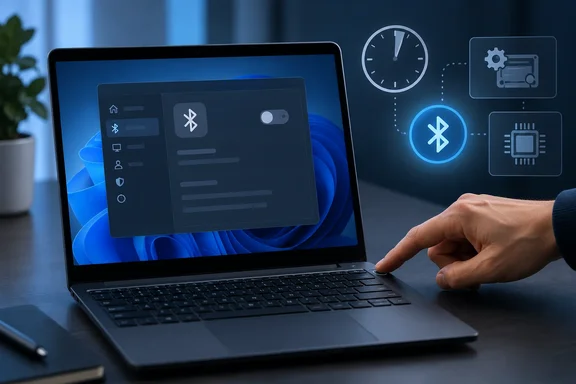
Microsoft treats a missing Windows 11 Bluetooth toggle as a hardware error
The Fix Bluetooth disappeared in Windows article on Microsoft Support covers one specific symptom. The Bluetooth control is missing or grayed out, you can't turn Bluetooth on or off, and accessories such as keyboards, mice and headphones won't connect. It is separate from pairing failures or audio dropouts, which Microsoft handles in other articles.
The Windows 11 section is direct about the cause. It says Bluetooth hardware errors are "typically caused by problems with the drivers or firmware provided by your PC manufacturer." It also tells readers to contact that manufacturer, because the manufacturer may have troubleshooting steps specific to the PC model.
The Windows 10 section describes the same symptom more broadly. There, the Bluetooth icon or toggle may be missing or appear grayed out in Settings or Action Center if Windows cannot detect or enable the Bluetooth hardware, and the problem can occur for several reasons, including incorrect Bluetooth settings, outdated or incompatible drivers, stopped system services, hardware malfunctions, or problems by recent Windows updates. Both explanations sit on the same page. For Windows 11, Microsoft puts the likely cause below the OS layer.
One boundary is worth stating early. A missing Bluetooth setting is not always a hardware failure. Microsoft's broader guidance says the setting can also disappear on a PC that has no Bluetooth adapter, or whose adapter driver isn't installed. If you've just built, reinstalled or upgraded a machine, check that it actually has Bluetooth before you start troubleshooting.
A Shift-held Shutdown in Windows 11, not a Restart, comes first
Microsoft's first Windows 11 step is also the least invasive:
- Hold the Shift key.
- While holding Shift, select Start > Power > Shut down.
- Once the PC is off, wait one minute.
- Turn the PC back on and check whether Bluetooth has returned.
Microsoft adds a note that matters: pick Shut down, not Restart, so the PC and its Bluetooth hardware are completely powered off. The guidance is aimed at a radio that has stopped responding and needs to lose power to reset. A restart doesn't guarantee that.
Microsoft doesn't explain why Shift is needed. As general context, which Microsoft's page doesn't state, holding Shift during shutdown is widely understood to force a full shutdown instead of the hybrid Fast Startup shutdown that Windows uses by default. Whatever the exact mechanism, the instruction is clear: power the machine off fully and give the hardware time to reset.
Users on Microsoft's community forum have described the same pattern. One user on Microsoft Q&A traced repeated Bluetooth disappearances on a Windows 11 Home laptop and a Windows 10 Home laptop to the same Bluetooth mouse. Rebooting usually brought Bluetooth back on the personal laptop, but rebooting the work laptop didn't fix the problem. Later they reported that doing a hard shutdown and giving it a minute restored the bluetooth functionality again. That's one person's account, not a controlled test, but it matches the difference Microsoft now draws between a shutdown and a restart.
The Windows 10 section doesn't make that distinction. Its last suggestion is a normal restart through Start > Power > Restart, which Microsoft says helps resolve temporary system issues. On Windows 10 PCs with the same symptom, the Windows 11 approach of a full shutdown and a one-minute wait is a reasonable thing to try, but it's an inference: Microsoft's Windows 10 instructions don't include it.
Device Manager and optional updates for drivers and firmware
Microsoft's second Windows 11 step is a driver check in Device Manager. In the Device Manager window, select Bluetooth, and then locate your Bluetooth adapter (its name may include the word "Bluetooth" or "Radio"). Press and hold (or right-click) the Bluetooth adapter, and then select Update driver > Search automatically for drivers. You open Device Manager by right-clicking Start. Follow the prompts, select Close, restart if asked, and then check Bluetooth again.
This step assumes the adapter still appears under the Bluetooth category. Microsoft's separate driver-update article adds a useful limitation: if Windows says the best driver is already installed, a newer version may still be available on the PC manufacturer's website. An automatic search that finds nothing doesn't mean you're up to date.
The third step covers firmware. Microsoft says some Bluetooth problems come from firmware, and that manufacturers may offer optional BIOS or UEFI updates that improve hardware stability and help the system recover from unresponsive Bluetooth devices. The route in Windows 11 is:
- Select Start > Settings > Windows Update.
- Select Advanced options > Optional updates.
- If any optional updates are listed for your PC, check the box and select Download & install.
- When installation finishes, select Restart now.
- After Windows restarts, check whether Bluetooth has returned.
If Windows Update doesn't list any optional updates, Microsoft says to visit your PC manufacturer's support website to check for newer BIOS, UEFI, or firmware updates specific to your device model. The phrase "specific to your device model" matters. Firmware isn't interchangeable, and Microsoft's advice is limited to updates your manufacturer publishes for your exact machine. It doesn't name chipsets, models or version numbers, and it doesn't give a success rate for any of these steps.
Airplane mode and the Get Help troubleshooter come last on Windows 11
The fourth step checks the obvious: Airplane mode can disable Bluetooth. Ensure it is turned off. Press Windows + A to open quick settings. Make sure Airplane mode is turned off. It takes seconds. Microsoft's wording is that Airplane mode can disable Bluetooth, which is softer than the Windows 10 section's flat statement that it does. In Microsoft's Windows 11 framing, a grayed-out control points first to the hardware, not the airplane switch.
The fifth step is the automated troubleshooter. If you are using a Windows 11 device, start by running the automated Bluetooth troubleshooter in the Get Help app. It will automatically run diagnostics and attempt to fix this Bluetooth problem. Microsoft says the tool "attempts" a fix, which is not a promise.
The order is unusual. The troubleshooter's wording tells users to "start" with it, yet it is listed fifth, after a shutdown, a driver search, a firmware check and the Airplane mode check. On Microsoft's broader Fix Bluetooth problems in Windows page, Get Help is the entry point, and users move to symptom-specific articles only if the Bluetooth troubleshooter in Get Help app is unable to resolve your issue. The two pages don't agree on order. Running Get Help early does no harm, but based on the disappearance article's own explanation, it's less likely than the shutdown to bring back a hung radio.
The Windows 10 section still points to software causes
The same page has a separate Windows 10 procedure, and the differences are clear enough to compare side by side.
| Step | Windows 11 section | Windows 10 section |
|---|---|---|
| First | Shift + Shut down, wait one minute | Get Help Bluetooth troubleshooter |
| Second | Device Manager driver update | Device Manager driver update |
| Third | Optional BIOS/UEFI firmware updates | Airplane mode check |
| Fourth | Airplane mode check | Check for Windows Updates |
| Fifth | Get Help Bluetooth troubleshooter | Normal restart |
| Stated likely cause | OEM drivers or firmware | Settings, drivers, services, hardware or Windows updates |
On Windows 10, the driver step says that if you recently upgraded to Windows 10 or installed updates, your current Bluetooth driver may not be compatible. Its Windows Update step, reached through Start > Settings > Update & security > Windows Update, is justified because some Bluetooth drivers are delivered through Windows Update.
Microsoft also reminds readers on its Bluetooth pages that support for Windows 10 has ended on October 14, 2025, and that after that date Microsoft no longer provides free software updates from Windows Update, technical assistance or security fixes for Windows 10. Your PC will still work, but we recommend moving to Windows 11. For Windows 10 users, the "check for updates" step may turn up less than it once did, unless the PC is enrolled in an extended support arrangement. Your manufacturer's driver download page becomes the more dependable place to look.
When the five steps don't work: reinstall, rollback and the manufacturer
Microsoft's disappearance article stops at five steps and then points to the PC manufacturer. Its separate Update Bluetooth drivers in Windows article, which covers Windows 10 and 11, documents more driver options. These are follow-up steps from a different article, not part of the disappearance sequence.
Reinstall the Bluetooth driver
Open Device Manager and expand Bluetooth. Right-click the Bluetooth adapter, or press and hold it, and select Uninstall device. Then restart the PC. Microsoft says Windows automatically reinstalls the Bluetooth driver after the restart.
Roll back a recent driver
Microsoft suggests this if Bluetooth worked before a recent driver or Windows update. In Device Manager, expand Bluetooth, right-click the adapter, choose Properties, open the Driver tab and select Roll Back Driver. The button only works if a previous driver is stored.
Get the driver from the manufacturer
Go to your PC manufacturer's support website, search by your device's model number, download the latest Bluetooth driver for your version of Windows, install it and restart.
Users on Microsoft Q&A, the company's community forum, often suggest checks that neither official article includes. These include selecting View > Show hidden devices in Device Manager to see whether the adapter is still there, restarting the Bluetooth Support Service in services.msc, and, restarting the PC into BIOS/UEFI setup, looking for Bluetooth, Wireless, or Integrated Devices settings, and verifying Bluetooth is enabled. They come from forum contributors, not Microsoft's documentation. They're worth knowing, but they aren't official guidance. The forum answers also reach a useful conclusion: if the adapter is missing from Device Manager even after a hardware rescan, the problem is probably at the hardware or firmware level, which fits Microsoft's advice to go to the manufacturer.
What this means for you
Try the full shutdown first. It costs one minute and needs no downloads or admin decisions. Move to drivers and firmware only if Bluetooth is still missing when the PC comes back on. Windows 11 users should follow Microsoft's order more or less as written. Windows 10 users have a different official sequence and fewer update channels than before.
- Hold Shift, select Start > Power > Shut down, and wait one minute before powering on. Microsoft says a Restart won't fully power off the Bluetooth hardware.
- In Device Manager, check that the adapter still appears under Bluetooth before updating its driver. If Windows says the best driver is installed, check the manufacturer's site anyway.
- Install BIOS or UEFI updates only from Windows Update's Optional updates list or from your manufacturer's page for your exact model.
- Press Windows + A to rule out Airplane mode, and run the Get Help Bluetooth troubleshooter on Windows 11. Microsoft only says it attempts a fix.
- If Bluetooth worked before a recent update, Device Manager's Roll Back Driver option and the uninstall-and-restart reinstall are documented next steps.
- If none of this brings the toggle back, contact your PC manufacturer. Microsoft names OEM drivers and firmware as the usual cause.
Microsoft's new Windows 11 guidance treats a missing Bluetooth toggle as a problem with the radio and the OEM software behind it, not with Windows settings, and it orders its fixes that way. For most people, the one-minute Shift-shutdown will either bring Bluetooth back or show that the problem needs driver or firmware work. If it keeps happening after that, Microsoft's article sends you to the PC manufacturer for a model-specific fix.