

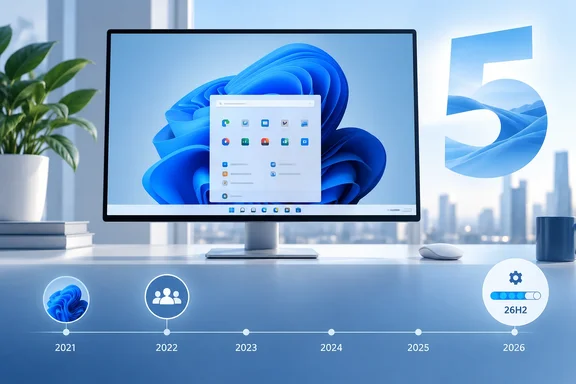
Two separate events
The anniversary. Microsoft's launch post went up on October 4, 2021. It said availability would begin as the date became October 5 in each time zone. Availability came through a free upgrade on eligible Windows 10 PCs (the cite below confirms the launch details), and Windows 11 has been on the market since October 5, 2021. The anniversary marks public availability, not the announcement date.
The billion-user milestone. This was not announced for the anniversary. Satya Nadella said it on Microsoft's fiscal Q2 2026 earnings call. His words: "Windows reached a big milestone, 1 billion Windows 11 users. Up over 45 percent year-over-year." Windows Central reported the news on 29 January 2026. The anniversary coverage is a retrospective on a figure that is already about eight months old.
How it compares with Windows 10
Press coverage puts the Windows 11 milestone at 1,576 days against 1,706 for Windows 10. That is a gap of roughly 130 days. Heise's version of the comparison reads 150 days, so even the published math is inconsistent.
Treat the day counts with care:
- Windows 10 used a different metric. On March 16, 2020, Microsoft said over one billion people... more precisely, that it had passed one billion monthly active devices. Windows 11's claim is phrased as "users". Microsoft has not defined how it counts those users, so the figures may not be like for like.
- The day counts are secondary calculations. Microsoft's announcements give the milestone and launch dates. The tallies come from outlets. Heise noted that Nadella omitted these details when he mentioned the billion mark.
- Windows 10 started with a goal. Windows Central notes that Windows 10 famously failed to reach that goal in the timeframe Microsoft set out. That makes the comparison a bit awkward as a race.
The safe reading is that Windows 11 got there sooner by the commonly reported estimates. It is not a precisely audited record.
Why growth sped up: plausible, not proven
Many outlets credit the end of Windows 10 support. XDA says the surge was likely driven by Windows 10 end-of-life, business upgrades, and holiday PC purchases. It also admits that it's impossible to tell for sure what caused this.
That matches Microsoft's own forward guidance on the same call. The company said Windows OEM growth would be affected as the benefit from Windows 10 end of support normalizes. Treat that as the company acknowledging a migration tailwind. It is not an official explanation of the user count. Nothing in the earnings remarks credits AI features for the growth either.
Counter-arguments to keep in mind:
- Third-party usage trackers have sometimes shown a different picture. Our own forum discussion noted some measurements indicated a resurgence of Windows 10 use around the end of support, partly because of extended security updates and PCs that could not upgrade.
- A billion users includes many people who were moved by hardware refreshes or end-of-support deadlines, not necessarily by enthusiasm.
Windows 11 26H2: the operational news
The real change for admins this week is the new version. Microsoft's release-health page says Windows 11, version 26H2 has reached general availability as of September 29, 2026. It carries the features announced for 25H2 and 24H2. It installs using servicing technology, so the process is fast, with a single restart. The rollout is phased. It is offered first on eligible 25H2 and 24H2 devices with the "Get the latest updates as soon as they're available" setting turned on.
Lifecycle facts from Microsoft's release information page:
- 26H2: available 2026-09-29, build 26300.9550, supported to 2028-10-10 for Home and Pro editions and to 2029-10-09 for Enterprise and Education.
- 26H1: a separate version, available since 2026-02-10. Microsoft says it is for new devices and is not offered as an in-place update from 24H2 or 25H2.
- Hotpatching: not available on 26H1.
So "the annual update" is not a single upgrade path for every PC. Check which branch a device sits on before planning.
Known issues to watch
Microsoft's 26H2 page lists open problems, which is worth knowing before a broad rollout:
- AC-3 audio decoding: some applications that need Dolby Digital decoding might close unexpectedly. The status is confirmed, with a fix planned. It is more likely in legacy apps, and Microsoft says many modern apps ship their own decoders.
- Domain trust failures: Credential Guard-protected machines might lose their trust relationship with the domain. Microsoft ties this to Machine Identity Isolation, which is only supported with Windows Server 2025 domain functional level and above. Devices configured for it without that environment need it disabled via Intune, group policy or the registry.
- Black screen after sign-in: observed mainly on Azure Virtual Desktop hosts using FSLogix. The workarounds are launching explorer.exe manually through Task Manager or applying a Known Issue Rollback group policy.
- USB Audio Class 1.0 devices: some may show a Code 10 error or produce no sound.
These are Microsoft's statements as of the page's latest update, and statuses may change.
Five years in perspective
The 2021 launch post pitched Windows 11 as a redesign. It emphasized a centered Start menu, Snap Layouts, Widgets, a new Microsoft Store, gaming features such as Auto HDR and DirectStorage, and a hybrid-work angle. Microsoft's current messaging leans on AI and Copilot+ PCs. The evidence here does not measure how much of the user base uses those AI features, so the billion figure should not be read as an AI success story.
Bottom line
- Windows 11 reached its fifth anniversary on October 5, 2026.
- Microsoft announced one billion Windows 11 users earlier, on its fiscal Q2 2026 call, with growth above 45% year over year.
- The "faster than Windows 10" claim rests on reported day counts and on a loosely comparable metric.
- The Windows 10 end-of-support effect is plausible but not officially quantified.
- For IT teams, the actionable item is 26H2 and its known issues, not the anniversary.
References
- Windows 11 Celebrates 5 Years With a Over 1 Billion User Milestone Windows Report · 2026-10-05T14:31:34+00:00
- Windows 11 reaches one billion users 150 days earlier than Windows 10 heise.de
- Windows 11, version 26H2 known issues and notifications | Microsoft Learn learn.microsoft.com