

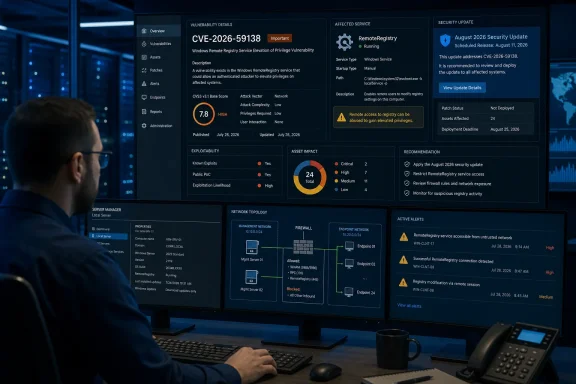
RemoteRegistry is enabled for management or assessment tooling and make sure they receive the applicable August security update; the advisory’s short title alone does not establish that every Windows endpoint is exposed.Microsoft’s entry was published at 7:00 a.m. Pacific time on August 11. As of this writing, the company has provided the vulnerability name and impact category but has not published separate technical guidance explaining the malformed request, the required access level, affected Windows versions, CVSS score, exploitability assessment, or whether it has observed exploitation. Searches of the National Vulnerability Database and CVE.org did not yet return an indexed public record for the identifier, and no independent technical analysis or proof of concept has surfaced.
That absence is significant for a vulnerability that names a network-facing Windows management service. It means defenders should resist filling the gaps with assumptions—particularly the common assumption that a Remote Registry flaw must be either unauthenticated or confined to old servers. Microsoft has disclosed neither point.
The exposed service is narrower than the Windows installed base
Remote Registry, whose service name is RemoteRegistry, enables remote users and management tools to connect to and modify a computer’s registry. It is a real dependency in some enterprise workflows: inventory systems, assessment tooling, older management platforms, and some support processes may use it. Microsoft’s own documentation notes that RegConnectRegistry requires the Remote Registry service to be running on the target computer.
But “installed” and “reachable” are different states. The service can be present while stopped, configured for manual or trigger start, blocked by host firewall policy, or reachable only from administration subnets. Microsoft also documents that the service is designed to stop after ten minutes of idleness in at least some supported Windows configurations.
Remote Registry access is also subject to authorization controls. Microsoft’s Remote Registry Protocol documentation says that, on modern Windows and Windows Server releases, remote registry access is restricted to members of the local Administrators group by default. That is important operational context, but it does not prove that CVE-2026-59138 requires administrator authentication. A denial-of-service bug can occur before authorization, during protocol handling, or after a session has been established. Microsoft has not said which condition applies here.
The sensible conclusion is narrower: organizations that have intentionally enabled Remote Registry and permit network paths to it should prioritize the update and confirm their exposure. A Windows workstation fleet with the service disabled or inaccessible from untrusted networks is not automatically in the same risk category as a server management segment where Remote Registry is routinely used.
Microsoft has not disclosed the failure mode
The submitted advisory information includes explanatory text about exploit-code maturity and confidence in vulnerability details, but it does not include the actual maturity rating or any corresponding technical assessment. That text is a description of a scoring concept, not evidence that exploit code is public, that attacks are under way, or that Microsoft has validated a particular attack path.
This distinction is easy to lose on Patch Tuesday, when a terse vulnerability title gets converted into scanner alerts and dashboard severity colors within hours. The public record currently supports only these points:
- Microsoft has assigned CVE-2026-59138 to a denial-of-service vulnerability involving the Remote Registry service.
- Microsoft published the advisory on August 11, 2026, as part of its monthly security release.
- Microsoft has not publicly described the affected builds, attack complexity, privileges required, network prerequisites, or a workaround specific to this CVE.
- No independent outlet has yet published technical reproduction steps, exploit analysis, or evidence of exploitation.
That makes the operational impact uncertain. The word “denial of service” can cover anything from a service process that needs restarting to a system crash, memory exhaustion, or a condition that repeatedly disrupts remote administration. It may affect only the Remote Registry function, or it may impair broader management activity on a machine. Until Microsoft adds details, treating the title as proof of a remotely crashable Windows host would overstate the record.
There is useful historical context, but it should not be mistaken for a diagnosis. Microsoft has previously documented a non-security Remote Registry memory-leak issue that could eventually hang a Windows system after paged-pool memory consumption rose over time. That older issue was attributed to Endpoint Mapper logic and was fixed in Windows 10. It does not establish the root cause, exploitability, or remediation behavior of CVE-2026-59138.
What administrators should check today
Start with configuration, not speculation. Inventory whether the service is active across servers and endpoints, then correlate that inventory with the products and builds Microsoft eventually lists in the Security Update Guide.
On an individual machine, administrators can check the current service state and startup configuration with:
Get-Service -Name RemoteRegistry
sc.exe qc RemoteRegistry
At enterprise scale, prioritize systems that fall into three groups: Windows servers in management networks, endpoints running inventory or assessment agents that rely on remote registry access, and machines where firewall rules permit Remote Registry-related traffic from broad internal ranges. The relevant question is not simply whether the service appears in services.msc; it is whether a client can reach a running service across the network.
Apply the relevant August 2026 cumulative update through the organization’s normal Windows Update, Windows Server Update Services, Microsoft Configuration Manager, Intune, or third-party patch-management workflow. Because Microsoft has not yet published the affected-product table in an easily indexed public record, do not close the alert solely because an endpoint received an August update: verify that the installed KB applies to that device’s Windows release once the Security Update Guide lists the deployment mapping.
Organizations that do not require Remote Registry should review whether it is enabled and exposed more broadly than intended. Disabling a service merely to avoid a newly disclosed CVE can break tooling and support processes, so this is a change-control decision rather than a universal emergency workaround. Segmenting administrative protocols, limiting Remote Registry access to known management hosts, and removing obsolete dependencies remain sound controls regardless of the eventual CVSS vector.
The missing details affect patch priority
CVE-2026-59138 should enter the August patch queue now, especially for managed servers where Remote Registry is deliberately available. It does not yet justify declaring an enterprise-wide emergency on the facts Microsoft has published.
The key missing field is the attack precondition. If Microsoft later says exploitation requires authenticated administrative access, the practical exposure will center on trusted management networks and post-compromise disruption. If the flaw can be triggered before authentication by a network-adjacent attacker, the priority changes sharply for systems with permissive internal firewall rules or exposed administration services.
For now, the concrete consequence is straightforward: patch Remote Registry-enabled Windows systems first, preserve their management dependencies, and do not confuse an incomplete advisory with evidence of active exploitation or universal exposure.