
The record appeared at 7:00 a.m. Pacific time on Tuesday, August 11, coinciding with Microsoft’s monthly security release. Microsoft’s Windows 11 servicing documentation confirms that new August cumulative updates are available for the supported client branches: KB5121000 for Windows 11 version 26H1, KB5121003 for Windows 11 versions 25H2 and 24H2, and KB5120240 for Windows 11 version 23H2. Each directs administrators to the August Security Update Guide for the security fixes included in the package.
That establishes the important point: this is a patched Windows security issue, not an unpatched advisory awaiting a future release. It does not, however, establish which individual Windows editions and server releases CVE-2026-61933 affects. Microsoft has not exposed that detail in the material presently available for this CVE.
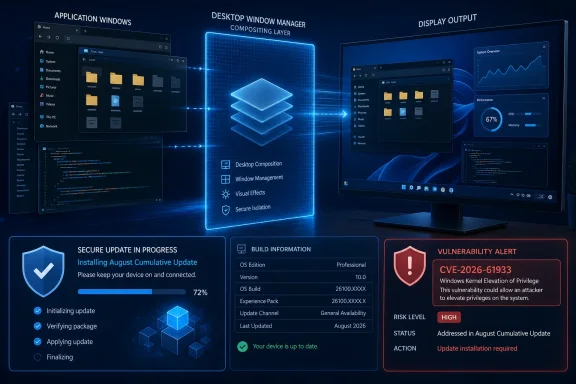 The DWM component makes this a desktop exposure
Desktop Window Manager, commonly seen as dwm.exe, is the Windows compositor responsible for drawing and combining application windows, the desktop, visual effects, and display output. It is a core part of the interactive Windows session rather than an optional application most organizations can disable or remove.
That gives CVE-2026-61933 a broad potential footprint across interactive Windows installations if Microsoft’s eventual affected-product list spans the normal supported client branches. It also means the usual mitigation advice for a network-facing service vulnerability does not apply: there is no DWM port to block, no service account to rotate, and no meaningful configuration switch that removes the component from a standard graphical Windows desktop.
For a Windows endpoint to be at risk, an attacker would generally need a route to execute code or operate locally in the affected user session. That could be a malicious application, a compromised standard-user account, a browser-to-code execution chain, a remote-access foothold, or another vulnerability used as the first stage of an intrusion. Information-disclosure flaws often serve that post-compromise role: exposing data that helps an attacker defeat randomization, discover sensitive material, or make a later privilege-escalation exploit more reliable.
Microsoft has not said that CVE-2026-61933 discloses heap memory, addresses, graphics buffers, window contents, credentials, or any other specific data category. Administrators should not fill in that blank from the generic “information disclosure” label. The label describes the security outcome, not the mechanism or the value of the information an attacker could obtain.
Microsoft’s record is unusually thin for practical prioritization
The supplied MSRC entry contains generic explanatory text for the CVSS report confidence metric. That text explains why confirmed vendor findings deserve attention and why public technical details can change an attacker’s opportunity. But the metric definition is not a vulnerability analysis, and it does not disclose whether Microsoft has observed exploitation, whether proof-of-concept code exists, or whether the issue was publicly known before August 11.
Those distinctions matter. A locally exploitable information leak with no public disclosure and no known exploitation belongs in the ordinary monthly patching queue, subject to an organization’s endpoint risk model. A flaw already used in attacks, or one with a readily reproducible public proof of concept, deserves a different deployment order even when its base CVSS number is modest.
Microsoft’s current public material for CVE-2026-61933 does not provide that distinction. No independent security outlet had published technical reporting on this specific CVE by the time of this review, and searches of the CVE and NVD public records did not surface an independently indexed entry for it. That is not evidence that the vulnerability is minor or that it lacks a CVSS score; it is evidence that the vulnerability’s public metadata has not yet caught up with Microsoft’s Patch Tuesday publication.
This is a recurring administrative problem with same-day patch triage. The Security Update Guide is the primary record, but the surrounding data consumers depend on—NVD enrichment, third-party vulnerability platforms, scanner content, and independent analysis—often arrive later. Organizations should use Microsoft’s advisory and the released cumulative update as the source of truth for remediation, while treating severity dashboards that do not yet list the CVE as incomplete rather than reassuring.
August’s cumulative packages are the practical remediation path
Microsoft’s release notes identify the following August 11 Windows 11 packages as currently available:
- Windows 11 version 26H1 receives KB5121000, advancing the release to OS Build 28000.2704.
- Windows 11 versions 25H2 and 24H2 receive KB5121003, advancing both branches to OS Builds 26200.9168 and 26100.9168 respectively.
- Windows 11 version 23H2 receives KB5120240, advancing the branch to OS Build 22631.7517.
These are cumulative updates. A system already current through July does not need a special standalone fix for CVE-2026-61933; it needs the August security cumulative update appropriate to its branch and architecture. Microsoft says the Windows 11 packages are available through Windows Update, Windows Update for Business, Windows Server Update Services, and the Microsoft Update Catalog.
For managed estates, the practical deployment sequence remains familiar: validate the August update against the hardware and software mix represented by the pilot ring, install it on a controlled group of user endpoints, then expand. The fact that Microsoft’s release notes list no currently known issues is useful, but it is not a substitute for testing. “No known issues” means Microsoft had not identified a broad regression at the time of publication; it does not guarantee compatibility with an organization’s endpoint security agent, custom display driver, virtual desktop configuration, kiosk image, or graphics-heavy line-of-business software.
There is one deployment detail that deserves special attention for teams maintaining Windows installation media. Microsoft’s August Windows 11 notes say dynamic-update deployments must include the matching boot.stl file in installation media. Omitting it can prevent a device from booting that media and produce error 0xc0430001. That is not specific to CVE-2026-61933, but it is relevant to administrators who intend to remediate bare-metal or offline systems by refreshing images rather than applying the cumulative update to an existing installation.
Do not confuse an information leak with a remote compromise
The CVE title does not describe remote code execution, a security-feature bypass, or elevation of privilege. It describes an information-disclosure flaw in a local desktop subsystem. That normally changes the order of operations, not the decision to patch.
Internet-facing Windows servers, domain controllers, exposed VPN appliances, email systems, and remote-code-execution issues with active exploitation should still take precedence where they exist in the same month’s release. But organizations should not defer the DWM fix indefinitely on the theory that it is “only” a disclosure bug. Endpoint compromises increasingly rely on chains: one weakness provides access, another provides information, and a third supplies the privilege or execution capability needed to reach high-value assets.
The sensible classification today is a standard Windows endpoint security update with incomplete public technical context. Apply the August cumulative update on the normal accelerated schedule for managed desktops, prioritize machines used by administrators, developers, finance staff, help-desk personnel, and employees with access to sensitive browser sessions or privileged management tools, and record the installed KB and build number for audit purposes.
What Microsoft still needs to clarify
The omission worth watching is not whether a patch exists. Microsoft’s August Windows cumulative-update documentation makes clear that the security release is live. The missing information is whether CVE-2026-61933 affects Windows 10, Windows Server, particular Windows 11 branches, or only a narrower set of builds; what the CVSS vector and severity are; whether exploitation is assessed as more or less likely; and whether Microsoft knows of public disclosure or active exploitation.
Those fields often appear as the Security Update Guide record matures or as the CVE moves through the broader vulnerability databases. Until then, security teams should resist assigning a severity from earlier DWM vulnerabilities. Windows DWM Core Library has had both information-disclosure and privilege-escalation defects across multiple Patch Tuesday cycles, with different attack conditions and consequences. CVE-2026-61933 must be evaluated on its own published vector and affected-product data once Microsoft provides it.
For now, the concrete milestone is deployment: Windows 11 26H1 systems should be at Build 28000.2704 after KB5121000, Windows 11 25H2 and 24H2 systems at Builds 26200.9168 or 26100.9168 after KB5121003, and Windows 11 23H2 systems at Build 22631.7517 after KB5120240. That is the defensible remediation state while the rest of CVE-2026-61933’s technical record catches up.
