

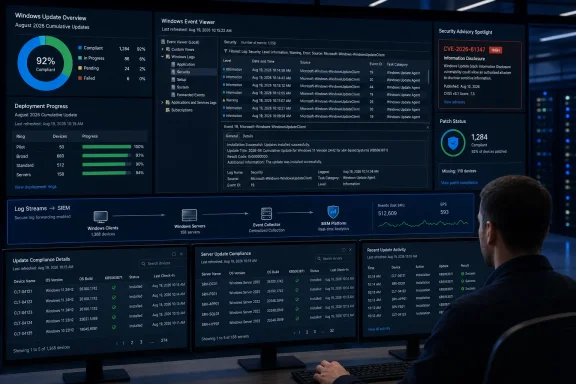
The important limitation is just as clear. Microsoft’s advisory identifies the affected component and vulnerability class, but the public record available at publication does not provide the technical conditions required to turn this into a targeted exposure assessment: no attack scenario, affected build list, CVSS vector, update KB mapping, workaround, or mitigation guidance has been published in the advisory material reviewed for this report. The National Vulnerability Database and CVE.org also did not provide a publicly usable corresponding record when this article was prepared.
That leaves CVE-2026-61347 as a patch-management item, not a threat-hunting emergency with a known indicator or a configuration switch that can be safely recommended.
What Microsoft has actually disclosed
Microsoft’s Security Update Guide lists CVE-2026-61347 as Windows Event Logging Service Information Disclosure Vulnerability, released on August 11. Information disclosure means successful exploitation could expose data that should remain inaccessible; it does not, by itself, mean the attacker can alter data, execute code, or gain administrative rights.
The distinction is operationally significant. Windows Event Log is foundational infrastructure: Event Viewer, Windows Event Forwarding, endpoint-security products, SIEM collectors, management tools, and many troubleshooting workflows ultimately rely on the Event Log service or its data. A vulnerability in that area could concern the confidentiality of event information, memory contents, or another protected resource associated with event-processing operations. Microsoft has not said which of those possibilities applies here.
Administrators should resist filling that gap with assumptions. “Windows Event Logging Service” does not establish that the bug is remotely reachable, that it affects Windows Event Forwarding, that it can be triggered by an event producer, or that it leaks Security log records. Those may be reasonable questions to investigate once Microsoft publishes an exploitability assessment or technical detail, but they are not facts established by CVE-2026-61347’s current public entry.
Microsoft’s advisory does confirm the vulnerability’s existence through its own Security Update Guide publication. It does not identify public exploitation or public disclosure in the material presently available.
The missing affected-product list is the immediate administrative problem
A typical Windows security advisory ties a CVE to specific monthly cumulative updates and supported product versions. That mapping is what lets an organization determine whether Windows 11 workstations, Windows Server systems, legacy Windows 10 estates, Azure Edition servers, or a more limited product set require remediation.
For CVE-2026-61347, that mapping was not exposed in the public advisory material available at the time of publication. That omission prevents a precise statement such as “patch Windows Server 2025 but not Windows 11 25H2,” and it prevents security teams from writing a reliable one-off detection query based only on the CVE identifier.
The conservative response is to treat this as an August Windows servicing issue across supported Windows inventory until Microsoft supplies the affected-product table. Organizations should use their endpoint-management platform to identify devices missing the August 11 cumulative update for their respective release branch, rather than searching only for a separate standalone KB associated with this CVE. On modern Windows releases, a single cumulative update commonly addresses many CVEs together; the absence of a unique KB reference does not mean there is no fix.
This is also why vulnerability scanners may lag. Some products ingest Microsoft’s advisory metadata before the vendor has completed product-to-KB associations, CPE mappings, or supersedence logic. A scanner showing no result for CVE-2026-61347 on release day should not be treated as proof that a device is unaffected. Conversely, a scanner association without a Microsoft product/build mapping should be validated against the installed cumulative update, not accepted blindly.
Event Logging’s role makes patch verification more valuable than service workarounds
The Windows Event Log service is not a peripheral component that administrators can casually disable while waiting for more details. It underpins local event channels, the Event Viewer experience, event subscriptions, auditing, and the telemetry pipeline used by security and operations teams. Disabling or disrupting it can create an operational blind spot precisely when teams need evidence of malicious activity.
Microsoft has not published a workaround for CVE-2026-61347. In the absence of one, administrators should not disable Windows Event Log, turn off auditing, or broadly stop Windows Event Forwarding in an attempt to reduce risk. Such measures would impose visible security and troubleshooting costs without evidence that they address the vulnerability.
The practical containment control remains prompt update deployment. For organizations that stagger patches, CVE-2026-61347 alone does not presently support an evidence-based claim that every deployment ring must be bypassed. There is no published active-exploitation notice, no public proof of concept, and no disclosed attack vector in the advisory material reviewed here. But systems that are already in the expedited security-patching tier—domain controllers, jump hosts, management servers, remote-access infrastructure, and devices carrying sensitive operational data—should receive the applicable August cumulative update on their normal accelerated timetable.
A sound verification process includes more than checking whether Windows Update reports success:
- Confirm the device has installed the August 11, 2026 cumulative update appropriate to its Windows release and servicing channel.
- Reboot systems where the update requires it, because a downloaded or staged cumulative update does not necessarily replace vulnerable binaries.
- Confirm the post-update OS build in endpoint-management reporting or locally with
winver,systeminfo, or the installed-update inventory. - Watch Event Viewer and centralized telemetry after deployment for unexpected Event Log service failures, subscription interruptions, or agent ingestion problems.
That last point is routine release hygiene, not evidence of an expected defect. Microsoft has not announced a known issue involving the Event Logging Service fix.
Do not confuse disclosure risk with log tampering
The name of this CVE invites an understandable but incorrect leap: that attackers can rewrite Security events, erase evidence, or forge audit records. Microsoft has categorized CVE-2026-61347 as an information-disclosure vulnerability, not an integrity or elevation-of-privilege issue. Based on the classification alone, it should not be described as a log-wiping or log-tampering flaw.
That does not make the issue trivial. Event data can be sensitive. Depending on configured auditing and the log channel involved, Windows logs may contain usernames, workstation names, process paths, command-line arguments, IP addresses, task and service activity, access attempts, application errors, and operational details that help an attacker map an environment. The actual confidentiality impact of CVE-2026-61347 remains unknown because Microsoft has not disclosed what information could be revealed or under what access conditions.
The better security posture is to keep ordinary log-protection controls in place: restrict access to event channels, secure event collectors, limit privileged administration, preserve centralized copies of high-value logs, and avoid placing credentials or secrets in scripts and application error output. Those controls reduce the sensitivity of what an attacker might learn from many kinds of local or remote information exposure. They should not, however, be presented as a substitute for applying Microsoft’s update.
The publication gap should influence communications, not patch urgency
There is no independent technical reporting on CVE-2026-61347 available at the time of publication beyond Microsoft’s disclosure, and no technical advisory has surfaced describing exploitation, proof-of-concept code, vulnerable builds, or attack prerequisites. That is normal on Patch Tuesday, when CVE records can appear before scanners, third-party databases, and security researchers have processed the underlying fixes.
It also means internal security communications should be precise. Tell stakeholders that Microsoft has released a fix for an information-disclosure issue affecting the Windows Event Logging Service, that the affected-product scope has not yet been made publicly clear in the advisory material, and that the organization is deploying the August cumulative updates. Do not label it a zero-day, an actively exploited flaw, a remote log-exfiltration vulnerability, or a privilege-escalation route without evidence.
For now, CVE-2026-61347 belongs in the August patch deployment and compliance queue. The concrete test is whether every supported Windows device in scope receives and reports the applicable August 11 cumulative update—not whether an organization can yet construct a detailed exploit narrative from a CVE record Microsoft has only begun to populate.