

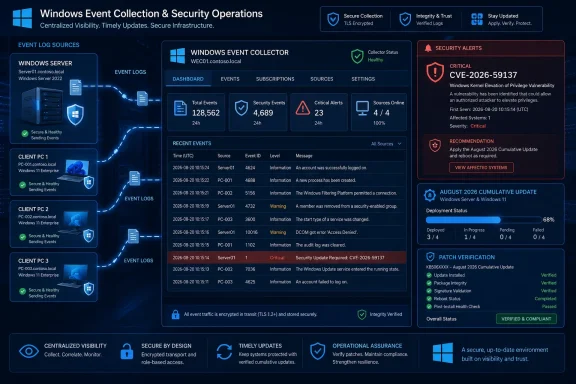
Microsoft’s Security Update Guide identifies the affected component as the Windows Event Logging Service and categorizes the impact as information disclosure. The entry was published at 7:00 a.m. Pacific time on August 11, coinciding with the regular Patch Tuesday release. Microsoft’s August release notes, as reflected in early administrator reporting on the r/sysadmin Patch Tuesday thread, contain 421 Microsoft CVEs overall, 236 of them in Windows. CVE-2026-59137 is one of those Windows fixes, rather than a standalone advisory or an out-of-band emergency release.
What Microsoft has not yet made public is just as important: the advisory’s searchable public material does not establish a CVSS score, attack vector, privileges required, user-interaction requirement, affected Windows versions, update KB mapping, exploitability assessment, workaround, or acknowledgement of a reporting researcher. No independent outlet appears to have published technical analysis of CVE-2026-59137 as of August 11.
The EventLog Service Is an Uncomfortable Place for a Disclosure Bug
Windows Event Log is an always-installed, automatic-start service named EventLog. Microsoft documents it as the component responsible for logging, querying, subscribing to, archiving, and managing event metadata. The service underpins Event Viewer, Get-WinEvent, Windows Event Forwarding, remote-event-log administration, many endpoint detection products, and a great deal of troubleshooting performed by Windows administrators.
Those roles make the vague label “information disclosure” unusually broad. Event data can include usernames, security identifiers, process command lines, hostnames, scheduled-task activity, service state, policy failures, application errors, and authentication events. The service’s normal authorization design is intended to differentiate who may read, write, or clear particular logs; Microsoft’s own Group Policy guidance notes that access rights can be set separately for individual logs, while writing to the Security log is specially restricted.
That does not mean CVE-2026-59137 exposes Security event records, enables unauthenticated log theft, or bypasses configured Event Log permissions. Microsoft has not said any of those things, and administrators should not fill the gap with worst-case assumptions. But the component’s role means that a disclosure weakness deserves more attention than the generic severity label alone might suggest, especially in environments where centralized monitoring turns endpoint logs into a rich source of operational and identity data.
Microsoft Has Confirmed the Fix, Not the Exposure Boundary
The published advisory currently supplies the CVE identifier, component, impact category, and release date. It does not explain the vulnerability’s root cause or identify the data an attacker could obtain. It also does not state whether exploitation requires local code execution, an authenticated user, a remote Event Log Management connection, a malicious event provider, access to an .evtx file, or some other condition.
This absence changes what organizations can responsibly conclude today. A security team can say that an unpatched Windows system contains a Microsoft-confirmed information-disclosure flaw in EventLog. It cannot yet credibly say whether its externally reachable servers, help-desk workstations, developer endpoints, domain controllers, or Event Collector servers face materially different exposure from this single CVE.
The distinction matters operationally. Many EventLog vulnerabilities have been local issues where an attacker already needs a foothold; others could involve interfaces used for remote query and collection. Microsoft supports remote access to event logs and documents Get-WinEvent use against remote computers, subject to firewall configuration and appropriate credentials. Until the advisory supplies an attack vector, changing remote Event Log Management firewall rules solely for CVE-2026-59137 would be speculative rather than evidence-driven.
Patch First, Then Prove Coverage
For enterprises, the right response is to treat CVE-2026-59137 as a cumulative-update compliance item, not as a reason to disable EventLog or broadly alter event-log permissions. Microsoft explicitly warns that stopping the Event Log service can compromise system security and reliability; it is deeply tied to the logging and diagnostic functions administrators need during incident response.
Prioritize patch verification on systems that aggregate, expose, or retain sensitive event data:
- Windows Event Collector servers and systems using Windows Event Forwarding should be included in the first deployment ring because they handle event data from many endpoints.
- Domain controllers, jump hosts, management servers, and SIEM connector hosts should be checked early because their logs commonly contain higher-value authentication and administrative records.
- Endpoints used by privileged IT staff should receive the normal expedited Patch Tuesday treatment, since locally accessible diagnostic data can still be valuable after compromise.
- Windows systems with remote Event Log Management enabled should be identified, but their configuration should not be changed solely on the basis of an unconfirmed remote attack path.
A useful verification approach is to confirm the August 11 quality update through Windows Update for Business, WSUS, Configuration Manager, or the Microsoft Update Catalog workflow already used in the environment, then validate the resulting operating-system build against Microsoft’s relevant release note. A KB number should not be guessed from the CVE record: Microsoft distributes Windows security fixes through different cumulative packages across supported Windows client, server, LTSC, and architecture combinations.
Organizations should also preserve normal log collection during the rollout. Disabling remote access, clearing logs, or stopping the service in an attempt to “mitigate” a disclosure bug can destroy the very evidence security teams would need if Microsoft later documents a meaningful exploitation path.
A Sparse Advisory Limits Triage, Not the Need to Update
Microsoft’s August Patch Tuesday release is large enough that most managed environments will already be moving Windows cumulative updates through test and production rings. CVE-2026-59137 belongs in that deployment work, but the available evidence does not justify elevating it above Microsoft’s publicly identified actively exploited or publicly disclosed vulnerabilities solely because EventLog is a sensitive component.
The finding worth watching is the advisory’s lack of an explicit affected-product list and exploitability data. Microsoft’s Security Update Guide is normally the primary place administrators use to map a CVE to product versions, builds, KB articles, and known issues. At publication time, the CVE’s visible public footprint is thin enough that automated vulnerability-management tools may recognize the identifier before an analyst can independently establish its practical reach.
That creates a familiar but avoidable reporting problem: scanners may flag a CVE by KB supersedence while administrators have no clear way to explain the risk to change-control boards. The defensible message is narrower. Apply the August 2026 Windows security update, document the systems covered, and do not claim an attack path Microsoft has not disclosed.
If Microsoft later adds a CVSS vector, affected builds, an exploitability assessment, or an acknowledgement, those fields will determine whether CVE-2026-59137 remains a standard cumulative-update item or becomes a targeted hardening priority for systems that expose or centralize Windows event data. For now, patch currency is the concrete control, and disabling Windows Event Log is not.