

Microsoft’s Security Response Center identifies the affected component as the Windows Graphics Kernel and the impact as elevation of privilege. That places the flaw in a security boundary that processes graphics-related work with kernel authority. A successful attack would require a foothold on the machine first; this is not described as a network-exposed, unauthenticated entry point. But local privilege escalation bugs routinely turn a limited user compromise, a malicious attachment execution, or an application sandbox escape into a far more consequential incident.
The submitted MSRC record was published at 7:00 a.m. Pacific time on Tuesday, August 11. As published, the material confirms that Microsoft has assigned and serviced the vulnerability, but it does not provide a technical root cause, proof-of-concept details, a named vulnerable driver path, or a usable severity and exploitability value in the text supplied here. The long explanation about Microsoft’s exploitability metric is generic reference material; it is not itself an exploitability assessment for CVE-2026-61346.
A kernel flaw changes the value of an initial compromise
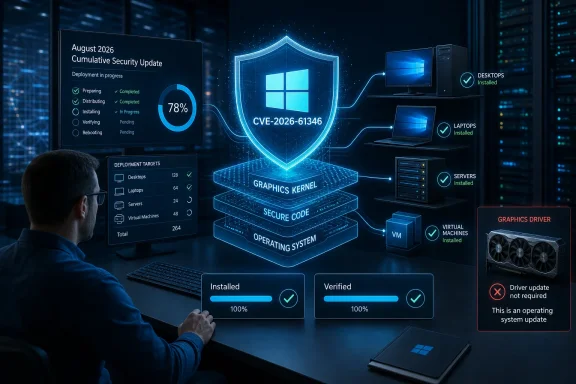
The Graphics Kernel is part of the Windows path that arbitrates graphics operations between applications, the display stack, and the operating system. It is not synonymous with a vendor’s NVIDIA, AMD, or Intel driver package, even though drivers operate alongside the same graphics subsystem. Microsoft’s fix therefore belongs in the operating-system security update process, not in a separate GPU-driver deployment.
Elevation-of-privilege vulnerabilities matter most after another control has already failed. An attacker who has obtained code execution as a standard user — through stolen credentials, a browser or Office exploit, a rogue installer, or a vulnerable local application — may use a kernel flaw to cross into a more privileged security context. The advisory does not say that CVE-2026-61346 grants SYSTEM privileges, and administrators should not invent that detail. It does establish that Microsoft found a path to elevate privileges in a Windows kernel component, which is sufficient reason to treat patching as a priority.
For enterprises that allow developers, contractors, kiosk users, remote-desktop users, or shared workstation users to run software locally, that distinction is operationally important. A local-only bug is less immediately urgent than an internet-facing remote-code-execution flaw, but it can be a high-value second-stage exploit for intruders who are already inside.
Microsoft has confirmed the fix, while the technical record remains thin
Microsoft’s advisory is the primary record for the CVE’s existence and remediation. Its publication means the company has issued a security fix through the August 2026 servicing cycle. Yet the public details currently available in the submitted record leave several questions unanswered:
- Microsoft has not identified the programming error or weakness category behind CVE-2026-61346 in the material supplied with the advisory.
- The supplied record does not state whether exploitation has been detected in the wild or whether the vulnerability was publicly disclosed before patch availability.
- It does not include the exploitability-assessment value, despite reproducing Microsoft’s definition of that metric.
- It does not name a KB article, specific Windows build, or an affected-product list in the text provided.
Those omissions do not make the advisory suspect. Microsoft commonly limits technical disclosure at release time, particularly for kernel vulnerabilities where exact code paths can speed exploit development. They do mean security teams should resist two familiar mistakes: downgrading the issue because no proof of concept is public, or upgrading it to “zero-day” status because the vendor has not shared enough detail.
No independently published technical analysis of CVE-2026-61346 was available in the reporting checked at publication time. In other words, this is currently a vendor-confirmed patch advisory rather than a vulnerability with a documented exploit chain. That is the proper level of confidence for defenders to use in their risk register.
Treat the August cumulative update as the remediation vehicle
Windows servicing does not normally deliver a discrete installer for one Graphics Kernel CVE. The remediation will be incorporated into the relevant August 11 cumulative security update for each supported Windows branch. Organizations using Windows Update for Business, Windows Server Update Services, Microsoft Configuration Manager, or a third-party patch platform should deploy the applicable cumulative update through their ordinary ringed process.
The important check is whether the device has received the August 11, 2026 cumulative security update for its installed release, not whether it reports the newest graphics driver from the PC maker or GPU vendor. Updating only an Intel, AMD, or NVIDIA driver does not establish that the Microsoft Graphics Kernel fix is present. Conversely, a system that has the cumulative Windows update may be remediated even if its separate display-driver package is unchanged.
Administrators should prioritize systems where local execution is common and where compromise would have outsized consequences: privileged-access workstations, shared administrative jump hosts, developer endpoints, virtual desktop pools, terminal servers, and devices used to administer identity or infrastructure services. A graphics-kernel flaw on a domain controller is still a local attack scenario, but servers that accept interactive sign-ins deserve particular scrutiny because they offer attackers a place to chain access with privilege escalation.
Windows 10 and Windows Server estates require an additional support-status check. A device that is outside its normal support lifecycle will not gain protection merely because the August Patch Tuesday release exists; it must be covered by the appropriate servicing program, including Extended Security Updates where applicable. Inventory reports that group machines only by “Windows 10” or “Windows Server” are insufficient. Patch teams need the exact version, edition, servicing channel, architecture, and update installation state.
Verification should focus on build compliance and failed deployments
The usual post-deployment work applies, but it deserves emphasis for a kernel-level fix. Confirm that the monthly cumulative update succeeded, that the device rebooted if required, and that the post-update build number matches the approved August baseline for that Windows release. A device can download an update, stage it, and still remain exposed until installation completes and any required restart is performed.
For managed environments, a sensible response is to separate the work into two tracks:
- Deploy the August cumulative security update first to the normal pilot ring, with special attention to systems running unusual display configurations, remote graphics workloads, virtual GPU stacks, CAD applications, and Remote Desktop Session Host roles.
- Move successful pilots into broad deployment quickly, while investigating update failures, servicing-stack problems, disk-space shortages, and devices held by safeguard or management-policy blocks.
The graphics wording may make teams worry about visual regressions, but the record supplied for CVE-2026-61346 contains no claim that the fix changes graphics features, driver interfaces, gaming performance, or display behavior. Do not defer the patch on the assumption that it requires a bespoke GPU compatibility project. Test the monthly cumulative update as you would any other Windows security release, with extra coverage for graphics-intensive and remotely rendered workloads.
The outstanding question is exploitability, not whether to patch
CVE-2026-61346 should enter the August patch queue as a confirmed Windows kernel elevation-of-privilege fix with limited public technical disclosure. The absence of a published root cause or exploit does not reduce the value of the update; it only limits the precision with which defenders can model an attacker’s path.
Microsoft may amend the advisory as it adds affected-product information, severity scoring, exploitability status, or acknowledgement details. Until then, the decision does not require waiting for those fields: install the applicable August 11 cumulative update, verify the resulting Windows build, and ensure machines that cannot receive current Windows security servicing are identified as an exception rather than quietly left behind.