

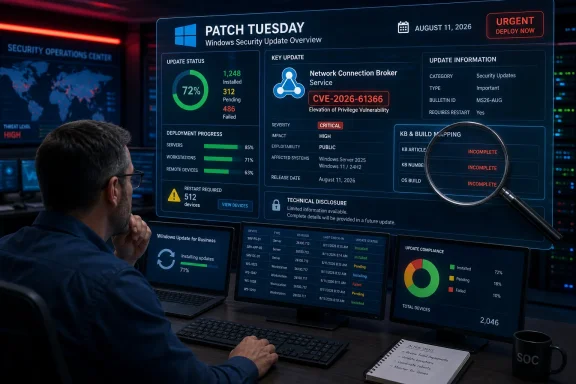
Microsoft’s Security Update Guide lists the issue under the Network Connection Broker component and classifies the impact as elevation of privilege. The advisory was published at 7:00 a.m. Pacific time on August 11 — 14:00 UTC — alongside Patch Tuesday. As of the evening of August 11, neither independent security reporting nor a separately indexed NIST National Vulnerability Database or CVE Program record could be located for this exact identifier.
That absence is meaningful, though not alarming by itself. Microsoft’s monthly disclosure material frequently reaches its own Security Update Guide before external vulnerability databases, scanners, and third-party write-ups have caught up. It means administrators should patch the affected systems, but should not invent an emergency exploitation scenario from the component name alone.
What Microsoft Has Confirmed — and What It Has Not
The confirmed facts are limited: CVE-2026-61366 is a Microsoft-assigned Windows flaw, the affected component is Windows Network Connection Broker, and successful exploitation is described as elevation of privilege. Microsoft’s publication is sufficient confirmation that the vulnerability exists and that a security fix has been released.
The advisory does not publicly spell out the underlying defect class. There is no published statement that the flaw involves memory corruption, an access-control failure, path handling, impersonation, a race condition, or any other common local-escalation mechanism. It also does not say whether an attacker needs an existing standard-user session, whether a sandboxed application can trigger it, or what privilege level an exploit could reach.
Those omissions matter for defenders because “elevation of privilege” covers a wide range of outcomes. Some Windows EoP flaws let a locally authenticated user move from ordinary user rights to a more powerful account context; others become valuable after attackers already obtain code execution through phishing, malicious installers, browser exploitation, or remote-access compromise. A CVE in that category can be an important second-stage tool for intruders without being an initial-access vulnerability.
Microsoft’s advisory page includes the standard explanation of CVSS report-confidence terminology, but that explanatory text is not itself a technical assessment of CVE-2026-61366. It should not be read as proof of public exploit code, active exploitation, or detailed third-party validation.
“Network” in the Product Name Does Not Establish a Remote Attack
The most likely source of confusion here is the component’s name. Windows Network Connection Broker sounds like a network-facing service, but the published vulnerability title does not establish that the flaw can be reached remotely over a network. Microsoft labels the impact as elevation of privilege, not remote code execution.
That distinction is more than semantics for patch triage. A remotely reachable, unauthenticated service flaw can demand accelerated emergency deployment across exposed servers. A local privilege-escalation flaw generally changes the risk calculation: it should still be patched promptly, especially on shared workstations, terminal servers, developer devices, kiosk systems, and systems that routinely execute untrusted content, but it does not automatically justify treating every device as externally exposed.
There is historical precedent for keeping those categories separate. Microsoft fixed a different Network Connection Broker elevation-of-privilege issue, CVE-2020-1526, in August 2020. Microsoft’s description of that older flaw said an attacker first needed execution on the victim system and then used a specially crafted application to elevate privileges. That prior CVE demonstrates that the component has had local-escalation defects before; it does not establish the attack vector, root cause, severity, or exploitation requirements for CVE-2026-61366.
Treating the 2020 advisory as a technical description of the 2026 issue would be a reporting error — and could lead defenders to build detections or compensating controls around conditions Microsoft has not actually identified.
The Missing KB and Build Mapping Is the Operational Problem
Microsoft’s CVE page has not yet provided a clear, public affected-product and remediation matrix for CVE-2026-61366: no named Windows editions, version ranges, cumulative-update KB numbers, build numbers, or standalone package links are visible in the submitted advisory material. That makes it impossible to state responsibly whether the flaw affects Windows 11 24H2, Windows 11 25H2, Windows Server 2025, Windows Server 2022, Windows 10 Extended Security Updates systems, or older LTSC deployments.
For most organizations, the practical answer remains to approve the relevant August 11 cumulative security update for every supported Windows release in scope. Monthly cumulative updates are the normal delivery vehicle for Windows component fixes, and a fully current supported device should receive the correction even before a CVE-to-KB mapping is cleanly exposed in every vulnerability-management console.
Administrators should resist using a missing CVE entry in an endpoint scanner as evidence that a system is not exposed. Vulnerability feeds are downstream consumers of vendor data and can lag on Patch Tuesday, especially when Microsoft’s advisory record is new. A device that has not installed its applicable August cumulative update should be considered unremediated until Microsoft publishes a more precise product mapping.
This is also a case where a software inventory alone is insufficient. Asset teams should verify installed update state — through Windows Update for Business reporting, Windows Autopatch, Microsoft Intune quality-update reports, WSUS, Configuration Manager, endpoint-management tooling, or build-level inventory — rather than waiting for CVE enrichment to populate.
How to Handle CVE-2026-61366 in Change Control
The sensible treatment is “patch in the August security cycle, validate normally, and monitor Microsoft’s record for added detail.” There is no published evidence at this point to support declaring an active emergency, building a one-off workaround, disabling a Windows service, or hunting for a known indicator of compromise tied specifically to CVE-2026-61366.
For organizations with staged deployment rings, this vulnerability belongs in the standard August baseline unless the affected system class carries unusually high local-risk exposure. Shared Windows Server environments, virtual desktop infrastructure, systems with broad local user access, application servers that execute customer-supplied content, and developer workstations are sensible candidates for earlier deployment because local privilege escalation has a clearer payoff in those environments.
A short validation plan is enough:
- Confirm that supported Windows devices receive the applicable August 11, 2026 cumulative security update through the organization’s normal approval channel.
- Track update installation by KB and OS build while Microsoft’s CVE record lacks a final product-to-update mapping.
- Flag Windows devices that are out of support or outside an Extended Security Updates entitlement, because they may not receive the cumulative package containing the fix.
- Recheck Microsoft’s Security Update Guide for revisions, exploitability changes, affected-product additions, acknowledgements, mitigations, or workarounds.
Do Not Let the CVE Number Outrun the Evidence
CVE-2026-61366 is a real Microsoft-published Windows security issue and should be remediated with August’s applicable security update. Beyond that, the public record is currently thin: no technical mechanism, CVSS score, attack vector, exploitation status, workaround, researcher credit, KB mapping, or affected-build list has been established in the material available at publication.
The immediate consequence is a documentation gap, not proof of an undisclosed zero-day campaign. Patch compliance is the control that matters today. Microsoft’s next revision to the advisory should determine whether this remains a routine local-escalation fix in a crowded Patch Tuesday release or becomes an issue that needs a more targeted deployment and detection response.