

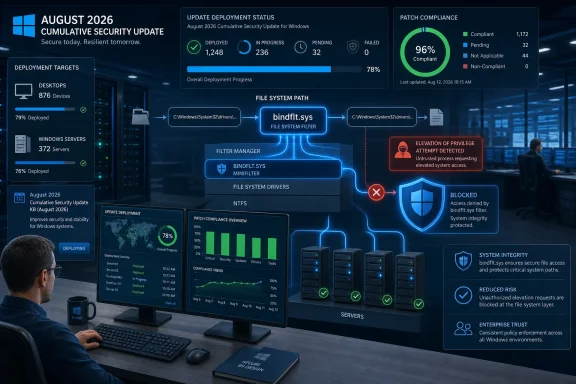
Microsoft’s Security Update Guide is the primary record for this CVE, and the company has confirmed the vulnerability exists. Yet the advisory’s public detail is unusually thin at publication: it identifies the affected Windows component and the impact class, but does not publicly describe the underlying flaw, a vulnerable function, a prerequisite configuration, a proof of concept, or a workaround. Searches of public CVE and NVD records at the time of publication did not yield an independently enriched entry for CVE-2026-61934, and no independent security outlet had published technical analysis of this exact CVE.
That leaves defenders with a clear patching requirement but no sound basis for treating it as an active-exploitation emergency. An elevation-of-privilege bug in a kernel-adjacent file-system component remains important, particularly for shared endpoints and servers where a foothold can be converted into broader control. But Microsoft has not publicly said that CVE-2026-61934 is exploited in the wild, publicly disclosed before patching, or associated with publicly available exploit code.
The Bind Filter Driver Controls File-System Redirection
The vulnerable component is Microsoft’s Bind Filter Driver, implemented as bindflt.sys. It is a file-system minifilter, not a networking bind driver despite the name. Microsoft’s driver documentation lists bindflt.sys at minifilter altitude 409800, placing it high in the file-system filter stack alongside other Windows components that observe or modify path handling.
Microsoft documents the Bindlink API as a mechanism that lets an administrator bind a file-system namespace to a virtual local path through the Bind Filter. The resulting bind links transparently redirect file access from a virtual path to a backing path, which can be local or remote. Applications using the virtual path do not need to know that redirection is taking place.
That capability serves legitimate Windows scenarios: it can make network-hosted content appear local to software that expects a normal local path, or present files from multiple locations as though they occupy a single directory tree. It also means the component sits where path interpretation, access checks, security descriptors, and file operations converge. A security defect there warrants attention because file-system redirection errors can produce outcomes far beyond an application crash.
Still, the component’s role should not be mistaken for an explanation of the vulnerability. Microsoft has not said whether CVE-2026-61934 involves path confusion, authorization checking, race conditions, an I/O control interface, symbolic links, memory safety, or any other specific failure. Treating any of those possibilities as established would be speculation.
“Elevation of Privilege” Means an Existing Foothold Is Usually Assumed
Microsoft categorizes CVE-2026-61934 as elevation of privilege. In practical incident-response terms, that usually means the vulnerability is relevant after an attacker, malicious user, or untrusted application has gained some level of local execution. The advisory does not identify the required starting privilege, attack complexity, or whether user interaction is required, so administrators should avoid reading more into the category than it supplies.
The credible operational concern is the familiar attacker chain: a phishing payload, browser exploit, abused remote-access account, malicious installer, or low-privilege insider establishes code execution; a local privilege-escalation vulnerability then attempts to turn that foothold into administrative or SYSTEM-level control. Once attackers reach that level, they can commonly disable security tooling, alter services and scheduled tasks, extract secrets, and establish persistence that is harder to remove.
This is why local elevation-of-privilege vulnerabilities belong in a regular monthly patch program even when they are not zero-days. Endpoint protection, application control, least-privilege administration, and credential hygiene reduce the chance an attacker gets the first foothold. They do not remove the need to close a privilege-escalation path once Microsoft has shipped a fix.
For organizations operating shared Windows Server systems, virtual desktop infrastructure, developer workstations, jump hosts, and devices used by local administrators, the impact can be more consequential than the label initially suggests. Those are environments where many identities, workloads, or management credentials may be exposed to a compromised local session.
The Public Record Does Not Support a Special Configuration Exception
A notable omission in Microsoft’s public advisory is an explanation of whether an organization must use Bindlink, Windows containers, Windows Sandbox, virtualization features, or any specific deployment configuration to be exposed. Microsoft’s Bindlink documentation says the developer API is available beginning with Windows 11 build 25314, but the presence of a modern Bindlink API does not establish the product scope of CVE-2026-61934.
Administrators should not assume that systems without a known Bindlink-dependent application are safe to defer. bindflt.sys is a Microsoft file-system minifilter, and its presence can be confirmed on a running system through standard filter-driver inventory. Whether the CVE is reachable merely because the driver is installed, only when it is attached to a particular volume, or only through a feature-specific request path remains undisclosed.
The same restraint applies to Windows versions. The advisory title alone does not identify affected builds, editions, or server releases. Microsoft normally maps vulnerability entries to specific security-update deployments in the Security Update Guide, but a title and component name are not a substitute for checking the update applicability for the exact operating-system release in service.
This distinction matters for patch governance. Do not create a separate exception policy based on the driver name, and do not spend time trying to locate a standalone “Bind Filter Driver” hotfix. Windows kernel and file-system fixes are ordinarily delivered through the applicable Windows security cumulative update, with separate servicing only where Microsoft explicitly publishes one.
Patch Through the August 11 Windows Servicing Cycle
CVE-2026-61934 was published at 7:00 AM Pacific Daylight Time on Tuesday, August 11, 2026, as part of Microsoft’s August security release. Microsoft’s August release is broad enough that organizations should use their established update rings rather than trying to isolate one driver-level change from the package.
A sensible response is to prioritize systems where local code execution would carry the greatest consequence: administrative workstations, Remote Desktop Session Hosts, VDI images, build systems, management servers, and servers hosting multiple tenant or user workloads. Validate the cumulative update in a representative ring, watch for file-system, container, virtualization, endpoint-security, and line-of-business application regressions, then advance it through the remaining deployment rings on the organization’s normal emergency timetable.
For Windows 10 systems, the response needs an additional lifecycle check. A device that is no longer receiving the applicable security update through an entitled support channel cannot be made whole by simply confirming that bindflt.sys exists or by applying a third-party driver update. The remedy is the Microsoft-serviced update for the supported OS branch, or a supported migration path where that update is unavailable.
Administrators should also record the installed cumulative-update KB and resulting OS build in their vulnerability-management evidence. Because the CVE is tied to a Windows component rather than a separately versioned application, checking a file version in isolation is weaker evidence than confirming that the appropriate Microsoft security package was successfully installed and the machine rebooted if required.
Confirmation Is Not the Same as Exploitation Evidence
The source material attached to Microsoft’s advisory explains its confidence metric: a vulnerability is considered confirmed when the vendor has verified its existence or sufficient technical evidence supports it. That is significant. CVE-2026-61934 is not a placeholder report awaiting confirmation, and the absence of public proof-of-concept code should not be interpreted as uncertainty over whether a fix is needed.
But confirmed existence and observed exploitation are separate questions. As of August 11, Microsoft has not publicly associated CVE-2026-61934 with active attacks, and no independent technical reporting has established an exploit chain for it. That makes the right posture prompt routine deployment, not unsupported claims that every affected Windows device is under immediate attack.
The unresolved item is Microsoft’s still-limited public detail: affected build scope, exploitability assessment, and any configuration prerequisites will determine whether CVE-2026-61934 becomes a standard cumulative-update entry or a sharper operational priority. Until that record expands, the defensible move is to deploy the August 11, 2026 Windows security update across supported systems and treat any unpatched endpoint with untrusted local code execution as carrying the residual risk Microsoft has now acknowledged.