

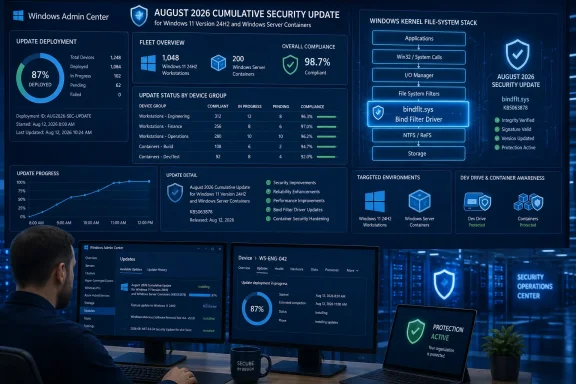
Microsoft’s Security Update Guide identifies the flaw as a Windows Bind Filter Driver elevation-of-privilege vulnerability and lists its publication time as 7:00 a.m. Pacific time, or 14:00 UTC. The advisory is part of the August 2026 Patch Tuesday release. At publication, however, Microsoft had not provided a public technical narrative explaining the underlying bug class, a reproduction path, or a workaround in the material available for this advisory.
That omission changes how this should be triaged. CVE-2026-62705 is an elevation-of-privilege issue, meaning it is relevant after an attacker or untrusted process already has some foothold on a Windows machine. It is not, based on the public record currently available, evidence of a remotely reachable pre-authentication compromise path. But local privilege escalation flaws are frequently what turns a constrained user-level intrusion into control over the operating system, making them important for shared endpoints, developer workstations, virtual desktop environments, and servers where multiple identities or automation jobs run.
BindFlt Is a File-System Component, Not a Network Driver
The name “Bind Filter Driver” can lead readers in the wrong direction. Microsoft’s Windows driver documentation identifies bindflt.sys as the component behind bind links: a mechanism that connects a file-system namespace to a local virtual path. Beginning with Windows 11 version 24H2, Microsoft documented bind links as part of the Bind Filter feature.
In other words, this is a kernel-mode file-system virtualization component. It sits in the file I/O stack, where Windows minifilters can observe, redirect, modify, or block file operations before they reach their target file system. Microsoft’s driver documentation is explicit that such filters operate inside the Windows executive, not as ordinary user-mode utilities.
That privileged position explains why a defect here can carry elevation-of-privilege consequences even when there is no remote attack vector. File-system virtualization has to make security-sensitive decisions about paths, identities, directory contents, reparse points, and how one namespace maps to another. A mistake in that chain can create a mismatch between what a caller is authorized to access and what the kernel-side filter ultimately resolves or operates on.
Microsoft has not said that CVE-2026-62705 involves path traversal, reparse points, a race condition, or an access-check bypass. Administrators should resist filling in that blank from older Bind Filter Driver CVEs or from generic minifilter research. The product label tells us where the flaw lives; it does not establish the exploit mechanism.
Windows 11 24H2 and Container Workloads Deserve Attention
Microsoft’s Bind Filter documentation places the feature in Windows 11 version 24H2 and later. Its Dev Drive guidance also lists bindFlt alongside the Windows Container Isolation Filter, wcifs, as filters needed for Docker scenarios running from a Dev Drive. That does not prove that CVE-2026-62705 is limited to Docker, Dev Drives, or containers. It does show that the driver has a concrete role in modern developer and container-oriented Windows deployments.
The immediate result is a more focused asset question for IT teams: which machines are actually running a Windows build and workload combination that loads BindFlt? A broad inventory can identify Windows 11 24H2-era systems, Windows Server systems used for containers, Dev Drive-enabled engineering endpoints, and devices where Docker or similar tooling is installed. That inventory is useful for validation and rollout priority, but it should not be misread as a substitute for applying the security update across Microsoft’s supported affected products.
On a device, administrators can inspect active file-system filters with the built-in fltmc filters command. Seeing bindFlt confirms that the filter is loaded; not seeing it at one moment does not establish that the machine is immune, because filter attachment and feature use can depend on the volume and workload. Microsoft’s Security Update Guide, rather than a one-time filter listing, remains the record that determines whether a specific Windows product and build is covered by the fix.
There is also no basis to recommend disabling the driver as a mitigation. Microsoft has not published one for CVE-2026-62705, and indiscriminately disabling a file-system virtualization filter can disrupt the features that rely on it. For Dev Drive and container users, the more defensible approach is to test and deploy the cumulative update through the normal servicing channel.
What Microsoft Has Confirmed — and What It Has Not
Microsoft has confirmed the existence of the vulnerability, assigned CVE-2026-62705, classified the impact as elevation of privilege, and released security updates on August 11. Those are sufficient reasons to patch.
The details that would determine urgency within a tightly controlled patch program remain thin in the public advisory material:
- Microsoft has not publicly described the vulnerable function, the required attacker privileges, or the final privilege level available after successful exploitation.
- Microsoft has not published a temporary configuration workaround or a safe method to disable the affected behavior.
- Microsoft has not publicly tied the issue to a specific container runtime, Dev Drive configuration, bind-link consumer, or Windows feature.
- No independent technical analysis or public proof-of-concept for CVE-2026-62705 was available in the reporting checked at publication time.
The absence of those details is not a reason to defer the update. It does mean security teams should avoid assigning an invented exploit story to the CVE. A local attack prerequisite may lower its position relative to an actively exploited remote-code-execution bug, but it does not make the issue routine on machines exposed to untrusted code, users, browser-delivered malware, or developer tooling.
Patch the Operating System, Then Verify the Servicing Result
This vulnerability is addressed through Microsoft’s monthly Windows security servicing. That normally means the August 2026 cumulative update for the installed Windows version, delivered through Windows Update, Windows Update for Business, Windows Server Update Services, Microsoft Configuration Manager, or the Microsoft Update Catalog.
For managed fleets, the correct validation target is the post-update Windows build or successfully installed August cumulative update—not merely the presence of an individual bindflt.sys file. Cumulative servicing updates can carry multiple kernel and file-system fixes, and replacing a single system driver manually is unsupported and can leave the machine in an inconsistent servicing state.
Organizations with container hosts, Dev Drives, endpoint security minifilters, backup filters, encryption products, or other software that attaches to the file-system stack should use their normal pilot ring. The risk worth testing is operational compatibility: filter drivers interact through a stack with defined load orders and altitudes, so a Windows fix in this area can expose latent conflicts in third-party filters. That is a deployment consideration, not evidence that the August update is defective.
For unsupported Windows releases, the situation is less forgiving. If Microsoft’s affected-product table lists a version that has fallen out of standard servicing, the answer is not to search for a standalone Bind Filter Driver package. The answer is to move the device onto a supported servicing path or, where Microsoft offers it, the applicable Extended Security Updates program.
The Immediate Consequence Is a Smaller Patch Queue Than the CVE Name Suggests
CVE-2026-62705 is a kernel-adjacent file-system security fix with incomplete public technical disclosure, not a newly documented public exploit campaign. The strongest conclusion the record supports is also the most useful one: install the August 11 Windows security update on affected systems, prioritize devices that execute untrusted workloads or use modern file-system virtualization features, and do not attempt to “mitigate” the issue by removing bindflt.sys.
Microsoft may add build ranges, CVSS detail, acknowledgements, exploitability assessment, or technical context in a revision to the Security Update Guide. Until then, the operational milestone is the same for every affected machine: reaching the August 2026 cumulative-update build that includes Microsoft’s fix.