

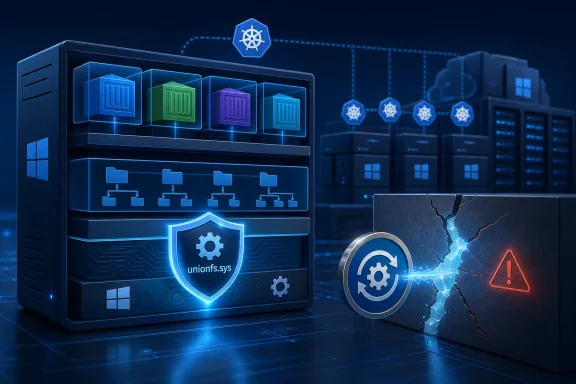
unionfs.sys, as part of the August 11, 2026 security release. The immediate priority is to patch supported Windows container hosts through their applicable August cumulative update, then verify that the update actually reached every host running Windows Server containers, Kubernetes Windows nodes, or local Windows container development workloads.
The Microsoft Security Response Center classifies the issue as a Windows Container Isolation FS Filter Driver elevation-of-privilege flaw. That makes the affected component more consequential than its obscure filename suggests: unionfs.sys sits in the path where Windows presents an isolated filesystem view to a container while the host remains responsible for enforcing the underlying access boundaries.
Microsoft has confirmed the vulnerability and shipped a fix. What it has not yet made clear in the advisory material supplied for CVE-2026-62772 is the underlying weakness, a CVSS score, the affected Windows builds, the required attacker privileges, or whether exploitation has been observed. Searches for independent technical reporting or a public proof of concept produced no corroborating disclosure at publication time. Administrators should therefore treat this as a patch-now local privilege-escalation issue, without inflating it into a confirmed container-escape campaign.
unionfs.sys puts the flaw at a sensitive boundary
A file-system filter driver is not an ordinary application component. Microsoft’s driver documentation describes filter drivers as code that operates within Windows file-system processing, where requests pass through layers of filesystem and security logic. In the container context, the relevant job is to make a container’s files appear separate from the host’s files and from those of other containers.
That filesystem virtualization is fundamental to a Windows container’s operating model. A container image, writable layer, bind mount, volume, registry view, and filesystem namespace may look self-contained from inside the workload, but the host kernel remains the authority that translates and enforces those views. A defect in that path can turn a workload-level foothold into something much more valuable: greater rights on the underlying Windows host.
The CVE title says “elevation of privilege,” not remote code execution. Nothing currently establishes that an unauthenticated network attacker can trigger CVE-2026-62772 directly, or that a malicious container can automatically obtain SYSTEM rights. Those distinctions matter. An elevation-of-privilege flaw normally needs an attacker to already have some form of local execution, such as code running under a low-privilege account, a compromised service, or a process inside a container.
Still, the location of the bug changes the risk calculation for container hosts. A host configured to run workloads from multiple teams, CI/CD systems, build jobs, or tenants has deliberately concentrated trust in the container isolation layer. A local flaw there deserves faster treatment than the same severity label might imply on a single-purpose desktop.
Process-isolated containers are the most important deployment to review
Microsoft distinguishes between process isolation and Hyper-V isolation for Windows containers. Process-isolated containers share the host kernel and also share it with other process-isolated containers. Hyper-V-isolated containers run inside an optimized virtual machine with their own kernel, providing a stronger boundary between the container and its host.
That design distinction does not prove that CVE-2026-62772 affects only process-isolated deployments; Microsoft has not publicly supplied enough technical detail to draw that conclusion. But it does identify where the practical consequences could be greatest. A filesystem isolation defect in a process-isolated container environment is closer to the host kernel and the shared filesystem machinery than the same workload running with Hyper-V isolation.
Microsoft’s own container security guidance is unusually direct on this point: process-isolated Windows containers are not considered a robust security boundary for hostile multi-tenant workloads. The company recommends Hyper-V isolation where workloads are untrusted because each container gets its own kernel and hardware-backed separation from the host.
For administrators, that creates a useful operational split:
- Windows Server hosts using process isolation for production containers should receive the August update on an expedited schedule and be checked for workloads that process untrusted code or customer-supplied artifacts.
- Windows 10 and Windows 11 development systems running Docker Desktop, containerd, or other Windows container tooling should be patched as part of normal August deployment, even if containers are used only intermittently.
- Kubernetes environments with Windows worker nodes should be assessed as host infrastructure, not merely as application servers; a node-level escalation can expose every workload scheduled there.
- Hyper-V isolation remains a worthwhile defense-in-depth measure, but it is not a substitute for installing the security update.
The important point is that a container host is not protected simply because its workloads are “inside containers.” A flaw in the enforcement code beneath those containers is exactly the type of problem the isolation model is supposed to prevent.
Microsoft has not published the details needed for fine-grained triage
The supplied MSRC record establishes the vulnerability’s existence and its component: Windows Container Isolation FS Filter Driver, unionfs.sys. It does not provide the technical information security teams normally use to rank a newly issued CVE against the rest of Patch Tuesday.
There is no disclosed weakness class, such as use-after-free, race condition, integer overflow, or improper access control. There is no public exploitability assessment in the material provided, no identified workaround, no stated attacker prerequisite, no confirmation of public disclosure, and no list of affected product versions or build numbers.
That absence has two practical consequences.
First, do not create a compensating control based on assumptions. Disabling Docker, removing a Kubernetes management tool, or blocking an inbound port may not address a flaw that is reached through local filesystem operations after an attacker has code execution. Conversely, administrators should not assume that a host without an actively running container is safe if the relevant Windows feature and driver are present. Microsoft needs to supply the affected-platform matrix before either conclusion can be made responsibly.
Second, vulnerability-management tools may initially vary in their treatment of the CVE. Microsoft’s advisory was published on August 11, 2026, and public vulnerability databases, scanner plugins, exposure-management platforms, and third-party Patch Tuesday summaries often lag a new MSRC entry. Use the August security update deployment state as the primary control rather than waiting for a scanner to produce a dedicated CVE-2026-62772 finding.
The lack of public exploit mechanics also limits the value of hunting for a signature. There is currently no defensible indicator set tied specifically to this CVE. Broad telemetry for suspicious container activity, unexpected privileged processes, abnormal writes to mounted host paths, and unusual service-account behavior remains sensible, but none of it can be represented as detection for CVE-2026-62772 itself.
Patch the host, then prove which hosts run Windows containers
Microsoft’s monthly cumulative updates are the expected delivery mechanism for this kind of Windows kernel and driver fix. Organizations should deploy the August 11 security update appropriate to each supported Windows release, following their normal Windows Update, Windows Server Update Services, Microsoft Configuration Manager, Intune, or third-party patch-management workflow.
The verification step deserves as much attention as deployment. Container hosts are frequently managed outside the conventional endpoint population: a build server in a separate network segment, an Azure virtual machine used by an engineering team, a Windows node pool in Azure Kubernetes Service, or a lab workstation running Windows containers for image creation. Those are the systems most likely to be missed by a broad “patch all desktops” policy.
Start with an inventory of machines where the Windows Containers feature, Docker Engine, Mirantis Container Runtime, containerd, Kubernetes Windows node services, or developer container tooling is installed. Separate production hosts from developer systems, then identify which production workloads use process isolation and which use Hyper-V isolation. The August cumulative update should be installed on both categories; the distinction helps determine where an unpatched interval carries the most risk.
Where the change-management process requires staging, test the update first on representative Windows container hosts. Validate that existing container images start, volume mounts behave normally, orchestration agents reconnect, and any filesystem-sensitive build or deployment pipelines continue to complete. But avoid treating functional testing as a reason to postpone broadly: the fix addresses a privilege boundary in a kernel-adjacent component.
A narrow advisory with a host-level consequence
CVE-2026-62772 is not a reason to declare every Windows PC exposed to a container escape. Microsoft has confirmed a local elevation-of-privilege vulnerability in a specific container filesystem driver, and the public record currently goes no further. There is no evidence in the available advisory material of active exploitation, a public exploit, or an internet-reachable attack path.
The action is nevertheless straightforward. Apply the August 11, 2026 Windows security update to supported systems, prioritize every machine that can host Windows containers, and use the patch cycle to correct a common blind spot: treating a container host as ordinary infrastructure rather than a shared-kernel security boundary.