

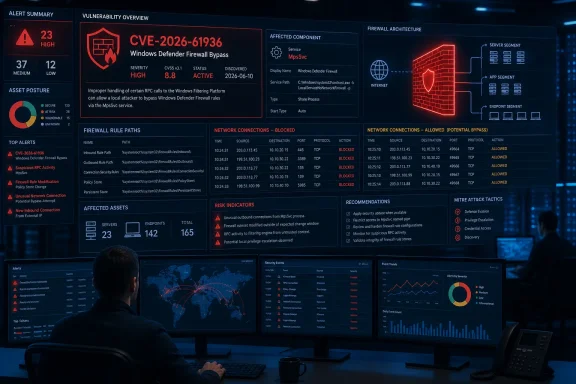
MpsSvc service. The advisory arrived at 7:00 a.m. Pacific time, three hours before Microsoft’s usual 5:00 p.m. UTC Patch Tuesday release window, but the public record presently provides almost none of the operational detail administrators need to judge exposure.That does not make the vulnerability harmless. It means defenders should resist two familiar mistakes: treating a firewall bypass as equivalent to remote code execution, or treating the lack of a public proof of concept as a reason to defer validation. Microsoft has confirmed the existence of the CVE; it has not yet publicly described the affected Windows releases, attack prerequisites, CVSS vector, exploitability assessment, detection guidance, workaround, or the cumulative updates that remediate it.
No independent technical analysis or vendor confirmation beyond Microsoft’s Security Update Guide entry was publicly available at the time of publication. The National Vulnerability Database also did not return an indexed record for CVE-2026-61936 during initial checks. For an advisory released only hours earlier, that may simply reflect publication and indexing lag, but it leaves vulnerability-management teams without the normal second source of product and configuration data.
The affected service sits behind Windows firewall policy
The name matters. This is not a vulnerability in Microsoft Defender Antivirus, Defender for Endpoint, or a third-party firewall product using the Defender brand. It concerns the Windows Defender Firewall service, MpsSvc, which runs inside svchost.exe and is part of the operating system’s local host-firewall enforcement and policy-management path.
Microsoft’s Windows documentation recommends that organizations keep MpsSvc enabled. Stopping it is unsupported and can cause collateral Windows problems, including failures involving the Start menu, modern-app installation or updating, and phone activation. The service therefore exists on systems where the firewall is actively used and also on systems where administrators have delegated network filtering to another security product but retained Windows’ built-in services for compatibility.
The firewall’s practical role is broader than the familiar “allow this app through the firewall” prompt. Windows Defender Firewall applies inbound and outbound rules by profile, program, service, port, protocol, address scope, and, in some configurations, IPsec requirements. Microsoft documents that block rules take precedence over ordinary allow rules, and many organizations use Group Policy or Intune to prevent locally created rules from weakening centrally managed configurations.
A bypass in this area could therefore have different consequences depending on the flaw’s exact mechanism. It might allow traffic that an administrator intended to block; it might undermine restrictions tied to a particular process or Windows service; or it might affect a narrower rule-processing scenario. Microsoft has not said which of those conditions applies to CVE-2026-61936, and administrators should not assume that it disables the firewall wholesale.
“Security feature bypass” defines the impact, not the attack path
Microsoft has classified the issue as a security feature bypass rather than elevation of privilege, remote code execution, information disclosure, or denial of service. That classification is useful but incomplete. It says the reported weakness can defeat a protective control; it does not say whether an unauthenticated network attacker can trigger it, whether local code execution is required first, or whether it is exploitable only after a user or administrator changes a configuration.
Microsoft’s own security-servicing criteria draw a distinction between bypasses of defense-in-depth features and violations of a security boundary. A bypass of an extra mitigation often requires another weakness or an already-compromised device to create direct risk. But Windows Defender Firewall policy is frequently used as an actual access-control layer: to reduce workstation lateral movement, contain server roles, restrict management protocols, and stop unsolicited inbound traffic.
That is the material operational point. In a consumer default configuration, where inbound traffic is generally blocked but outbound access is broadly allowed, the effect may be limited by the machine’s exposed services and network position. In a tightly managed enterprise configuration that uses firewall rules as segmentation controls, the same unknown bypass could matter much more because the policy is expected to prevent a connection, not merely make an attack inconvenient.
Organizations that use the firewall to enforce restricted administration should place the CVE in their August validation queue even before Microsoft provides a severity score. Examples include domain controllers with narrow management allow lists, jump servers configured with blocked outbound traffic, application servers limited to explicit dependency ports, and endpoints where local firewall-rule merging is disabled through Group Policy or Intune.
The missing patch mapping is the immediate management problem
Microsoft’s Security Update Guide is normally the authoritative place to map a CVE to supported products, KB packages, builds, and update channels. For CVE-2026-61936, that map is not yet visible in the material Microsoft has made searchable. That leaves an uncomfortable gap between “a confirmed Windows firewall bypass exists” and “these devices are remediated after installing this update.”
Administrators should not attempt to solve that gap by disabling MpsSvc, resetting firewall policy, or opening broad temporary rules. Microsoft explicitly warns against stopping the service. Resetting a server or endpoint’s policy can also erase carefully deployed local settings and create a larger exposure than the CVE itself.
The correct short-term response is disciplined inventory and change control:
- Confirm which endpoint and server groups rely on Windows Defender Firewall policy as an enforcement control, especially devices governed through Group Policy, Microsoft Intune, or configuration-management baselines.
- Preserve current firewall policy exports and management reports before deploying August updates, so unexpected rule or profile changes can be distinguished from the vulnerability itself.
- Stage the applicable August 11 Windows security updates as soon as Microsoft publishes the CVE-to-KB mapping, beginning with internet-facing Windows servers, management systems, domain controllers, and workloads with restrictive inbound or outbound rules.
- Review firewall logging where it is already enabled for unexpected allowed connections, profile transitions, service-specific rule mismatches, or management ports appearing from unauthorized source ranges.
- Avoid relying on a local firewall as the only containment layer for high-value assets. Network segmentation, service hardening, identity controls, and endpoint detection remain necessary if a host-level policy control is bypassed.
This is also a case where security teams should verify deployment by build and KB, rather than accepting a generic “fully patched” label from an endpoint console. Windows cumulative updates are cumulative within their supported servicing branch, but enterprises commonly have a mixed estate of Windows 11 releases, Windows Server versions, long-term servicing editions, and Windows 10 devices covered by Extended Security Updates. A CVE can apply to only part of that estate.
Microsoft needs to fill in the record quickly
CVE-2026-61936 was published on the same day as Microsoft’s August 2026 security release, which reportedly addresses 421 Microsoft CVEs across its product lines. The timing strongly suggests that a deployment mapping may follow through the Security Update Guide’s release data, but Microsoft has not publicly tied this firewall CVE to a particular KB in the available record.
The absence of exploitation reporting is not evidence that the issue is being used in attacks, and no public proof of concept has surfaced. Equally, there is no basis to call the bypass “low risk” merely because its technical details remain undisclosed. A firewall rule that is redundant in one environment may be the last host-level control protecting a legacy service in another.
For now, CVE-2026-61936 is a confirmed but thinly documented Windows security issue. The immediate task is not emergency configuration changes; it is identifying where Windows Defender Firewall rules carry real security weight, deploying the mapped August update when Microsoft identifies it, and verifying that the rules organizations depend on still enforce the traffic boundaries they were designed to protect.