
That absence is the story. A Winlogon vulnerability is not automatically a remotely exploitable “logon screen bug,” and administrators should not infer one from the component name alone. Microsoft’s advisory identifies an elevation-of-privilege issue, which ordinarily means an attacker needs some form of pre-existing code execution or authenticated access on the machine before using the flaw to cross a Windows security boundary.
Microsoft published the CVE at 7:00 a.m. Pacific time on Tuesday, August 11. At the time of publication, searches of the public CVE and NVD records did not produce an independently enriched entry for CVE-2026-61939, and no independent security research or exploit reporting had surfaced. The MSRC advisory is therefore the only authoritative record currently available for the vulnerability’s existence and classification.
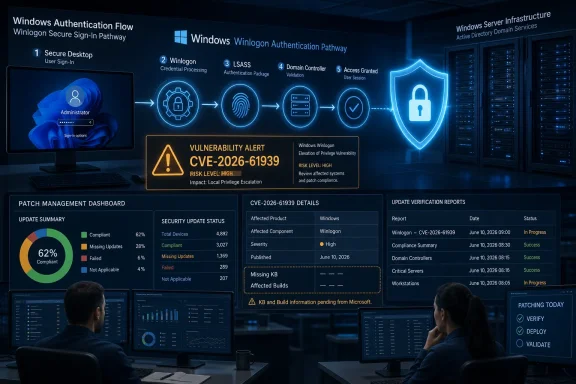 Why Winlogon Deserves Immediate Attention
Winlogon is the Windows process responsible for secure interactive user sessions: it participates in sign-in, sign-out, Ctrl+Alt+Delete handling, the secure desktop, and the handoff of credentials to the Local Security Authority. Microsoft’s Windows authentication documentation makes clear that Winlogon is part of the trusted path between the logon user interface, credential providers, and LSA.
That role gives the component unusual importance in endpoint security. A defect that lets a standard user, a compromised application, or a locally executing attacker obtain higher privileges could turn a contained foothold into administrator or SYSTEM-level control, depending on the vulnerability’s actual mechanics. On a workstation, that can mean defeating least-privilege controls. On shared servers, jump hosts, VDI pools, kiosk systems, and Remote Desktop Session Host deployments, the impact can be multiplied because many users and processes share the same Windows installation.
But the critical fact is what Microsoft has not said. The current disclosure does not establish that CVE-2026-61939 reaches SYSTEM, bypasses the secure desktop, exposes credentials, works through Remote Desktop, affects credential providers, or can be triggered without local access. Those are all materially different scenarios, and none should be treated as confirmed until Microsoft expands the advisory or an independent researcher documents the flaw.
The title alone does establish one practical point: this is a Windows local privilege escalation class of concern, not a reason to expose or shut down remote authentication services preemptively.
Microsoft’s Disclosure Leaves the Patch Mapping Unclear
Microsoft’s Security Update Guide normally serves two jobs at once: it describes the vulnerability and maps it to the products, builds, KB articles, and downloadable updates that remediate it. That mapping is the information patch-management teams need to prove coverage.
For CVE-2026-61939, the textual advisory material presently available does not expose that mapping. There is no listed Windows 11 release, Windows Server version, Windows 10 LTSC release, or KB identifier in the available record. There is also no published workaround or configuration change associated with the CVE.
That means organizations should avoid a common but weak response: marking the CVE “remediated” simply because endpoints installed an August cumulative update. The correct determination is whether the specific August 11 security update deployed to each supported Windows servicing branch includes CVE-2026-61939. Microsoft needs to provide, or restore visibility into, the affected-product and update tables before customers can make that assertion with confidence.
The distinction matters especially for organizations still operating long-lived servicing branches. Microsoft lists Windows 11 versions 24H2, 25H2, and 26H1 among supported client releases, while several Windows 10 and Windows Server LTSC or ESU paths remain in service on different timelines. A Winlogon fix may not land uniformly across those branches, and an endpoint inventory that reports only “Windows 11” or “Windows Server” is not granular enough to verify exposure.
Administrators should track build numbers and servicing channels rather than product-family labels. A Windows 11 24H2 device on build 26100 is not interchangeable with a Windows 11 25H2 device on build 26200 or a Windows 11 26H1 device on build 28000 for patch applicability purposes.
What Administrators Can Do Before Microsoft Adds Detail
The immediate response should be disciplined patch verification, not registry experimentation. Winlogon sits in Windows’ authentication and session-management path; unsupported attempts to disable it, replace its shell settings, alter its debugging configuration, or remove credential providers can create a security incident or leave devices unable to sign in.
Use the August 11, 2026 Windows security-update deployment as the investigation point, then retain evidence showing which devices received which cumulative update and resulting build. For managed estates, that means reconciling Windows Update for Business, Autopatch, WSUS, Configuration Manager, or third-party management reports against the actual OS build reported by the device.
A sensible short-term checklist is:
- Confirm that all supported Windows clients, servers, virtual desktops, and administrative workstations are receiving the August 2026 security baseline through their intended servicing channel.
- Separate consumer, broad enterprise, LTSC, ESU, and server populations in reporting, because they may receive distinct cumulative updates and may not share the same applicability.
- Prioritize machines where standard users can execute untrusted or user-supplied code, including RDS hosts, Citrix or VDI sessions, developer workstations, shared kiosks, build agents, and endpoints used to open email attachments or documents.
- Review endpoint detections for suspicious privilege changes, unexpected service creation, new scheduled tasks, security-product tampering, or abnormal child processes spawned after a user session begins. Those are general post-compromise behaviors, not signatures for CVE-2026-61939.
- Do not report the vulnerability as actively exploited, publicly disclosed before patching, or independently reproduced. Microsoft’s currently accessible record does not establish any of those conditions.
The report-confidence language supplied with the MSRC entry explains the CVSS concept of “Confirmed,” but it should not be read as public proof-of-concept code or a published attack chain. A vendor-confirmed vulnerability can still have no public technical write-up, no exploit sample, and no observed in-the-wild activity.
The Missing Data Changes How Teams Should Prioritize It
CVE-2026-61939 belongs in the August patch cycle and should be treated as a potentially important local escalation issue because it is in Winlogon. It does not, on the available evidence, belong in the same emergency category as an actively exploited vulnerability or an unauthenticated network compromise.
For vulnerability-management teams, the right interim status is “patch and verify when Microsoft’s product mapping is available,” rather than “ignore” or “critical emergency.” The lack of a CVSS score and vector prevents a defensible numerical priority assignment. A local flaw requiring a standard user and no interaction can deserve rapid rollout; a flaw requiring an administrator-level foothold has a very different practical consequence. Microsoft has not yet supplied the facts needed to distinguish those cases publicly.
The next concrete milestone is an update to Microsoft’s Security Update Guide that identifies affected Windows builds and the cumulative updates carrying the fix. Until then, the safest operational position is straightforward: deploy the August 11 Windows security updates through normal expedited security processes, preserve proof of installed KBs and builds, and keep CVE-2026-61939 open in remediation tracking rather than declaring it resolved from a generic monthly-update report.
