

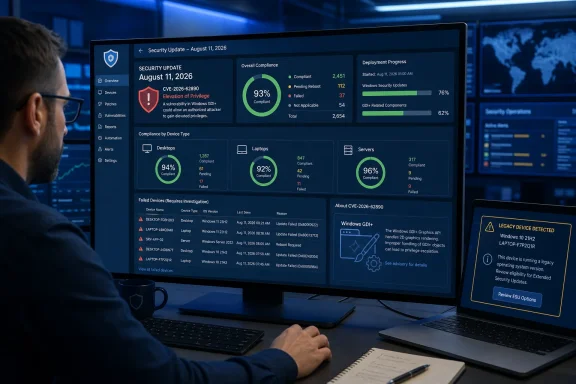
The Microsoft Security Response Center is the primary record for this CVE, and it identifies the affected component as Windows GDI+ and the impact as elevation of privilege. That means this is a post-compromise issue: an attacker would generally need some foothold on a machine before using the flaw to obtain broader rights. It is therefore different from the GDI+ remote-code-execution bugs that can turn a malicious image, document, or web-delivered graphic into the initial entry point.
The published material supplied with the advisory does not provide a technical description of the defect, a CVSS vector, an affected-build list, an associated KB number, or a public exploit status. That absence is material. A CVE title and impact category establish that Microsoft has acknowledged and patched a security condition, but they do not establish whether exploitation requires a standard user account, a particular application workflow, a malformed graphic, or a chain with another vulnerability.
The advisory confirms the bug, not an attack campaign
There is no independently published technical analysis of CVE-2026-62890 available as of August 12, 2026, and no other outlet has reported an exploit in the wild. Microsoft’s publication is enough to treat the vulnerability as real and to deploy the update, but it is not evidence that the flaw is being used in attacks.
That distinction is especially important with graphics-stack CVEs. “GDI+” is widely read as shorthand for image parsing and document rendering, which can lead defenders to assume a malicious file is the direct trigger. The advisory does not say that. It labels the issue as elevation of privilege, and that classification should keep incident-response teams from turning an unverified theory about email attachments or browser content into a detection rule.
The immediate risk is the familiar local privilege escalation problem: code already running with restricted rights may be able to cross a Windows security boundary. In practical terms, that can turn a limited account acquired through phishing, an unprivileged remote-access tool, a browser exploit, or a rogue signed-in user into a more consequential compromise. How far privileges can be raised is not stated in the public material and should not be assumed to mean SYSTEM access.
Do not confuse GDI+ with the older Windows GDI component
Microsoft’s naming is precise enough to matter here. GDI+ is the graphics subsystem commonly exposed through Windows imaging and drawing APIs, while Windows GDI and Win32k have their own histories, binaries, attack surfaces, and CVE records. Administrators should track CVE-2026-62890 as a GDI+ issue rather than merging it with similarly named GDI or DirectX Graphics Kernel flaws in vulnerability reports.
That is more than inventory housekeeping. Many endpoint-management tools and third-party vulnerability feeds group Windows graphics bugs under broad component labels, and a search for “GDI” can return a mixture of GDI+, GDI, Win32k, Desktop Window Manager, and graphics-kernel vulnerabilities. A remediation ticket should retain the full identifier and title: CVE-2026-62890 — Windows GDI+ Elevation of Privilege Vulnerability.
Microsoft has previously issued GDI+ fixes that were remote-code-execution issues, including high-severity image-processing bugs. This one is not publicly described that way. Treating every GDI+ CVE as a drive-by image exploit creates noise; treating a local elevation-of-privilege CVE as low priority because it needs a foothold creates a different and more serious blind spot.
August update compliance is the useful control
Because Microsoft releases Windows security fixes through cumulative servicing packages, enterprises ordinarily remediate a component CVE by installing the relevant August 2026 cumulative update or security-only package for the Windows version in use. The CVE record’s public text, however, does not identify the exact update packages or builds that contain the fix. Administrators should confirm the mapping in Microsoft’s Security Update Guide before using a KB number as proof of remediation.
The operational sequence should be:
- Confirm that Windows endpoints and servers have installed the applicable August 11, 2026 security update for their supported release channel.
- Review deployment failures, deferred restarts, inactive devices, disconnected field systems, and systems excluded from normal update rings.
- Check machines on extended-support arrangements separately, because their update entitlement and package catalog can differ from mainstream Windows releases.
- Preserve the CVE identifier in vulnerability-management exceptions so later revisions to Microsoft’s advisory can be reconciled without losing the original decision trail.
The key word is applicable. A device can report itself current in an endpoint-management console while still be on an update channel that has not received the relevant package, has failed to complete a reboot, or is no longer eligible for ordinary Windows servicing. Microsoft ended free Windows 10 updates for most editions on October 14, 2025; Windows 10 systems now require the appropriate Extended Security Updates coverage if they are still expected to receive current fixes. Those machines deserve an explicit compliance check rather than an assumption based on their Windows Update status.
Least privilege limits the value of an unpatched endpoint
CVE-2026-62890 is a reminder that endpoint hardening is still layered. Patching removes the known defect, but least-privilege controls reduce the usefulness of a local elevation-of-privilege bug during the interval before every device is remediated.
Organizations should make sure routine users do not have local administrator rights, that help-desk elevation workflows are time-limited, and that privileged administrators use separate accounts for ordinary email and web activity. Endpoint detection should also prioritize suspicious privilege changes, service creation, scheduled-task creation, token manipulation, new local administrators, and attempts to disable security tooling. Those controls will not identify this specific bug without technical indicators, but they can expose the outcome an attacker seeks from an elevation-of-privilege chain.
The advisory provides no workaround or component-disablement guidance in the material currently available. Disabling image-handling features, unregistering graphics libraries, or applying undocumented registry changes would therefore be speculative and likely disruptive. The supported response is to deploy the relevant Windows security update and verify installation.
Watch the CVE record for a substantive revision
Microsoft often expands Security Update Guide entries after initial publication, adding affected products, acknowledgements, revised exploitability assessments, or clarifying FAQs. Until that happens, there is no public basis to state that CVE-2026-62890 is publicly disclosed beyond Microsoft’s own patch release, actively exploited, or tied to a particular file format or application.
For now, this is a routine but real August 2026 patching item: a Microsoft-confirmed Windows GDI+ privilege-escalation flaw with limited public technical detail. The practical consequence is not an emergency shutdown of graphics features; it is a clean update-compliance exercise, with special attention to laptops, servers, and legacy Windows 10 systems that fall outside the organization’s normal patch-success reports.