

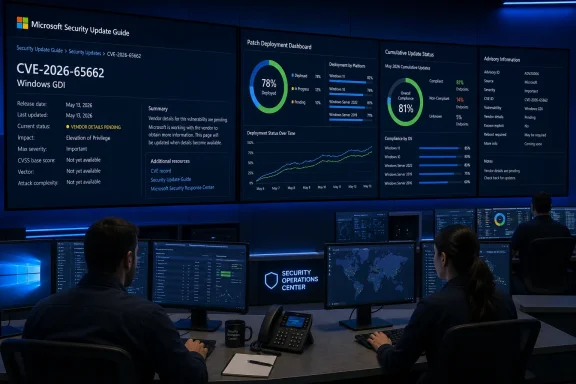
That absence changes the response. CVE-2026-65662 belongs in the August 2026 Windows patch-validation queue, but the available evidence does not support treating it as an emergency zero-day or building special detection logic around a guessed exploit path. Microsoft’s Security Update Guide is the authoritative source for the CVE’s existence and name; it was published at 7:00 a.m. Pacific time on August 11, or 14:00 UTC. As of August 12, the entry has no publicly stated modification date.
The CVE description supplied by Microsoft identifies the affected area only as Windows GDI, the long-standing Graphics Device Interface used by Windows and applications to create and manipulate graphical output. It does not say GDI+, identify a vulnerable DLL, name a file type such as EMF or WMF, describe a malicious-document scenario, or state that a local application is required. Those distinctions are operationally important, and none should be filled in from the history of older GDI bugs.
What Microsoft Has Confirmed — and What It Has Not
Microsoft’s publication is confirmation that the company recognizes CVE-2026-65662 as a Windows GDI information-disclosure issue. The supplied Security Update Guide material also includes Microsoft’s standard explanation of the report-confidence metric: this field communicates how certain the vulnerability’s existence and technical details are, as well as the amount of information potentially available to attackers.
But the material does not include the value Microsoft assigned to that metric. It would be inaccurate to call the bug “confirmed,” “unproven,” publicly disclosed, exploited, or protected by a workaround on the basis of the generic metric definition alone.
The same restraint applies to severity. “Information disclosure” is an impact category, not a measure of exploitability. Such bugs can range from limited exposure of process data to leakage of kernel addresses or other information that helps defeat memory protections. They can also be useful in attack chains without being sufficient to compromise a machine by themselves. Microsoft has not publicly specified which case CVE-2026-65662 represents.
No independent technical advisory, researcher disclosure, proof of concept, or detailed reporting for this specific CVE surfaced in searches conducted after publication. That is not evidence that the issue is harmless; it means the public record remains immature less than a day after Microsoft published it. It also means claims circulating about a crafted image, document, website, or local program would be speculation unless they are tied to a subsequent Microsoft revision or a named researcher’s disclosure.
The Identifier Does Not Yet Map Cleanly to a Deployment Decision
The core problem for Windows patch managers is not whether to patch Windows in general. It is determining which update package remediates CVE-2026-65662 on each supported branch.
A normal Microsoft Security Update Guide entry maps a CVE to affected products, severity, exploitability assessment, and security-update rows that identify the applicable KB articles and builds. That mapping is what allows a security team to prove that Windows 11 24H2, Windows 11 25H2, Windows Server 2025, Windows Server 2022, or an Extended Security Updates Windows 10 estate has actually received a fix.
The currently available record does not provide those mappings. Consequently, an administrator cannot yet responsibly claim that a particular KB remediates CVE-2026-65662 simply because it was installed on August 11. Nor can they establish that a product is unaffected merely because it does not appear in a search result.
This is more than a documentation nuisance. Vulnerability scanners and endpoint-management dashboards often ingest Microsoft’s metadata on a delay. If Microsoft later adds or revises product-and-KB associations, a device that looked compliant on August 12 can be reclassified as exposed without any change to the device itself. Teams using Microsoft Intune, Windows Autopatch, WSUS, Configuration Manager, Microsoft Defender Vulnerability Management, or third-party patch tools should expect possible inventory reconciliation once the record is fully populated.
The safest compliance statement at this stage is narrow: the August 11, 2026 Windows security-update deployment has been initiated or completed for the organization’s supported Windows builds. Do not attach CVE-2026-65662 to that statement until Microsoft identifies the remediating packages.
Why the “GDI” Label Is Not a Technical Root Cause
Windows GDI is a broad subsystem, and its name has appeared in Microsoft security advisories for several different classes of defects over the years. Earlier GDI information-disclosure vulnerabilities have involved improper exposure of memory contents or addresses. Some were reachable through specially crafted files or documents; others required a user to run a local application.
Those precedents explain why an information disclosure in graphics code deserves patching, but they do not explain CVE-2026-65662. Microsoft has not said that this CVE leaks memory, bypasses Address Space Layout Randomization, involves bitmap parsing, handles metafiles incorrectly, or affects a particular application such as Paint, Office, Edge, or a third-party image viewer.
That distinction prevents a common operational mistake: deploying controls built for an old bug against a new identifier with a similar title. Blocking WMF files, changing browser policy, or adding detections for a historical GDI exploit may still be defensible as broader hardening measures, but they are not documented mitigations for CVE-2026-65662.
It also means there is no evidence-based workaround to recommend beyond routine exposure reduction. Organizations should retain normal controls around untrusted attachments, downloaded graphics files, and unsigned or untrusted software, but should not describe those controls as a Microsoft-endorsed workaround for this CVE.
Patch Management Should Proceed Without Inventing Urgency
The right action for enterprises is to deploy the August 11 Windows security updates through the standard accelerated security ring, then verify installation by the cumulative-update KB and OS build applicable to each device population. This is the same discipline required for every monthly Windows security release: test the update on representative hardware, business-critical applications, virtual desktop images, printing workflows, graphics-intensive software, and systems with endpoint security agents before broad rollout.
The limited public record gives no basis for a special compensating control, an emergency out-of-band deployment, or a claim of active exploitation. It also gives no basis to defer the normal monthly update merely because the CVE has not yet accumulated public technical detail.
For Windows 10 devices, the support status deserves separate attention. Windows 10 reached end of support on October 14, 2025; organizations receiving post-support security fixes must be eligible for and enrolled in Microsoft’s Extended Security Updates program. A Windows 10 device outside ESU cannot be assumed to receive a fix if Microsoft later lists it as affected.
Administrators should preserve evidence now: export their August deployment status, record installed KB numbers and resulting build versions, and leave the CVE in a “vendor details pending” state in risk registers. That produces an audit trail without turning missing vendor metadata into an unsupported compliance conclusion.
Watch the Record, Not the Rumor
CVE-2026-65662 is a real Microsoft-published Windows vulnerability, but its public entry is currently too thin to support the conclusions that matter most to defenders. There is no disclosed exploit path, no independently reported exploitation, no named affected release list, and no published workaround in the material available today.
The next meaningful change will be a Microsoft revision that adds the security-update mapping, severity and exploitability fields, or a technical explanation. Until then, the concrete consequence is simple: deploy and validate the August 11 Windows updates on supported systems, preserve the deployment evidence, and do not let a familiar “Windows GDI” label substitute for facts Microsoft has not yet released.