

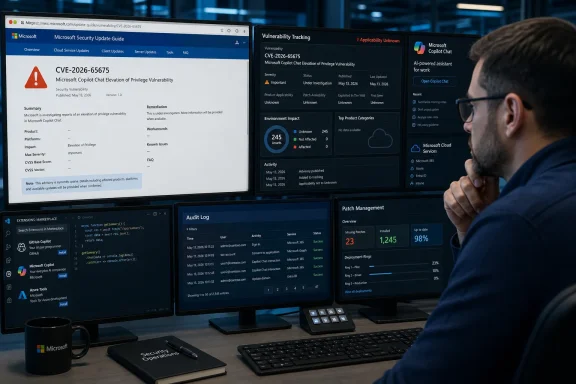
That is the immediate operational story: this is a Microsoft-issued CVE, not an unverified report, but it is not presently a patch-management advisory in any useful sense. Teams can record the identifier and make sure Copilot components are current, but they cannot responsibly claim that a particular Windows build, Visual Studio Code release, GitHub Copilot extension, or Microsoft 365 Copilot Chat tenant is remediated from the public record alone.
No independent security outlet had published technical reporting on CVE-2026-65675 as of Wednesday, August 12. Searches of public vulnerability indexes and the National Vulnerability Database also did not surface a usable record with a description or version range at publication time. That absence may be temporary—new Microsoft CVEs regularly reach external databases after the vendor’s own listing—but it leaves the MSRC entry as the only primary record presently available.
Microsoft has named an impact but not the product
“Security feature bypass” is an impact classification, not a technical explanation. It says a control intended to constrain behavior can be circumvented; it does not establish whether that control protects local files, authentication state, network access, tenant data, policy enforcement, prompt handling, or something else entirely.
The product name is unusually important here because Copilot Chat is not one thing. Microsoft and GitHub use closely related names across Microsoft 365 Copilot Chat, GitHub Copilot Chat, the Visual Studio Code Copilot Chat extension, Visual Studio integrations, and newer standalone Copilot development surfaces. Those products differ sharply in deployment model, data access, update mechanism, and administrative controls.
Microsoft has disclosed prior Copilot-related vulnerabilities with far more specific titles. CVE-2026-45482, for example, was identified as a Microsoft Visual Studio Code CoPilot Chat security feature bypass issue, and public CVE records associated it with GitHub Copilot and Visual Studio Code, a path-traversal weakness, and a defined affected-version range. CVE-2026-65675 omits all of those qualifiers in the material now publicly visible.
That omission makes it unsafe to infer that this new CVE concerns the Visual Studio Code extension merely because its title includes “CoPilot Chat.” It may concern that software, a different Copilot service, or a shared component. A similar naming pattern is not evidence of a shared flaw.
The advisory does not provide a patch target
For conventional Microsoft security updates, the Security Update Guide normally gives an affected-product matrix and links vulnerabilities to specific updates, KB articles, builds, or service-side fixes. None of that remediation data is publicly available for CVE-2026-65675 at this point.
Administrators therefore do not have answers to several basic questions:
- Microsoft has not stated whether the issue is fixed by a Windows update, an application update, an extension update, or a service-side deployment.
- Microsoft has not stated which Copilot Chat clients, channels, editions, or tenant configurations are affected.
- Microsoft has not assigned a public severity score or supplied the attack vector, required privileges, user-interaction requirement, or confidentiality, integrity, and availability impact.
- Microsoft has not indicated whether exploitation has been detected, publicly disclosed, or assessed as more likely because of available technical detail.
The supplied CVE title alone also does not support claims of remote code execution, data theft, prompt injection, local privilege escalation, or tenant breakout. Those may be risks in the broader AI-assistant threat model, but they are not established facts about CVE-2026-65675.
This matters for vulnerability-management reporting. A scanner or ticketing platform may flag the CVE as newly published, and an executive dashboard may treat “security feature bypass” as a deployable finding. Until Microsoft publishes product and remediation data, the correct status is closer to tracking required; applicability unknown than patch overdue.
Do not confuse this CVE with Microsoft 365 content controls
Microsoft’s documentation for Microsoft 365 Copilot Chat describes an administrator-controlled setting called harmful content protection. That setting can allow selected users to disable text-content filtering for a single conversation, principally for investigation, legal review, law-enforcement, or similar sensitive-content work. Microsoft says other protections—including prompt-injection defenses, copyright safeguards, biosecurity protections, and image protections—remain enforced.
Nothing in the CVE-2026-65675 listing connects the vulnerability to that feature. In fact, Microsoft’s documentation says the harmful-content toggle is available only to users included in a specific policy and applies only to the active conversation’s text responses. It would be a mistake to disable that policy, alter content-safety settings, or treat ordinary policy-authorized behavior as an indicator of compromise based solely on this CVE title.
The same caution applies to general Copilot data-access concerns. Microsoft 365 Copilot inherits Microsoft 365 permissions and has tenant-specific controls, while coding assistants operate inside development tools with local workspaces, extensions, terminals, repositories, and possibly agent capabilities. CVE-2026-65675 may turn out to affect one of those areas, but Microsoft has not said which one.
What IT teams can do before Microsoft fills in the gaps
The sensible near-term response is administrative hygiene rather than speculative emergency remediation. Organizations using Copilot products should verify that managed client software and extensions are configured to receive current releases, document where each Copilot Chat product is deployed, and retain the CVE in their vulnerability watchlist for a revised MSRC record.
For endpoint teams, that means checking inventories for Visual Studio Code and installed GitHub Copilot Chat extensions without declaring them affected. For Microsoft 365 teams, it means confirming which users have Copilot Chat access, which users can adjust responsible-AI protections, and whether tenant audit and activity logs are being retained according to policy.
Security operations teams should also avoid creating detections around an imagined attack chain. Microsoft has supplied no indicators of compromise, no suspicious command lines, no file paths, no network artifacts, and no account events tied to CVE-2026-65675. Monitoring for anomalous Copilot-related behavior is reasonable as a standing practice; representing that monitoring as CVE-specific detection is not.
The more useful control is change discipline. Keep records of client and extension versions, avoid unmanaged Copilot plugin deployments, restrict agentic tool permissions to the minimum necessary, and ensure that developers do not run coding assistants with elevated local privileges merely for convenience. Those measures reduce exposure to a broad class of development-tool failures regardless of what this CVE eventually proves to be.
The next MSRC revision is the real event
CVE-2026-65675 is currently a placeholder for a disclosed Microsoft security issue, not a sufficiently described vulnerability bulletin. Microsoft has confirmed the existence of a Copilot Chat security feature bypass through its Security Update Guide, but it has not yet given customers the details needed to distinguish urgent remediation from routine update compliance.
The next meaningful update must identify the affected product and fixed version or state that Microsoft has completed a service-side mitigation. Until then, Windows and IT administrators should track CVE-2026-65675, keep Copilot clients and extensions current, and resist filling the advisory’s missing technical facts with assumptions.