
BUG_ON() assertions to WARN_ON() checks. For administrators running Linux directly on AMD RDNA 3-class systems—or exposing a physical AMD GPU to a Linux guest through passthrough—the immediate task is to move to a kernel carrying the fix: Linux 6.6.148, 6.12.101, 6.18.42, 7.1.6, or newer mainline code beginning with 7.2-rc2.The NVD published the record on August 10, 2026, with kernel.org as the source. The underlying upstream work had already been sent in Alex Deucher’s July 2 AMDGPU fixes pull request for Linux 7.2, where it appeared among a set of changes removing fatal
BUG()and
BUG_ON()calls from AMDGPU error paths. The CVE therefore documents a fix that was upstream before the CVE identifier was assigned, rather than a newly discovered emergency patch.
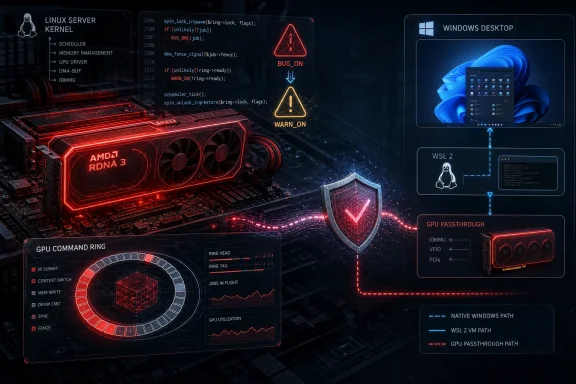
For Windows users, the first practical conclusion is narrow: this is not a Windows Radeon Software or AMD Adrenalin driver vulnerability. It concerns
drivers/gpu/drm/amd/amdgpu/gfx_v11_0.c, a Linux kernel source file. Standard WSL GPU acceleration also does not normally load the Linux AMDGPU kernel-mode driver against the physical Radeon hardware; Microsoft’s GPU-paravirtualization documentation describes a guest-side virtual rendering path that communicates with the Windows host driver through Dxgkrnl. Dual-boot Linux, bare-metal Linux workstations, and GPU-passthrough guests are the configurations that deserve attention.
 The CVE summary leaves out one of the code changes
NVD’s description says the patch will “replace
BUG_ON()with
WARN_ON()” because there is no need to crash the kernel in these cases. That is broadly accurate, but it omits a material implementation detail visible in the upstream code diff: the change does not treat every assertion identically.
The patch changes four alignment assertions from fatal failures into warnings. Two guard the GPU addresses used when the driver emits graphics and compute indirect buffers—command buffers submitted to the GPU. Another two validate fence writeback addresses, requiring eight-byte alignment for a 64-bit fence write and four-byte alignment for a 32-bit write.
A fifth assertion in the Kernel Interface Queue, or KIQ, fence path is simply removed. That check previously panicked the kernel if a 64-bit fence flag appeared where the KIQ path expected a 32-bit sequence writeback. The implementation is consequently more accurately described as “remove fatal assertions from GFX11 command and fence emission,” rather than the more limited wording in the CVE title.
That distinction matters operationally.
BUG_ON()is a kernel assertion mechanism intended for conditions the kernel considers impossible; when reached, it can bring the whole system down.
WARN_ON()records the unexpected condition but permits execution to continue. This fix removes the guaranteed machine-wide failure mode, but it does not turn a malformed or inconsistent command submission into a known-good GPU job.
In the changed paths, the driver logs the warning and continues writing the packet or fence information into a GPU command ring. A workload may still fail, a GPU reset may still be needed, or the driver may expose another error later. What the patch specifically guarantees is more modest and more valuable: a bad alignment condition at this point should no longer invoke a deliberate Linux kernel crash.
The evidence supports a denial-of-service concern, not a CVSS label
As of August 11, NVD has assigned neither a CVSS v4 score nor a CVSS v3 score to CVE-2026-68246. It also has no CWE classification, no exploit status, and no public attack narrative beyond the short kernel.org description. Treating it as “critical” based only on the word CVE would outrun the public record.
There is a nearby historical reason security teams may pay attention, but it must be kept separate. Earlier in 2026, Linux kernel developers removed different
BUG_ON()checks from GFX11 and GFX12 indirect-buffer handling under CVE-2025-68201. The upstream discussion for that earlier issue said the condition could be triggered trivially from userspace. That prior flaw involved the legacy Constant Engine flag, not the address-alignment and KIQ assertions addressed by CVE-2026-68246.
The similarity is architectural: both fixes reject the idea that a GPU-driver assertion should be able to take down an entire host. But the earlier discussion does not prove that CVE-2026-68246 is equally reachable from an unprivileged process. No independent advisory, vendor bulletin, or upstream commit message currently establishes a working trigger for this CVE. The responsible classification is a potential local denial-of-service hardening fix, pending a fuller assessment—not a confirmed privilege-escalation or data-exposure issue.
Kernel version numbers are useful, but package versions decide deployment
The NVD configuration lists the following fixed points:
| Kernel branch | First version NVD marks unaffected |
|---|---|
| Linux 6.6 | 6.6.148 |
| Linux 6.12 | 6.12.101 |
| Linux 6.18 | 6.18.42 |
| Linux 7.1 | 7.1.6 |
| Mainline | 7.2-rc2 |
NVD also references five stable-tree commits, indicating that the fix was carried across maintained branches rather than held solely for future mainline releases. That broad stable coverage is good news for systems that track upstream kernels closely.
It is not, however, a substitute for checking the distribution’s own kernel package advisory. Enterprise distributions routinely backport security fixes without adopting the upstream version number, while custom kernels and downstream vendor kernels can lag even when their base version sounds recent. Conversely, a mechanically broad NVD range beginning at version “0” does not mean every historical Linux kernel could be affected; the vulnerable code is specific to the
gfx_v11_0.cAMDGPU implementation and only matters on hardware and configurations that actually use it.
On an affected Linux machine,
uname -restablishes the running kernel version, but it does not establish whether a vendor has backported the patch. Package changelogs, a distribution security tracker, or the source package’s applied-patch list are the authoritative checks. For a custom build, the relevant upstream commit is
daa62107452d2451787c4248ca38fa2d1a0cbefd, with the stable hashes listed in NVD serving as branch-specific confirmation points.
Windows, WSL, and virtualization need different responses
A Windows desktop using an AMD Radeon GPU does not need a Radeon driver rollback, Adrenalin update, registry change, or BIOS change because of CVE-2026-68246. The vulnerable assertion is absent from the Windows display-driver stack.
The same is generally true for ordinary WSL GPU compute and graphics. Microsoft’s GPU-PV design places the physical GPU kernel-mode driver in the Windows host partition; the guest receives a virtual rendering path rather than direct control through Linux’s
amdgpuDRM driver. Updating WSL remains sound hygiene, but this CVE alone is not evidence that the Windows host’s AMD driver is exposed.
The exception is direct assignment. A Hyper-V, KVM, Proxmox, or VMware environment that passes through an AMD GFX11 GPU to a Linux guest changes the equation: the guest may load AMDGPU and execute the affected code. So does a Windows workstation that dual-boots into Linux for gaming, rendering, ROCm, or GPU development. In both cases, the Linux guest or alternate boot environment—not Windows—must be patched.
- Linux fleet owners should update the kernel through their distribution channel and reboot into the patched image before closing the ticket.
- Virtualization teams should inventory AMD GPU passthrough guests separately from ordinary GPU-PV or WSL workloads.
- Security teams should record the CVE as an unscored kernel denial-of-service fix and avoid assigning a severity higher than the evidence currently supports.
- Windows-only endpoints without a Linux installation or a directly assigned Linux GPU do not require remediation for this CVE.
The concrete outcome is straightforward: Linux systems using AMDGPU GFX11 should absorb the available stable kernel update, while Windows and normal WSL users should not mistake a Linux driver assertion fix for a new Radeon Adrenalin emergency.
