
BUG_ON() assertions become WARN_ON() checks in drivers/gpu/drm/amd/amdgpu/sdma_v5_2.c—but its operational effect is significant: an invalid condition that previously forced a kernel panic now records a warning and lets the system remain running.The National Vulnerability Database published the record on August 10, 2026, with kernel.org as the source. The upstream patch was written by AMDGPU maintainer Alex Deucher, reviewed on the AMD graphics mailing list in June, and included in the DRM fixes sent for Linux 7.2-rc2 in early July. The chronology matters: this is a recently assigned CVE for a fix that had already entered the normal kernel maintenance pipeline, rather than a newly discovered zero-day response.
For Windows users, this is not a Radeon Software or AMD Adrenalin vulnerability, and it does not apply to the Windows display driver installed by Windows Update. It matters to dual-boot systems, Linux workstations and servers, SteamOS-like devices, virtual-machine hosts using Linux, and any environment where the open-source
amdgpukernel module controls an AMD GPU.
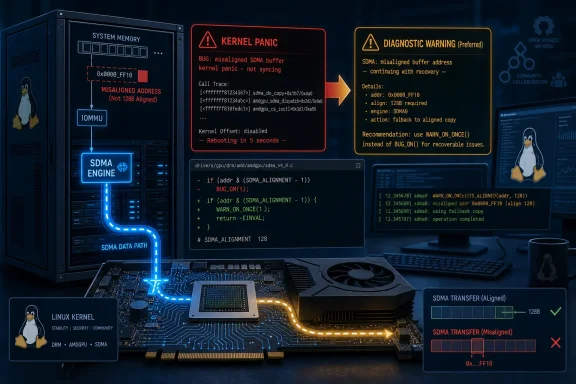 The vulnerable behavior was a self-inflicted kernel panic
The affected routines,
sdma_v5_2_ring_emit_fence(), build fence packets for AMD’s System DMA engine. A fence is a synchronization marker: GPU work writes a sequence value to memory, allowing the driver and scheduler to tell whether a batch of work has completed.
The packet format expects the fence address to be aligned on a four-byte boundary. Before the fix, the driver handled a bad address with
BUG_ON(addr & 0x3). In Linux kernel terminology,
BUG_ON()is not an ordinary error return. If its condition is true, it triggers a fatal kernel fault—effectively turning a driver invariant failure into a host-wide crash.
The patched code keeps the alignment test but changes it to
WARN_ON(addr & 0x3). That emits a warning and stack trace for diagnostics without immediately taking down the machine. The patch’s entire rationale is unusually blunt: there was no need to crash the kernel in these cases.
That means the primary security consequence documented by the fix is availability. An unexpected misaligned fence address could previously convert a graphics-driver fault into a denial of service against the whole Linux host. On a desktop, that means a hard crash and reboot. On a workstation with long GPU jobs, a render node, a VM host, or a machine providing remote sessions, it can mean interrupted workloads and lost state.
This is not proof that a warning makes the bad request safe
The important limitation is in the code itself. The new
WARN_ON()does not reject the address, repair its alignment, return an error to userspace, reset the GPU, or prevent the packet from being written. It merely stops treating the condition as grounds for immediate kernel death.
That is an intentional choice, but it changes the failure mode rather than establishing that malformed fence addresses are harmless. The driver will still write the lower and upper halves of the address into the SDMA packet after producing the warning. What happens next depends on the GPU, firmware, scheduler state, and the caller that supplied the address.
There is no public exploit narrative in the NVD record, no listed CWE, no CVSS vector or severity, and no claim that an unprivileged local user—or a remote party—can reliably induce the condition. NVD has left CVSS v2, v3, and v4 assessments as “N/A.” Administrators should therefore resist two equally unhelpful readings of the CVE: it is not evidence of a demonstrated code-execution flaw, but neither is it merely cosmetic cleanup. The upstream fix removes a kernel-panic tripwire from a GPU command-submission path.
The patch was also part of a broader AMDGPU series replacing or removing unnecessary
BUG()and
BUG_ON()uses across several graphics and SDMA versions. The 7.2 DRM pull request lists parallel changes for GFX 9 through GFX 12.1 and SDMA 4.4.2, 5.0, 6.0, 7.0, and 7.1. CVE-2026-68250, however, is specifically about the SDMA 5.2 implementation and should not be treated as a catch-all identifier for that wider cleanup.
The affected systems are narrower than the version range suggests
The NVD record lists Linux releases before 6.6.148, 6.12.101, 6.18.42, and 7.1.6 as affected, with Linux 7.2-rc2 identified as containing the original fix. Those are the relevant upstream stable thresholds:
| Kernel branch | Fixed release |
|---|---|
| 6.6 LTS | 6.6.148 |
| 6.12 LTS | 6.12.101 |
| 6.18 | 6.18.42 |
| 7.1 | 7.1.6 |
| Mainline | 7.2-rc2 and later |
There is a caveat in how this inventory is expressed. The CVE data declares an affected version floor of
0for each stable branch. That does not mean the vulnerable SDMA 5.2 driver existed in every Linux release since version 0; it is an automated range representation, not a hardware applicability statement. The relevant code did not even exist in the ancient kernel versions such a reading implies.
The actual exposure is limited to machines that both run a kernel containing the pre-fix code and use the
amdgpudriver’s SDMA 5.2 path. The driver source identifies firmware families including Sienna Cichlid, Navy Flounder, Van Gogh, Dimgrey Cavefish, Beige Goby, and Yellow Carp. Those are AMD internal GPU or APU codenames, not a universal list of retail products, and the practical match depends on the exact GPU IP block detected by the running driver.
This is why a blanket claim that “all AMD graphics on Linux are affected” would be wrong. Older Radeon hardware using other driver paths, newer AMD hardware using a different SDMA implementation, systems booted with another graphics driver, and machines without an AMD GPU do not enter this specific code path. Even a system with compatible hardware must encounter the invalid fence-address condition for the old fatal assertion to fire.
Package versions, not uname -r, decide whether a distribution is covered
The upstream version table is useful, but it is not the final answer for enterprise Linux or long-supported desktop distributions. Red Hat, Canonical, SUSE, Debian, Valve, appliance vendors, and cloud-image maintainers often backport individual security fixes while retaining an older-looking base kernel version. A distribution kernel reported as 6.6.x may already contain the patch; a custom or third-party kernel reported as a newer build may not, depending on its source base and maintenance policy.
Administrators should check the distribution’s kernel changelog or security advisory for CVE-2026-68250 and the SDMA 5.2 patch, rather than relying only on the major.minor version string. For self-built kernels, the NVD record names five stable commits carrying the backport, while the original upstream change is commit
ae658afc7f47f6147371ec42cc6b1a793dfdb5af.
A practical triage sequence is straightforward:
- Confirm that the active kernel uses the
amdgpudriver for the AMD device, rather than assuming every Radeon-branded system is in scope. - Check the installed distribution kernel package’s changelog or advisory status for CVE-2026-68250.
- Update to a vendor-provided kernel incorporating the fix, or to one of the upstream fixed releases where applicable.
- Treat AMDGPU alignment warnings in kernel logs as diagnostic events worth investigating; the patch preserves the warning precisely because the underlying condition remains abnormal.
For fleet managers, this should be a routine kernel-maintenance item, not an emergency shutdown event. The record offers no evidence of active exploitation or a network-reachable attack path. But the fact that a malformed state used to invoke
BUG_ON()means it belongs in the same availability-hardening work that keeps GPU hosts from turning a driver edge case into a full operating-system outage.
The immediate result is fewer avoidable crashes, not a complete validation fix
The strongest conclusion supported by the record is narrow: Linux kernels carrying the old SDMA 5.2 code could panic rather than warn when an alignment invariant was violated during fence emission; updated kernels avoid that deliberate panic. That is useful hardening for machines where graphics reliability is part of system reliability.
What remains unresolved in the public record is the origin of the misaligned address. Neither the CVE entry nor the upstream patch explains which caller can generate it, whether it has been observed outside debugging or corruption scenarios, or whether the post-warning GPU behavior can cause a reset, a hung workload, or some other recovery path. The kernel developers chose to preserve the condition for diagnostics while refusing to sacrifice the whole host to it.
Update the kernel where your vendor has shipped the backport. After that, an SDMA 5.2 alignment failure should leave evidence in the logs instead of leaving the machine at a boot screen.
