

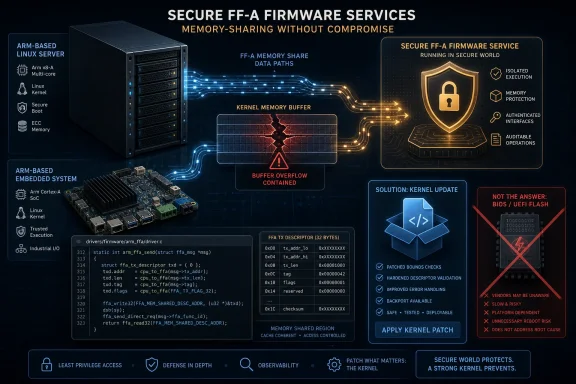
The newly published NVD record, sourced from kernel.org on August 10, identifies an out-of-bounds write in drivers/firmware/arm_ffa/driver.c, specifically the ffa_setup_and_transmit() path used to construct FF-A memory-sharing descriptors. Upstream kernel developers describe two failures: on FF-A versions before 1.2, the driver could write the reserved member beyond the smaller descriptor format; separately, its capacity test could allow a constituent memory-range record to be written past the transmit buffer boundary.
There is no CVSS score, CWE classification, public exploit, or affected-product advisory from a Linux distributor attached to the record as of August 11. That makes this a patch-now kernel-maintenance issue for the relevant Arm fleet, rather than evidence of a broadly exploitable vulnerability on ordinary PCs.
The bug is in Linux’s FF-A client, not the secure firmware itself
FF-A is an Arm interface for communication between the normal-world operating system or hypervisor and isolated firmware services, often in TrustZone. Linux’s own documentation describes uses including secure-partition services, TPM command-response-buffer access, and protected KVM’s proxying of FF-A calls.
That context limits the exposure significantly. A Linux machine needs to be running on Arm hardware, have an FF-A-capable firmware stack, and exercise the memory lend, donate, or share operations that reach ffa_setup_and_transmit(). The vulnerable code is not part of the Windows kernel, standard x86 Linux systems, or a conventional UEFI update path.
The “firmware” label in the CVE title is therefore easy to misread. It names the Linux source-tree subsystem — drivers/firmware/arm_ffa — rather than a flaw that an OEM can remediate through a BIOS or firmware-package update. The remediation is a Linux kernel update. Firmware updates can still matter for other Arm security issues, but they are not the stated fix for CVE-2026-68401.
For Windows administrators, the record does not establish an issue in Windows 11, Windows Server, Hyper-V, or the Windows TPM stack. It also does not name WSL, Azure, Snapdragon PCs, or any Microsoft product as affected. Organizations operating Linux Arm guests, appliances, embedded devices, Android-derived kernel branches, or Arm servers should instead determine whether their kernel configuration and platform firmware expose the FF-A path.
A 16-byte descriptor was being treated like a larger one
The primary defect is unusually concrete. The upstream patch, authored by Mostafa Saleh and carried in Sebastian Ene’s FF-A and KVM patch series, says that for FF-A versions below 1.2, ffa_emad_size_get() returns 16 bytes for an Endpoint Memory Access Descriptor, or EMAD. The reserved field sits at offset 24 in the larger structure definition.
The old code explicitly set fields including flag and reserved to zero. That was safe only when the negotiated FF-A descriptor layout actually contained those fields. On an older FF-A version, zeroing reserved wrote beyond the 16-byte object that the protocol allowed at that location.
The fix changes the initialization model. Rather than assigning fields one by one according to a C structure whose full size does not represent every wire-format version, the driver clears exactly the number of bytes returned for the negotiated FF-A version. It then fills only the fields appropriate to the protocol format.
This is the kind of bug that can hide in otherwise defensive code. The developer was trying to obey the protocol’s “must be zero” requirements for reserved fields. But zeroing a field that does not exist in an older, shorter descriptor is still a write beyond the valid object boundary.
The patch also repairs the fragment-buffer test used when the driver emits the list of physical address ranges to share with a secure partition. Previously, the code verified the address of the next constituents entry against the maximum fragment size, but did not include the size of the record it was about to write. The revised test includes sizeof(*constituents), blocking a write whose starting address is inside the buffer but whose trailing bytes would overrun it.
Neither the NVD record nor the upstream patch describes attacker control, privileges required, data disclosure, code execution, or a working exploit. An out-of-bounds write is a serious primitive in kernel code, but its impact here depends on whether a local workload can trigger a relevant FF-A memory transaction on a compatible Arm platform. It should not be converted into claims of a remotely exploitable Windows flaw without evidence.
The published version data contains a real contradiction
The NVD entry lists 6.18.42, 7.1.6, and 7.2-rc4 as the first fixed kernel releases or development point. Those are the clearest upstream targets for administrators tracking unmodified kernel releases.
But the same machine-readable NVD configuration also contains conflicting historical ranges. One portion says kernels before 6.4 are unaffected, while another marks ranges beginning with 5.15.114, 6.1.31, and 6.3.5 as affected. Those statements cannot all describe one continuous upstream version history in the ordinary sense.
The upstream commit message provides the more useful technical boundary: it identifies commit 111a833dc5cb, “firmware: arm_ffa: Set reserved/MBZ fields to zero in the memory descriptors,” as the change that introduced the issue. The NVD record’s own main product range also presents Linux 6.4 as the first affected upstream version and all earlier releases as unaffected.
That makes the older 5.15, 6.1, and 6.3 entries look like a metadata problem or a description of particular Git histories rather than a reliable assertion that every kernel in those release families is vulnerable. Until NVD corrects or clarifies its configuration data, distribution security teams should verify the actual arm_ffa driver code and their backport set instead of treating those old version strings as a complete exposure list.
This distinction matters most for enterprise distributions. A package branded as a 6.1 or 6.6 kernel can carry years of backported fixes and features, while an ostensibly newer upstream number can omit a vendor backport. Check the distributor’s security tracker, changelog, and patch references for CVE-2026-68401 or the upstream fix, rather than using uname -r alone as a vulnerability verdict.
CVE-2026-68401 covers one patch in a broader FF-A cleanup
The patch was submitted as the first driver fix in a six-patch series covering FF-A descriptor calculations and protected KVM validation. The public Patchew archive shows the CVE-mapped change as upstream commit 3383ffb7ef937317361713ffcc21921a7848511a.
A companion driver patch in that series, b4d961351aa84fdf0148783fb1f3a1391b8a0adb, changes how Linux locates the EMAD array for FF-A 1.1 and later, uses the protocol-provided offset, and adds additional boundary checks. Other patches in the same series modify Arm64 protected KVM’s handling of FF-A messages.
Those related changes should not be collapsed into CVE-2026-68401. The CVE’s description and references point to the specific out-of-bounds-write patch, while the companion work carries separate Fixes: references and addresses distinct offset-calculation and hypervisor-validation problems. The practical lesson for downstream maintainers is simpler: take the maintained kernel update, not a hand-copied three-line CVE patch, unless the vendor has explicitly confirmed the exact backport and its prerequisites.
What Arm Linux operators should do now
- Update to a distribution kernel that the vendor says includes CVE-2026-68401; upstream lists Linux 6.18.42, 7.1.6, and 7.2-rc4 as fixed points, but distribution package versions will differ.
- Prioritize systems using FF-A-backed secure services, Arm trusted-execution environments, FF-A TPM support, or protected KVM deployments, because those configurations are closer to the driver’s intended memory-sharing path.
- Do not schedule a BIOS, UEFI, or TPM firmware update as the direct response to this CVE unless the platform vendor identifies a separate firmware issue; the published repair changes Linux kernel source code.
- Treat the NVD’s pre-6.4 version data cautiously until its contradictory affected-range entries are reconciled, and obtain a package-level answer from the Linux distributor for long-term-support kernels.
The immediate consequence is narrow but actionable: Arm Linux systems using FF-A services need a kernel patch, while Windows-only estates do not have a named affected component to remediate from this CVE.