

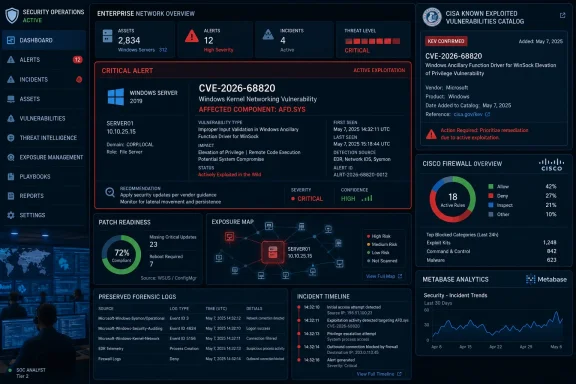
CISA’s August 11 alert is the authoritative confirmation that exploitation evidence met its threshold for KEV inclusion. It identifies CVE-2026-68820 as a use-after-free vulnerability in the Windows Ancillary Function Driver for WinSock, the kernel component commonly known as AFD.sys. A use-after-free in that layer deserves serious attention because AFD sits beneath a wide range of Windows networking activity; however, CISA’s alert does not say whether exploitation provides local elevation, remote code execution, or another outcome, and administrators should not fill in those blanks from the vulnerability class alone.
The same caution applies to the other two additions. CISA identifies CVE-2026-20349 as a heap inspection vulnerability affecting Cisco Secure Firewall Adaptive Security Appliance and Firewall Threat Defense, while CVE-2026-72898 is described as a Metabase SQL injection vulnerability. All three are in KEV because CISA says they have been exploited, not because they share a single attack chain or carry the same operational risk.
What turns this from another three-item KEV update into an immediate operations issue is CISA’s new Binding Operational Directive 26-04. The directive, issued June 10, replaced the older one-size-fits-all federal KEV patching approach with a model based on asset exposure, KEV status, exploit automation, and the degree of control an attacker can achieve. The headline for federal civilian agencies is no longer simply “patch every KEV by a fixed catalog due date.” It is “know which assets are exposed, determine the applicable risk tier, and preserve evidence where compromise may already have occurred.”
The Windows entry is urgent, but the patch target is still missing
A review of Microsoft’s publicly indexed Security Update Guide material and NVD search results did not surface a record for CVE-2026-68820 when this article was prepared. That absence does not negate CISA’s exploitation finding; disclosure and remediation pages frequently arrive after a KEV alert, are temporarily unavailable to indexing systems, or appear in a vendor’s monthly release material after the initial advisory.
It does mean that Windows teams should resist a common but dangerous impulse: searching for a similarly named WinSock or AFD vulnerability, finding an older KB, and treating it as the fix. Microsoft has disclosed several Windows Ancillary Function Driver for WinSock vulnerabilities over the past year, including use-after-free issues, but a CVE number is the only reliable way to match a security update to the vulnerability at hand.
Until Microsoft publishes the affected-product list and update mapping, organizations should take inventory rather than guessing. Identify Windows endpoints and servers that have not received the latest cumulative updates, then identify systems where untrusted users, remote-access tooling, virtual desktop workloads, application servers, or development environments could give an attacker an initial foothold. A kernel vulnerability may be the second stage of an intrusion rather than the internet-facing entry point, and that changes the first responders’ search.
For endpoint-management teams, the practical move is to establish a deployment ring that can accept the eventual Microsoft fix quickly. Confirm that Windows Update for Business, WSUS, Microsoft Configuration Manager, or the organization’s RMM tooling can detect and deploy the relevant cumulative update without waiting for the next ordinary maintenance window. Do not create an emergency patch job around an unspecified KB number.
The distinction is important: KEV status confirms active exploitation, not the exact attack path affecting your systems. A Windows fleet that is fully patched may still need a compromise review if it had vulnerable builds during the period of exploitation; a fleet that lacks the forthcoming fix should be treated as a priority exposure even if its endpoints are not directly internet-facing.
CISA’s catalog data has not caught up with the alert
There is a second operational wrinkle. CISA’s public kev-data repository is intended to mirror the agency’s canonical catalog within minutes of updates. The version retrievable during reporting was dated August 10 and did not yet contain CVE-2026-20349, CVE-2026-68820, or CVE-2026-72898, despite CISA’s August 11 alert announcing the additions.
That is a real gap for organizations that automate KEV response from the JSON or CSV feed rather than monitor CISA alerts. The catalog record normally supplies the fields that automation needs: the date added, remediation direction, applicable deadline information, ransomware-use status, vendor links, and CISA’s related vulnerability-enrichment data. None of those three records was available in the mirror version reviewed here.
The likely explanation is ordinary publication lag rather than a contradiction in CISA’s reporting. Still, the effect is the same for a SOC or vulnerability-management team whose workflow depends on a daily feed pull: the alert has arrived before the machine-readable record required to create a precise ticket automatically.
Teams should therefore make today’s alert a manual exception. Add all three CVE IDs to KEV watchlists now, create temporary cases for product owners, and recheck the catalog record once CISA publishes it. For CVE-2026-68820, the eventual record should be compared against Microsoft’s advisory before closing the case. The product name alone is insufficient for reliable scoping, especially in estates that include Windows client, Windows Server, Server Core, Azure-hosted VMs, and third-party appliances built on Windows components.
BOD 26-04 makes exposure inventory part of patching
CISA’s new directive matters here because it connects remediation urgency to the actual condition of the asset. The agency says the four inputs are whether the asset is publicly exposed, whether the vulnerability is in KEV, whether an attacker can automate exploitation, and whether exploitation gives partial or total control. Federal agencies must maintain and classify their asset inventories rather than treating a CVSS score as a complete prioritization decision.
CISA’s June announcement says the directive also requires agencies, in designated high-risk scenarios, to determine whether an adversary compromised an asset before the patch was applied. That is a major operational shift. Patching removes a known path forward; it does not evict an attacker who has already used it to obtain credentials, establish persistence, create accounts, or alter remote-management settings.
For the Windows flaw, that means security teams should prepare a bounded triage plan now, even without technical exploitation indicators from Microsoft. Review endpoint detection telemetry around suspicious process injection, service creation, scheduled tasks, abnormal local-group membership changes, token manipulation, credential dumping behavior, and unexpected network connections originating from endpoints where a user-level compromise was plausible. These are general post-compromise checks, not indicators uniquely tied to CVE-2026-68820, and they should be labeled that way in incident documentation.
Cisco and Metabase owners face a different question: whether their products are reachable from the internet, administrative networks, partner networks, or VPN users. ASA and FTD appliances frequently occupy trust-boundary positions, so remediation cannot be scheduled as a routine appliance refresh without first checking exposed management interfaces, VPN portals, logging integrity, administrator accounts, configuration changes, and outbound connections. Metabase deserves similar scrutiny where public dashboards, embedded analytics, or externally accessible administrative surfaces connect the BI platform to production databases.
CISA has not stated in this alert that any of the three vulnerabilities are tied to ransomware, a specific threat group, or a shared campaign. Organizations should avoid assigning an attribution or presumed exploit chain that the record does not support.
What administrators should do before vendor guidance arrives
The lack of published version ranges is inconvenient, but it does not justify waiting passively for a KB article or appliance advisory. The right interim response is controlled and evidence-focused.
- Confirm whether Cisco ASA, Cisco FTD, self-hosted Metabase, or Windows systems that may be pending current cumulative updates exist in the environment, including subsidiaries, labs, cloud subscriptions, and outsourced operations.
- Mark each asset’s exposure state: directly internet-reachable, reachable through a public VPN or reverse proxy, internally reachable, or isolated. That classification will determine the urgency under the BOD 26-04 model and is more useful than a generic criticality label.
- Preserve logs before applying emergency updates to potentially exposed Cisco, Metabase, or Windows systems. Retain firewall, VPN, web, authentication, EDR, Windows event, database, and cloud-control-plane logs long enough to investigate activity preceding remediation.
- Monitor Microsoft’s Security Update Guide for CVE-2026-68820 and wait for Microsoft’s explicit affected-build and KB mapping before declaring Windows devices remediated.
- Reconcile automation against CISA’s machine-readable catalog after it refreshes, because the record may add mitigation directions, exploitability characterization, or forensic-triage expectations that do not appear in the short August 11 alert.
For Windows shops, the immediate action is not an unverified patch deployment. It is to put CVE-2026-68820 into the emergency queue, verify cumulative-update readiness, preserve endpoint telemetry, and wait for Microsoft to publish the one detail CISA’s alert does not provide: exactly which Windows builds need to be updated.
Update: Microsoft classifies CVE-2026-68820 as an elevation-of-privilege flaw (August 12, 2026)
Microsoft’s Security Update Guide now lists CVE-2026-68820 as a Windows Ancillary Function Driver for WinSock elevation-of-privilege vulnerability. This resolves the key uncertainty in the initial reporting: the actively exploited AFD.sys flaw is positioned as a post-compromise escalation route, rather than confirmed remote code execution.
For Windows administrators, that increases the importance of reviewing systems where attackers could already obtain a standard-user foothold through phishing, exposed remote-access services, malicious software, or compromised credentials. Endpoint telemetry and privilege-change evidence should be preserved before remediation.
Microsoft’s entry still needs to be used alongside its affected-product and update mapping before teams mark devices remediated.