
 aemon versions before 6.17 and centers on
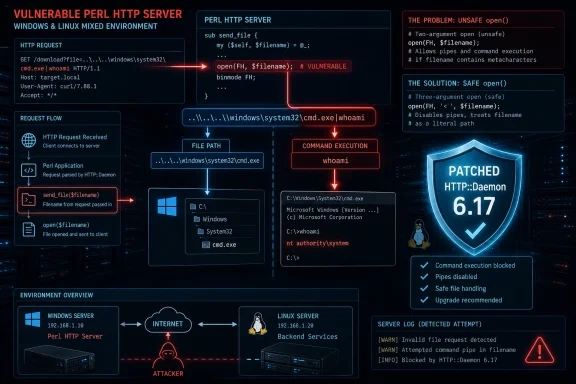
 send_file, which previously passed filename strings into Perl’s two-argument open behavior. In exposed applications, an attacker-controlled value could be interpreted as more than a path—potentially resulting in command execution, unintended file writes, or disclosure of command output through an HTTP response.
For Windows administrators, developers, and security teams, the key lesson extends well beyond one Perl module. The vulnerability illustrates how legacy convenience syntax, especially in server-side code that handles request parameters, can turn a file path into a control channel. The upstream correction is available in HTTP:aemon 6.17, while Linux distributions are also shipping backported fixes for their own packaged versions.
 Background: A Small HTTP Server Module With a Large Trust Boundary
HTTP:aemon is a Perl module designed to make it straightforward to build a basic HTTP server. Its send_file routine is intended to stream a named file, or an already-open handle, to a connected client. That is a practical feature for lightweight download services, development utilities, embedded administration tools, test services, and internal web-facing applications.
The routine’s flexibility was also its risk. A program may accept a request, derive a filename from a URL path or query parameter, and hand that value to send_file. If the application treated the result purely as a path but the underlying file-opening operation interpreted special characters as instructions, the module crossed a critical boundary: untrusted HTTP input reached an operating-system-facing API without being constrained to literal filename handling.
That distinction matters on any host capable of running Perl, including Windows systems using ActivePerl-compatible environments, Strawberry Perl, bundled development stacks, CI agents, containers, and Windows Subsystem for Linux instances. The direct impact depends on whether an application exposes an affected HTTP::Daemon endpoint and allows request-derived data to influence send_file. It is not enough simply to find the module installed; administrators must identify whether vulnerable calling patterns exist in deployed code.
The issue is classified as CVE-2026-8450. Ubuntu’s security tracking assigns it a CVSS v3.1 score of 9.1 out of 10, with network attack vector, low attack complexity, no privileges required, no user interaction, and high confidentiality and integrity impact. Those metrics reflect the severity of an exposed service using the vulnerable pattern—not a guarantee that every machine with the library installed is remotely exploitable.
What Went Wrong in send_file
The danger of Perl’s two-argument open
Older HTTP::Daemon code used Perl’s two-argument form of open when processing the string supplied to send_file. That older interface combines the file mode and target into a single interpreted expression. Perl’s own documentation describes this style as a legacy form that new code should generally avoid in favor of the three-argument alternative, which separates the mode from the filename.
In particular, Perl documents that one- and two-argument open calls strip leading and trailing whitespace and honor redirection-style characters. This capability, commonly called “magic open,” can be useful in trusted scripts, but it is fundamentally unsafe when a filename is derived from untrusted input. The safer form explicitly supplies read mode and treats the third argument as the literal target.
The vulnerable behavior means the string passed to send_file was not reliably interpreted as “open this ordinary file for reading.” Certain input shapes could instead cause Perl to create a pipe to a subprocess, receive output from a subprocess, or open a target in a write-oriented mode.
More than a typical directory traversal flaw
It would be a mistake to reduce CVE-2026-8450 to a conventional path traversal problem. A directory traversal weakness allows an attacker to escape an intended folder through relative path components or flawed canonicalization. This flaw was more dangerous in a different way: the attacker-controlled string could be parsed as an instruction to the open mechanism, rather than merely as a location on disk.
The documented impact breaks into three major categories:
- Operating-system command execution: pipe-style input could result in a subprocess being opened under the HTTP daemon’s identity.
- Response-body disclosure: a read-pipe form could make subprocess standard output available in the server’s HTTP response stream.
- Arbitrary file creation or truncation: write-oriented forms could create, overwrite, or append to attacker-selected locations reachable by the process.
The service account is central to the real-world consequence. If an HTTP:
aemon-based program runs with a restricted account and has access only to a narrow content directory, exploitation may be contained. If it runs as an elevated Windows service account, an administrative local account, a broad Linux service identity, or a CI worker with credentials and repository access, the blast radius can be far greater.
Why the HTTP layer makes it particularly serious
An affected send_file call becomes dangerous only when attacker-controlled bytes can reach it. The most obvious pattern is a download endpoint that maps a query parameter, route fragment, or request-derived filename to send_file. The upstream security fix specifically identifies this type of design as an example of a vulnerable integration.
That is a common enough pattern to warrant urgent review. Lightweight internal utilities often begin as trusted-only tools: an artifact browser, log downloader, test output viewer, or device-management page. Over time, they may become reachable through a reverse proxy, VPN, cloud ingress rule, temporary tunnel, or an overly broad firewall exception. A service once considered harmless can suddenly have an internet-facing or organization-wide trust boundary.
The Fix in HTTP:aemon 6.17
Explicit read mode and a literal path
The upstream remediation changes send_file to use Perl’s three-argument form of open with explicit read mode:
open(my $fh, '<', $file)
The practical security value is that the file path is no longer interpreted using two-argument open shell-magic behavior. A maliciously shaped string is treated as a literal filename; if no file exists with that exact name, the operation fails instead of being converted into a pipe or a write redirection.
This is an excellent example of a secure-by-construction API call. It does not rely on regular expressions to blacklist special characters, guess which command syntax may be dangerous on a platform, or normalize whitespace after the fact. Instead, it selects an interface whose semantics make the intended operation unambiguous.
Perl’s documentation independently supports that approach. It recommends favoring three-argument open over the older concatenated form because separating mode and filename avoids ambiguity, and it specifically advises using the three-argument call for filenames containing arbitrary or unusual characters.
Additional hardening included with the security update
The upstream patch does more than replace one open call. It also changes send_file behavior in two useful ways:
- A
binmodefailure now closes the handle and returns failure instead of proceeding with an unsuitable PerlIO layer. - A successful transfer of an empty file returns the true-but-numerically-zero value
'0E0', allowing callers that use a boolean check to distinguish a legitimate empty response from a failed file open.
Neither behavior is the core CVE remediation, but both changes are meaningful. Security fixes often surface edge cases in error handling, and robust return contracts make it less likely that application code will respond incorrectly during a failure. For developers, the '0E0' change is worth noting because it may affect code that compares return values rather than simply checking success in a boolean context.
Regression testing and future prevention
The upstream pull request added tests for several dangerous magic-open shapes and ordinary-file controls. It also added a Perl::Critic policy intended to prohibit two-argument open within the codebase going forward.
That preventive step deserves attention. Security fixes are strongest when they do not merely patch one site but also create guardrails against reintroducing the same class of defect elsewhere. Static-analysis rules, code review checklists, and secure coding conventions can convert a one-time remediation into a sustained engineering control.
Why Updating Is Necessary but Not Sufficient
Version 6.17 fixes command interpretation, not unsafe file selection
Upgrading to HTTP:
aemon 6.17 is the primary fix for CVE-2026-8450. However, the module’s updated documentation makes an important limitation clear: preventing two-argument open shell-magic does not validate the path that an application supplies.
An application could still have problems if it permits clients to influence filenames without appropriate controls. The fixed send_file can still open legitimate filesystem objects that an application did not intend to expose, including symlinks, device files, named pipes, and files outside the intended document root. The documented warning notes that named pipes can also block a worker, which can become an availability concern.
This creates an important operational distinction:
- CVE-2026-8450 remediation stops a path string from being interpreted as a command or redirection directive.
- Application-level path validation ensures the resulting literal path is an approved, regular file inside an approved location.
Both controls are needed for a secure file-serving endpoint.
The persistent document-root problem
A secure download service should not use a client-provided path as a filesystem path. Instead, it should map an approved identifier to a server-side record, or it should carefully resolve a relative filename within a dedicated content root.
A strong design typically includes the following safeguards:
- Use fixed server-side roots. Store downloadable files in a dedicated directory rather than exposing arbitrary host locations.
- Reject traversal syntax early. Reject relative components such as
.., platform-specific separator tricks, unexpected control characters, and alternate path forms before any file operation occurs. - Canonicalize and re-check containment. Resolve the candidate path and verify it remains beneath the approved root after canonicalization.
- Require ordinary files. Confirm the target is a regular file rather than a symbolic link, device, FIFO, or directory.
- Use an allowlist where possible. A database key, generated object identifier, or fixed manifest is safer than accepting free-form filenames.
- Run with least privilege. The HTTP service should operate under an identity that cannot alter application code, system configuration, credential stores, or unrelated user data.
The updated HTTP:
aemon documentation specifically advises canonicalization, rejection of .. segments, checking for a regular file, and enforcing a vetted prefix when the filename can be influenced by request input.
Assessing Exposure on Windows and Mixed Environments
Do not assume a Windows host is out of scope
The CVE describes behavior in a Perl module, not a Linux kernel feature or a distribution-specific service. That means the relevant question is not whether the host runs Windows, but whether it runs an affected HTTP:
aemon version in an application where untrusted input reaches send_file.
Windows teams should consider exposure in several places:
- Native Perl installations used by internal applications or legacy administration tools.
- Perl bundled with test frameworks, build systems, or developer toolchains.
- Windows-hosted containers running Linux-based Perl applications.
- WSL distributions that run local services or developer-facing web utilities.
- CI/CD runners that process untrusted branches, pull requests, artifacts, or test data.
- Hybrid deployments where a Windows management plane fronts Linux services or proxies traffic to internal tooling.
The presence of the module alone is not evidence of a remotely exploitable service. But an inventory that only looks for desktop software and Windows patches may miss a vulnerable dependency embedded in an internal toolchain or container image.
Package versions may not match the upstream version number
Administrators should also avoid a simplistic rule such as “anything below 6.17 is vulnerable.” That rule works for direct upstream installations, but Linux vendors often backport the patch into older package version lines. The package may retain a version that appears lower than 6.17 while including the security fix.
Ubuntu, for example, lists fixed updates for several supported releases, including packages based on upstream version families such as 6.16, 6.13, 6.06, and 6.01. Oracle Linux similarly issued an update for its 6.01 package stream, identifying the correction as a fix for send_file shell-magic injection through two-argument open.
SUSE’s advisory likewise lists fixed builds across multiple enterprise product lines, with package revisions that include the vendor’s security update rather than a simple jump to the upstream 6.17 release.
For this reason, remediation validation should use the vendor advisory and installed package release—not only the module’s apparent upstream major/minor number.
A Practical Remediation Plan
1. Identify installed instances and deployment paths
Begin with software inventory. Look for HTTP::Daemon in application dependency manifests, CPAN installation directories, package-manager databases, Perl library paths, container image SBOMs, and build environments.
For direct Perl installations, check the module version from the same Perl interpreter used by the service. A workstation may have multiple Perl installations, and the version obtained from an interactive shell may not be the one used by a scheduled task, Windows service wrapper, IIS integration, or CI agent.
For Linux or WSL packages, use the platform’s package tooling and compare the installed release to the relevant vendor security advisory. Ubuntu’s tracker identifies fixed packages for supported releases, while Oracle and SUSE publish specific patched builds for their affected product families.
2. Upgrade or apply the vendor backport
Where the application directly manages CPAN dependencies, move to HTTP:aemon 6.17 or later. The 6.17 documentation confirms that send_file now uses explicit three-argument open behavior and explains the updated security boundary.
Where the module comes from an operating-system repository, install the vendor-provided security update rather than manually replacing a system package with an upstream archive. Vendor packages can contain distribution-specific patching, dependency handling, signatures, and support integration. Ubuntu explicitly cautions against cherry-picking its patch details instead of obtaining the supported package fix.
3. Review every call site of send_file
Search application code for:
send_file(
send_file_response(
HTTP::Daemon::ClientConn
For each result, determine whether the supplied value can be influenced by:
- URL paths
- Query parameters
- Form values
- HTTP headers
- Cookie values
- Uploaded filenames
- Database values that originated from user input
- CI variables, artifact names, or build metadata
- Inter-process messages from less-trusted systems
A call site that always sends a compiled-in path or a server-generated temporary file is materially different from one that passes a route parameter directly to send_file.
4. Add durable path restrictions
Even after patching, put application controls around file access. The safest endpoint accepts an opaque identifier, performs an authorization check, maps the identifier to a server-side object, and streams only the resulting approved file.
If free-form filenames are unavoidable, implement canonicalization and strict root containment checks. Do not rely only on stripping .. or replacing slashes: Windows path semantics, alternate separators, UNC paths, device names, symbolic links, and encoded request data create edge cases that simplistic filtering can miss.
5. Reduce the service account’s power
Assume a file-serving bug may eventually reappear in another dependency. The daemon should run with the narrowest practical rights:
- No administrative privileges.
- No write access to application code and deployment directories.
- No access to secrets unrelated to the service.
- Limited write access, ideally only to a controlled temporary directory.
- Restricted outbound network access where feasible.
- Segregated storage for served content.
Least privilege does not eliminate CVE-2026-8450, but it can greatly reduce the consequences of a successful exploit or a future flaw in adjacent code.
Detection, Monitoring, and Incident Response Considerations
What defenders should look for
Organizations that discover an exposed vulnerable service should review access logs, application logs, process creation telemetry, and filesystem events around request-driven download endpoints. Suspicious activity may include malformed or unusual filename parameters, especially values containing redirection symbols, pipe characters, unexpected whitespace, or command-like fragments.
On Windows, useful telemetry may come from process-creation auditing, endpoint detection and response tools, PowerShell logging where relevant, Windows Event Forwarding, and application-specific service logs. On Linux and WSL, audit frameworks, systemd journal data, shell/process telemetry, and file integrity tools may provide complementary evidence.
There is no single universal indicator because exploitation depends on the application’s routing, logging, service identity, and runtime environment. The strongest investigation begins by identifying the actual vulnerable call path and then correlating HTTP requests with child-process launches and unexpected file modifications.
Treat command output exposure seriously
The read-pipe behavior is particularly notable because it can turn subprocess output into HTTP response content. That means an attacker may not need an interactive shell to obtain sensitive information. Depending on the daemon’s privileges and available commands, response data could expose environment details, configuration values, tokens, filesystem contents, or diagnostics.
Security teams should therefore consider both execution evidence and data exposure during triage. Review web-access logs for suspicious download attempts, then determine whether the endpoint could have returned data generated by a subprocess. If sensitive configuration or credentials may have been readable by the service account, rotate those secrets according to incident-response policy.
Availability impact may be indirect
The CVSS scoring listed by Ubuntu records no direct availability impact, but that should not be interpreted as a guarantee that service availability is unaffected. A maliciously chosen path may still point to special files or named pipes, and the fixed module’s documentation warns that named pipes may block a worker.
This is a useful reminder that standardized severity vectors and production operational risk are related but not identical. A flaw centered on confidentiality and integrity can still create outages through process exhaustion, blocked workers, emergency patching, or incident containment.
The Broader Secure Coding Lesson
CVE-2026-8450 is fundamentally a case study in API semantics. The vulnerable code did not need to invoke a shell directly in application logic. It only needed to pass a request-influenced string into an older API form that could interpret the string as something other than data.
That pattern appears across languages and platforms:
- Shell command construction from request values.
- SQL statements built by concatenating strings.
- Template engines evaluating untrusted expressions.
- Archive extractors writing paths without containment checks.
- Serialization systems deserializing attacker-controlled objects.
- File APIs that permit ambiguous modes, redirects, device paths, or special namespace handling.
The answer is not merely “sanitize harder.” Input validation is essential, but it is strongest when combined with interfaces that preserve a strict separation between data and instructions. HTTP:
aemon 6.17 demonstrates that approach by moving from an ambiguous two-argument file open to an explicit mode-plus-literal-path operation.
For Windows-focused organizations, the vulnerability is also a prompt to expand software supply-chain visibility beyond Microsoft patches and mainstream Windows applications. A small Perl dependency in a developer tool, test service, embedded appliance workflow, WSL distribution, or container can create a meaningful exposure if it processes network input. The platform is only one part of the security equation; code paths, privileges, and trust boundaries determine the real risk.
The immediate action is straightforward: patch affected HTTP:aemon deployments, validate vendor backports correctly, and audit every request-influenced use of send_file. The long-term value comes from adopting explicit APIs, restrictive file-serving designs, and least-privilege service identities so that a filename can remain what it should have been all along: data, not an instruction.
