

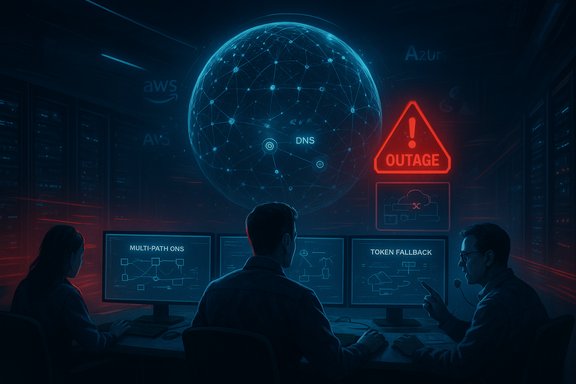
The internet blinked — and in 2025 that blink was not an isolated outage but a string of cascading control‑plane failures that turned habitual confidence in “the cloud” into an urgent conversation about resilience, vendor transparency, and the architectural choices that create systemic risk.
Background / Overview
The modern public cloud is strikingly consolidated. As of mid‑2025, the three largest providers — Amazon Web Services, Microsoft Azure and Google Cloud — together controlled roughly two‑thirds of global infrastructure spend. That market concentration matters because a handful of control‑plane primitives — DNS, global edge routing, identity issuance and managed metadata stores — are reused by millions of applications. When those primitives fail, the failure mode looks, to users and downstream apps, like “the internet went dark” even when compute fleets and storage systems remain technically intact.2025’s most visible outages clustered around exactly those primitives. A high‑profile AWS incident in October traced to DNS resolution problems for DynamoDB endpoints inside the US‑EAST‑1 region; a separate late‑October outage at Microsoft was caused by an inadvertent configuration change in Azure Front Door (AFD); and Cloudflare’s mid‑November failure was rooted in a malformed bot‑management configuration file that cascaded across its global proxies. Each event was different in origin but similar in effect: authentication failures, 5xx gateway responses, blank admin consoles, throttled orchestration and long recovery tails.
This feature unpacks what failed, why those failures cascaded, who was hurt, and — most importantly for IT teams and Windows administrators — what practical changes reduce the blast radius of future incidents.
Anatomy of the outages: what actually broke
DNS and control‑plane failures (AWS, October 20, 2025)
The October AWS event began with DNS resolution errors for DynamoDB endpoints in the US‑EAST‑1 (Northern Virginia) region. Because DynamoDB and related regional metadata are used by multiple AWS subsystems for orchestration and state, the DNS problem propagated: instance launches failed, Lambda invocations timed out, and health checks produced misleading signals. The proximate fix — restoring correct DNS state and stopping the faulty automation — was followed by hours of backlog clearing, throttling and staged remediation. Independent reporting captured widespread consumer and enterprise impacts, and researchers warned that headline tallies of user reports vary by methodology and should be treated as indicative rather than audited. Why DNS becomes so catastrophic in a cloud environment is simple but often misunderstood: DNS is no longer just name→IP translation. Modern clouds use DNS for service discovery, endpoint selection, and internal control wiring. A missing or malformed record can turn healthy servers into unreachable islands. When clients and SDKs aggressively retry, the result can be a “thundering herd” that amplifies the outage and extends recovery windows.Global edge routing and configuration (Microsoft Azure, October 29, 2025)
Nine days later, Microsoft reported a severe disruption tied to Azure Front Door (AFD), its global Layer‑7 edge and application delivery fabric. The trigger was an inadvertent configuration change that propagated an invalid state across many PoPs (Points of Presence). The visible symptoms were near‑instantaneous: failed sign‑ins for Microsoft 365 and Xbox, blank admin blades in the Azure Portal, and 502/504 gateway responses for AFD‑fronted customer endpoints. Microsoft’s containment playbook — block further configuration changes, deploy a last‑known‑good configuration, and fail management surfaces away from the troubled fabric — worked, but DNS and global routing convergence meant some tenants experienced long tails of degraded behavior. This outage underlines a core architectural reality: when the “front door” handles TLS termination, routing, identity fronting and WAF rules, a single faulty change can ripple across authentication and management paths, making recovery complex because the very surfaces used to fix problems are sometimes the ones impaired.Edge policy and configuration propagation (Cloudflare, November 18, 2025)
Cloudflare’s November incident was caused by a permissions change in a ClickHouse cluster that led to duplicate rows in a model feature file used by Bot Management. That doubled the file’s size beyond a hardcoded expectation in the proxy software, which then began returning HTTP 5xx errors across large swaths of the network. Because the feature file was regenerated and propagated every five minutes, the network experienced oscillating behavior — intermittent recovery followed by repeat failure — until operators stopped propagation, rolled back to a known good file, and restarted proxies. Cloudflare published a detailed post‑mortem and pledged remediation such as stricter validation, global kill switches and ingestion hardening. Cloudflare’s incident is a cautionary example of how internal configuration pipelines and data ingestion paths — not just external attacks or capacity problems — can disable critical edge infrastructure that sits at the first hop for billions of requests.Authentication and shared third‑party infrastructure (Holiday gaming outages, Dec 24–25, 2025)
Holiday gaming outages in late December, affecting Fortnite, Rocket League, Steam and other major titles, highlighted another dimension of concentration risk: shared authentication providers and platform services. Many titles rely on shared back ends such as Epic Online Services (EOS) or federated sign‑in flows; when those services degrade under holiday load or internal faults, multiple games and platforms experience simultaneous login failures even if game servers themselves are operational. Epic’s public status page documented intermittent login issues on December 25, and multiple outlets recorded widespread player reports through the holiday peak. Attribution in these cross‑platform incidents is often noisy in real‑time; vendor status pages and post‑incident reports are necessary to separate correlation from causation.What made 2025 different — systemic enablers of cascade
2025’s outages share common structural enablers that made them more visible and destructive than isolated server failures.- Control‑plane centralization: Many cloud features — metadata stores, identity services, global routing fabrics — are implicitly treated as always‑available. That assumption converts a local configuration error into a global outage when those services are widely reused.
- Automated rollout velocity without conservative guardrails: Rapid deployment systems and automation pipelines reduce human error in many cases but can also allow a bad config or DB permission change to propagate globally before rollbacks can be enacted.
- Retry amplification and lack of jitter: SDKs and internal control loops that retry aggressively without randomized backoff magnify transient failures into capacity storms, slowing recovery and increasing error footprints.
- Opaque dependency graphs: Customers often cannot easily map which cloud primitives their applications implicitly depend on, making planning for failure and purchasing resilience difficult.
Who paid the price — business, operational and human impacts
The outages hit a broad cross‑section of users and industries. Consumer apps and gaming platforms suffered login failures and interrupted real‑time features; retailers and food services reported point‑of‑sale and ordering disruptions; airlines experienced check‑in and payment delays; and enterprise productivity suites (Microsoft 365, Google Workspace) saw authentication and admin‑portal failures that slowed work and incident response. The cumulative human cost included lost transactions, delayed flights, developer firefighting hours, and eroded customer trust — measurable impacts that translated into direct and reputational losses for affected companies. Quantifying financial damage precisely is hard in real time and depends on vertical (ad‑driven platforms lose revenue differently than airlines). Many public figures circulating on social trackers and aggregators are estimates; treat aggregate counts like “millions of Downdetector reports” as indicative of scale rather than precise audited loss metrics. That caveat was explicitly noted in multiple incident reconstructions.Strengths revealed by the incidents
Despite the visible damage, these outages also showcased engineering strengths that prevented worse outcomes.- Rapid incident triage and rollback: In each high‑profile event, provider engineers were able to identify proximate causes, block further harmful rollouts, and restore last‑known‑good states or stop faulty propagations within hours. That response model — freeze, rollback, route around the bad components — is a core competency that limited the scope of many outages.
- Transparent public status communications: Large providers maintained public status pages and posted detailed technical updates, which helped customers and the press correlate symptoms and mitigation timelines (even as precise impact tallies diverged by tracker).
- Post‑incident commitments: Several vendors committed to specific remediation steps — feature‑file validation and kill switches at Cloudflare, deployment validation and rollback safety improvements at Microsoft, and promises of deeper analysis from AWS — a necessary precondition for long‑term improvement.
Weaknesses exposed and ongoing risks
The outages also exposed enduring weaknesses that should concern customers, regulators, and engineers.- Single‑point control‑plane assumptions: Many architectures assume control planes and global routing fabrics are effectively infallible. 2025 showed they are not. Reducing blast radius requires treating DNS, identity, edge routing and other primitives as first‑class failure modes in designs and SLAs.
- Insufficient canarying and cross‑PoP validation: Changes that propagate to global PoPs without conservative, geographically distributed canaries increase the chance of global failures. Microsoft’s AFD incident is a case in point.
- Lack of customer‑level observability into provider internals: Customers cannot always see the exact interplay between a provider’s internal configuration or a DB permission change and their own app behavior. That opacity makes failure diagnosis slow and planning difficult.
- Operational complacency around authentication failovers: Many apps fail hard on identity or token store failures instead of providing reduced‑functionality offline modes or cached authentication fallbacks — a brittle choice for mission‑critical workflows. Holiday gaming outages underscored this dependency.
A practical resilience playbook for enterprise IT and Windows administrators
No single strategy eliminates cloud risk, but layered, rehearsed measures reduce exposure. Priorities:- Inventory dependencies
- Map every production flow to the cloud primitives it uses: DNS, managed databases (DynamoDB, Cosmos DB), identity services (Azure AD/Entra ID, Google Identity), edge WAF/CDN services, and third‑party authentication providers. This mapping should be part of every DR and procurement review.
- Design for control‑plane failure
- Add reduced‑functionality modes: cached tokens, offline reads, or degraded but usable admin consoles.
- Where possible, decouple business‑critical writes from a single managed metadata store; use queued, idempotent retries with circuit breakers and jitter.
- Multi‑path for identity and DNS
- Ensure authentication flows have alternate token issuers or cached SSO pathways for short windows.
- Use multiple independent DNS resolvers and validate client failover behavior under TTL and cache scenarios. Test these patterns regularly.
- Harden change management and canarying
- Require providers to expose meaningful canary metrics and rollback hooks; insist on conservative rollouts for global edge and bot‑management changes. Where contractual leverage exists, push for staged, geo‑segmented deployments and meaningful guardrails.
- Practice blackout drills
- Rehearse incidents where management consoles are unreachable. Maintain out‑of‑band break‑glass admin credentials and emergency automation that can be executed without the primary cloud control plane.
- Demand post‑incident rigor
- Include explicit post‑incident analysis and remediation timelines in SLAs. Require root‑cause transparency and measurable follow‑ups for incidents that materially affect service levels.
- Evaluate multi‑cloud pragmatically
- Multi‑cloud is not a silver bullet, but critical services with regulatory, safety, or revenue impact should have architected alternatives or passive cold‑standbys with validated failover scripts.
- Invest in observability and synthetic testing
- Run continuous synthetic tests that emulate DNS failures, AFD misconfigurations and bot‑management regressions at the edge. Observability must include provider‑facing instrumentation where available.
Policy and market implications
The concentrated footprint of hyperscalers means regulators and procurement teams will pay attention. Expect:- Increased scrutiny on provider operational transparency and SLAs.
- Procurement redlines requiring incident post‑mortems and concrete remediation timelines for systemic failures.
- Market pressure on challenger clouds and regional providers to offer differentiated resilience propositions for governments and critical infrastructure.
Where reporting remains uncertain — flagged caveats
A few widely circulated numbers and narratives should be treated with caution:- Aggregated “downdetector” totals and social tracker counts are useful momentum indicators but are not audited measurements of economic impact. Several incident reconstructions explicitly caution against treating headline totals as precise.
- Real financial loss estimates remain imprecise in real time; insurers and loss‑modelers will publish calibrated figures only after comprehensive claims data is available. Public analysis that attempts exact dollar tallies in the immediate aftermath should be considered provisional.
Final assessment — what 2025 taught us about the cloud
2025 did not invent outages; it re‑emphasised a lesson the industry should have internalised years ago: convenience compounds correlated risk. The major incidents of the year were not caused by capacity exhaustion or targeted attacks but by failures in the glue — DNS, edge routing, identity and internal configuration pipelines — that tie distributed systems together.That reality reshapes the conversation from “which cloud” to “how we architect on top of clouds.” The right response is not to abandon cloud at scale; it is to treat resilience as design discipline, demand stronger operational guarantees, and rehearse the exact failure modes that matter. Providers responded with transparency and technical fixes. Customers must now do their part: map dependencies, harden control‑plane failure modes, and insist that convenience comes with verifiable safeguards.
The cloud will continue to power modern software. The choice going forward is whether organisations will accept outages as an expensive and unpredictable risk, or whether they will convert recent pain into engineering investment and contractual discipline that makes future blinks less likely and less damaging.
Acknowledgement: public provider status pages and post‑incident posts were consulted to verify timelines and root‑cause summaries; independent technical reconstructions were used to cross‑check amplification, retry‑storm and propagation dynamics. Some headline tallies circulating on social platforms were flagged in contemporaneous reconstructions as provisional and are discussed here with that caution in mind.
Source: The Economic Times The year the cloud went dark: Inside 2025’s biggest tech outages
