

In 2025, major employers from UPS and Meta to Nissan, Microsoft, Starbucks, Johns Hopkins, Workday, Oracle, Dell, and Hudson’s Bay announced or carried out large job cuts across logistics, technology, retail, finance, health, autos, and public-sector-adjacent institutions. The common thread is not a single recessionary shock. It is a corporate reset in which automation, AI infrastructure spending, weak legacy business lines, and investor pressure are turning headcount into the easiest number to move. For Windows users and IT pros, the layoffs are not distant business-page weather; they are a preview of how the software, cloud, device, and support ecosystems around them are being rebuilt.
The lazy version of the 2025 layoff narrative says companies are “cutting jobs because of AI.” That is partly true, but it is also too neat. AI is the phrase executives now use to explain almost everything: capital expenditure, reorgs, hiring freezes, management flattening, productivity targets, and the quiet cancellation of work that no longer fits the new story being told to investors.
What makes the 2025 wave different is its breadth. UPS is not a chatbot company. Chiquita is not a hyperscaler. Johns Hopkins was not chasing a consumer AI assistant when it cut thousands of positions after a federal funding cliff. Hudson’s Bay was not pivoting to generative models when it hit the end of the road as a department-store institution.
Yet the pattern rhymes. Organizations that once carried complexity as a sign of scale are now treating complexity as a liability. They are closing facilities, simplifying management layers, walking away from low-margin business, consolidating plants, and shifting money toward whatever their boards believe is the next defensible margin engine.
For the technology industry, that engine is AI. For logistics, it is automation and network redesign. For retail, it is fewer stores, fewer layers, and less tolerance for slow turnarounds. For automakers, it is production capacity that matches a harsher market. The labels vary, but the managerial instinct is the same: shrink the old organization before the new one has fully proved itself.
That matters because logistics is where automation stops being abstract. A warehouse or hub is a place where software, robotics, routing systems, scanners, labor contracts, and delivery promises all collide. When UPS talks about efficiency, it is talking about real buildings, real shifts, and real routes.
The Teamsters’ pushback is therefore not just labor theater. UPS’s restructuring lands in a workforce governed by contracts, seniority, and long-running battles over how much speed and surveillance can be pushed into delivery work. Automation does not simply replace a task; it changes the bargain between employer and employee.
For IT readers, UPS is a useful warning because “digital transformation” often begins as an infrastructure modernization project and ends as a workforce redesign. A routing algorithm, a warehouse management platform, or a telemetry system may be sold internally as a productivity tool. Once deployed at scale, it becomes a management system.
Mark Zuckerberg’s “year of efficiency” did not end as a one-off correction. It became a template. Meta’s workforce strategy now appears built around a narrower definition of value: engineers aligned with AI, infrastructure, advertising optimization, and frontier research are easier to defend; teams outside those lanes live closer to the edge.
There is a cultural shift here that should not be underestimated. When a company as profitable as Meta keeps cutting, the message to the rest of the industry is not “we are in trouble.” The message is “profitability no longer protects headcount.” That is a colder, more durable standard.
It also makes AI less of a department and more of a sorting mechanism. Employees are not merely being asked whether they can use AI tools. They are being judged by whether their work fits into a company increasingly organized around AI as the central growth thesis.
The company is not shrinking because demand for Microsoft software vanished. Azure, Microsoft 365, Windows, security, GitHub, LinkedIn, Xbox, and enterprise licensing remain enormous businesses. The issue is allocation. Microsoft is redirecting money, talent, and executive attention toward AI infrastructure and AI features that require vast capital spending before their long-term returns are fully settled.
That is why the layoffs feel different from the old Windows-era restructurings. In previous cycles, Microsoft cut after failed bets, product resets, or slow-growth units. In 2025, cuts coexisted with aggressive investment. The company was not retreating from ambition; it was making room for a more expensive version of it.
For administrators and developers, the practical consequence is a Microsoft that may move faster in some areas and feel thinner in others. Support quality, documentation consistency, product polish, QA, and feature stability are all areas customers watch closely when vendors flatten teams. AI may help fill some gaps, but anyone who has administered Microsoft environments knows that automation often handles the happy path better than the weird edge case at 2:00 a.m.
Workday’s cut of about 1,750 jobs was framed around focusing investment on AI and international expansion. Oracle’s layoff figures have been harder to pin down, with reports ranging from WARN-notice-level confirmed cuts to broader claims of thousands affected, but the direction is clear enough: the company is spending heavily on cloud and AI infrastructure while trimming staff. Dell’s workforce decline from roughly 108,000 to 97,000 underscored the hardware side of the reset, where AI servers are a growth story but traditional PC and enterprise hardware cycles remain uneven.
The paradox is that AI is both a hiring engine and a layoff rationale. Companies are still recruiting for machine learning, infrastructure, data center, security, and chip-adjacent roles. At the same time, they are cutting sales, support, HR, marketing, recruiting, operations, and sometimes engineering functions that do not map cleanly to the AI buildout.
That does not mean every layoff is caused by AI. It means AI has become the organizing excuse for a broader repricing of corporate labor. If a function cannot be linked to growth, automation, or strategic infrastructure, it is more vulnerable than it was two years ago.
This is the industrial side of the transformation economy. For a decade, automakers were told the EV transition would reward speed, scale, and software-like ambition. Then demand became uneven, subsidies shifted, China’s EV makers intensified price competition, and luxury buyers proved less predictable than the spreadsheets suggested.
Nissan’s cuts are dramatic because they involve the hard assets of industrial capitalism: plants, production lines, suppliers, regional workforces, and national politics. A software company can reorganize teams across Slack and Teams. An automaker cannot casually move a factory without dragging communities and governments into the decision.
Porsche’s slower approach is designed to avoid the optics and disruption of mass layoffs, but it carries the same message. Even premium brands are not immune to a market that has become more expensive to serve and harder to forecast. The clean EV-growth curve promised by consultants has become jagged.
The department store model has been under pressure for years from e-commerce, changing urban retail patterns, debt, and the hollowing out of mall traffic. The brand still had history, recognition, and emotional weight. It did not have enough economic gravity to withstand the structural shift.
Disney and Starbucks show the less terminal version of the retail and media reset. Disney cut hundreds of roles in marketing, development, and corporate functions as Bob Iger continued reshaping the company around streaming economics, theatrical discipline, and a more restrained content machine. Starbucks eliminated 1,100 corporate positions while trying to simplify management and restore store-level performance.
The lesson is that consumer brands can remain famous while their operating models become unsustainable. A beloved logo is not a labor strategy. If anything, strong brands now give executives more cover to cut behind the scenes while presenting the public face as unchanged.
This kind of job loss is different from a company chasing margin. It is what happens when institutional employment depends on grants, contracts, and government priorities that can change abruptly. A university or NGO-adjacent program may look stable from the outside, but its payroll can be tied to funding streams that disappear with a policy decision.
The United Nations Secretariat’s reported reductions, driven by funding shortfalls and budget pressure, belong in the same category. International institutions are labor-intensive because diplomacy, field operations, humanitarian coordination, and administration require people in places where software alone cannot substitute for trust or presence. When member-state funding falters, those people become the variable.
These cuts also complicate the “AI did it” story. The 2025 layoff wave is not reducible to automation. It is a broader age of institutional fragility in which public funding, private capital, consumer demand, and technology transition are all becoming less forgiving.
Agricultural supply chains are especially exposed because they combine perishable goods, concentrated geographies, labor intensity, weather risk, infrastructure bottlenecks, and political pressure. When protests, legislation, or social-security disputes paralyze operations, companies can respond with withdrawal as well as negotiation.
For readers used to thinking in terms of cloud availability zones and endpoint management, Chiquita is a reminder that “resilience” is not only a technical property. A supply chain can have redundant systems and still fail if the social contract around the workforce breaks down. The same is true, in a different form, for logistics hubs, factories, and health programs.
That is why the 2025 layoff list feels so strange at first glance. Bananas, cloud servers, cartoon mice, and luxury cars do not share a market. They share exposure to systems being reoptimized under stress.
That distinction matters. A selective cut can be a sign of weakness, but it can also be a sign of managerial opportunism. If the broader labor market has normalized layoffs, executives can make changes that would have looked harsher in a tighter hiring environment.
Finance also has a long history of using technology to remove friction and labor from transactions. Branch networks, call centers, compliance workflows, underwriting, fraud monitoring, and customer service have all been reshaped by software. AI simply gives firms a new language and a new toolkit for continuing that process.
The risk is that too much trimming leaves institutions brittle. Customers rarely notice the absence of back-office capacity until a dispute, outage, fraud incident, or regulatory failure exposes it. Efficiency is visible on earnings calls before fragility is visible in operations.
This is especially true in technology. The largest AI bets require enormous upfront spending, but the revenue model is still uneven. Copilots, agents, premium subscriptions, inference APIs, AI PCs, and enterprise automation tools are all promising, but they are not guaranteed to produce margins comparable to classic software licensing. The bill for infrastructure arrives before the proof of durable demand.
So companies cut where the story is least defensible. Middle management becomes “layers.” Support becomes “efficiency.” Content development becomes “focus.” Recruiting becomes “discipline.” Facilities become “network optimization.” The vocabulary changes, but the intent is to restore leverage.
That does not make the strategy irrational. Some companies genuinely became bloated during the zero-interest-rate growth years. Some legacy operations really are misaligned with current demand. Some automation will remove work that no customer wants to pay for. But the bluntness of the cuts shows that corporate America is often better at removing cost than redesigning work humanely.
They may show up as slower support queues, thinner account coverage, more self-service portals, more AI chatbots between customers and humans, and faster retirement of legacy features. They may appear as aggressive upsells into AI tiers, bundled assistants, or “modernized” admin experiences that automate common tasks while making unusual workflows harder. They may appear as documentation that increasingly reads as machine-maintained rather than field-tested.
The danger is not that AI tools are useless. Many are already useful, especially for summarization, scripting assistance, log triage, and repetitive administrative work. The danger is that vendors use AI’s usefulness to justify removing the human structures that made complex systems survivable.
Anyone who has managed Windows estates at scale knows the difference between a feature demo and a production dependency. Enterprises do not merely need innovation. They need predictable patching, clear deprecation timelines, responsive escalation paths, and support teams that understand the difference between a forum workaround and a regulated environment.
Dell’s shrinking headcount is a case in point. The company is central to the enterprise PC and server market, and it is deeply involved in the AI infrastructure boom. But if a hardware vendor tightens its workforce while repositioning around AI, customers may reasonably ask where the cuts land: sales engineering, support, logistics, firmware validation, driver testing, or internal operations.
The AI PC transition is already more complicated than the marketing suggests. Businesses must evaluate device refresh cycles, Windows 11 readiness, security baselines, app compatibility, endpoint management, data governance, and whether local AI workloads justify premium hardware. That requires guidance, not just slogans.
If the channel becomes thinner and more automated, smaller businesses may be left with generic advice. Large enterprises will still get attention because they buy at scale. The middle of the market could end up with the worst combination: expensive new requirements and less human help navigating them.
This language matters because it changes how employees, customers, and investors interpret job cuts. A layoff once implied something had gone wrong. Now it can be presented as evidence that management is doing exactly what it promised.
There is a brutal efficiency to that logic. If the stock market rewards margin discipline and AI positioning, executives have a strong incentive to announce both in the same breath. The cut becomes proof of seriousness. The AI plan becomes proof of imagination.
But strategy-by-layoff carries long-term costs. Companies lose institutional memory, informal expertise, customer relationships, and operational slack. Those losses rarely appear immediately on a balance sheet. They appear later, when a migration fails, a plant restart slips, a customer churns, or a support incident spirals because the person who knew the old system is gone.
For IT leaders, vendor layoffs should now be part of procurement and risk review. If a critical supplier is cutting heavily while promising a major platform transition, customers should ask what happens to support, roadmap commitments, security response, and legacy compatibility. The cheapest contract may become expensive if the vendor no longer has enough people behind it.
For workers, the old advice to join a large, stable organization looks weaker than it once did. Scale still matters, but alignment matters more. Roles tied to growth narratives, infrastructure modernization, security, compliance, and customer-critical operations may be safer than roles viewed as coordination layers or legacy overhead.
For policymakers and communities, the year’s cuts show how fragile local economies can be when a single employer changes direction. A closed plant, shuttered hub, liquidated retailer, or canceled grant program is not just a line in a corporate filing. It is a shock that moves through households, suppliers, tax bases, and public services.
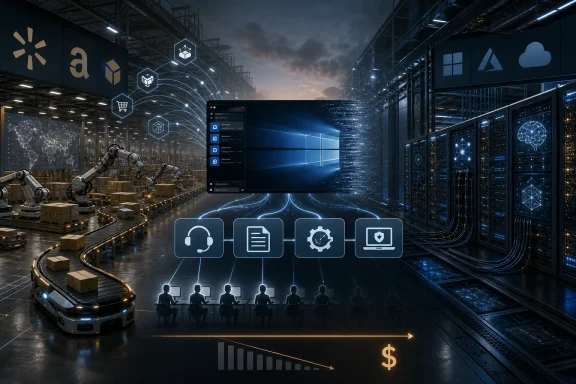 The Layoff Story Is No Longer Just a Tech Story
The lazy version of the 2025 layoff narrative says companies are “cutting jobs because of AI.” That is partly true, but it is also too neat. AI is the phrase executives now use to explain almost everything: capital expenditure, reorgs, hiring freezes, management flattening, productivity targets, and the quiet cancellation of work that no longer fits the new story being told to investors.What makes the 2025 wave different is its breadth. UPS is not a chatbot company. Chiquita is not a hyperscaler. Johns Hopkins was not chasing a consumer AI assistant when it cut thousands of positions after a federal funding cliff. Hudson’s Bay was not pivoting to generative models when it hit the end of the road as a department-store institution.
Yet the pattern rhymes. Organizations that once carried complexity as a sign of scale are now treating complexity as a liability. They are closing facilities, simplifying management layers, walking away from low-margin business, consolidating plants, and shifting money toward whatever their boards believe is the next defensible margin engine.
For the technology industry, that engine is AI. For logistics, it is automation and network redesign. For retail, it is fewer stores, fewer layers, and less tolerance for slow turnarounds. For automakers, it is production capacity that matches a harsher market. The labels vary, but the managerial instinct is the same: shrink the old organization before the new one has fully proved itself.
UPS Shows What Automation Looks Like When It Leaves the Slide Deck
UPS became one of the year’s clearest examples because its cuts were large, tangible, and tied to a familiar name: Amazon. The company announced plans to eliminate 20,000 jobs and close dozens of facilities as it reduced lower-margin Amazon volume and pushed deeper into automation. This was not a speculative Silicon Valley reorg; it was a physical network being redrawn.That matters because logistics is where automation stops being abstract. A warehouse or hub is a place where software, robotics, routing systems, scanners, labor contracts, and delivery promises all collide. When UPS talks about efficiency, it is talking about real buildings, real shifts, and real routes.
The Teamsters’ pushback is therefore not just labor theater. UPS’s restructuring lands in a workforce governed by contracts, seniority, and long-running battles over how much speed and surveillance can be pushed into delivery work. Automation does not simply replace a task; it changes the bargain between employer and employee.
For IT readers, UPS is a useful warning because “digital transformation” often begins as an infrastructure modernization project and ends as a workforce redesign. A routing algorithm, a warehouse management platform, or a telemetry system may be sold internally as a productivity tool. Once deployed at scale, it becomes a management system.
Meta Turns Performance Management Into a Permanent Operating System
Meta’s 2025 cuts fit a different but equally important model. The company’s reported reduction of lower-rated employees and continued reallocation toward AI and “superintelligence” work showed how Big Tech has normalized layoffs as part of performance architecture. The old boom-era assumption was that giants would hire aggressively, absorb inefficiency, and let growth paper over internal sprawl. That era is gone.Mark Zuckerberg’s “year of efficiency” did not end as a one-off correction. It became a template. Meta’s workforce strategy now appears built around a narrower definition of value: engineers aligned with AI, infrastructure, advertising optimization, and frontier research are easier to defend; teams outside those lanes live closer to the edge.
There is a cultural shift here that should not be underestimated. When a company as profitable as Meta keeps cutting, the message to the rest of the industry is not “we are in trouble.” The message is “profitability no longer protects headcount.” That is a colder, more durable standard.
It also makes AI less of a department and more of a sorting mechanism. Employees are not merely being asked whether they can use AI tools. They are being judged by whether their work fits into a company increasingly organized around AI as the central growth thesis.
Microsoft’s Cuts Put a Windows Giant Inside the Same Contradiction
Microsoft’s 2025 layoffs hit close to home for WindowsForum readers because Microsoft is both a platform vendor and an ecosystem anchor. The company spent the year talking about AI infrastructure, Copilot, agents, and productivity while cutting thousands of roles across the business. That contradiction is now central to understanding Microsoft.The company is not shrinking because demand for Microsoft software vanished. Azure, Microsoft 365, Windows, security, GitHub, LinkedIn, Xbox, and enterprise licensing remain enormous businesses. The issue is allocation. Microsoft is redirecting money, talent, and executive attention toward AI infrastructure and AI features that require vast capital spending before their long-term returns are fully settled.
That is why the layoffs feel different from the old Windows-era restructurings. In previous cycles, Microsoft cut after failed bets, product resets, or slow-growth units. In 2025, cuts coexisted with aggressive investment. The company was not retreating from ambition; it was making room for a more expensive version of it.
For administrators and developers, the practical consequence is a Microsoft that may move faster in some areas and feel thinner in others. Support quality, documentation consistency, product polish, QA, and feature stability are all areas customers watch closely when vendors flatten teams. AI may help fill some gaps, but anyone who has administered Microsoft environments knows that automation often handles the happy path better than the weird edge case at 2:00 a.m.
The Cloud Is Spending Like a Boom and Hiring Like a Bust
Oracle, Workday, Dell, and Microsoft all illustrate the same uncomfortable equation: AI infrastructure is expensive enough that even healthy technology companies are looking for labor offsets. GPUs, data centers, power contracts, memory, networking gear, and model development do not pay for themselves. If executives promise investors that AI will be transformational, they also need to show discipline somewhere else.Workday’s cut of about 1,750 jobs was framed around focusing investment on AI and international expansion. Oracle’s layoff figures have been harder to pin down, with reports ranging from WARN-notice-level confirmed cuts to broader claims of thousands affected, but the direction is clear enough: the company is spending heavily on cloud and AI infrastructure while trimming staff. Dell’s workforce decline from roughly 108,000 to 97,000 underscored the hardware side of the reset, where AI servers are a growth story but traditional PC and enterprise hardware cycles remain uneven.
The paradox is that AI is both a hiring engine and a layoff rationale. Companies are still recruiting for machine learning, infrastructure, data center, security, and chip-adjacent roles. At the same time, they are cutting sales, support, HR, marketing, recruiting, operations, and sometimes engineering functions that do not map cleanly to the AI buildout.
That does not mean every layoff is caused by AI. It means AI has become the organizing excuse for a broader repricing of corporate labor. If a function cannot be linked to growth, automation, or strategic infrastructure, it is more vulnerable than it was two years ago.
Nissan and Porsche Reveal the Industrial Version of the Same Reset
The auto industry’s 2025 layoff story is less about generative AI and more about overcapacity, EV uncertainty, Chinese competition, and expensive transitions. Nissan’s restructuring, including thousands of job cuts and plans to close factories, reflected a company trying to resize itself after weak sales, failed strategic momentum, and pressure in the global EV race. Porsche’s plan to reduce jobs gradually through attrition and hiring restraint showed a softer version of the same anxiety.This is the industrial side of the transformation economy. For a decade, automakers were told the EV transition would reward speed, scale, and software-like ambition. Then demand became uneven, subsidies shifted, China’s EV makers intensified price competition, and luxury buyers proved less predictable than the spreadsheets suggested.
Nissan’s cuts are dramatic because they involve the hard assets of industrial capitalism: plants, production lines, suppliers, regional workforces, and national politics. A software company can reorganize teams across Slack and Teams. An automaker cannot casually move a factory without dragging communities and governments into the decision.
Porsche’s slower approach is designed to avoid the optics and disruption of mass layoffs, but it carries the same message. Even premium brands are not immune to a market that has become more expensive to serve and harder to forecast. The clean EV-growth curve promised by consultants has become jagged.
Retail’s Old Giants Are Discovering That Nostalgia Does Not Pay Rent
Hudson’s Bay offered one of the starkest non-tech examples of the year. Canada’s oldest department store chain did not merely trim around the edges; it entered liquidation and shed most of its remaining workforce. If Big Tech layoffs are about reallocating toward the future, Hudson’s Bay was about finally running out of runway.The department store model has been under pressure for years from e-commerce, changing urban retail patterns, debt, and the hollowing out of mall traffic. The brand still had history, recognition, and emotional weight. It did not have enough economic gravity to withstand the structural shift.
Disney and Starbucks show the less terminal version of the retail and media reset. Disney cut hundreds of roles in marketing, development, and corporate functions as Bob Iger continued reshaping the company around streaming economics, theatrical discipline, and a more restrained content machine. Starbucks eliminated 1,100 corporate positions while trying to simplify management and restore store-level performance.
The lesson is that consumer brands can remain famous while their operating models become unsustainable. A beloved logo is not a labor strategy. If anything, strong brands now give executives more cover to cut behind the scenes while presenting the public face as unchanged.
Johns Hopkins and the UN Show How Funding Cuts Become Labor Cuts
Not every layoff in 2025 came from corporate repositioning. Johns Hopkins’ more than 2,200 job cuts followed the termination of hundreds of millions of dollars in USAID-linked funding. The university’s reductions hit public health and medical programs across the United States and dozens of countries, making the layoff story inseparable from policy.This kind of job loss is different from a company chasing margin. It is what happens when institutional employment depends on grants, contracts, and government priorities that can change abruptly. A university or NGO-adjacent program may look stable from the outside, but its payroll can be tied to funding streams that disappear with a policy decision.
The United Nations Secretariat’s reported reductions, driven by funding shortfalls and budget pressure, belong in the same category. International institutions are labor-intensive because diplomacy, field operations, humanitarian coordination, and administration require people in places where software alone cannot substitute for trust or presence. When member-state funding falters, those people become the variable.
These cuts also complicate the “AI did it” story. The 2025 layoff wave is not reducible to automation. It is a broader age of institutional fragility in which public funding, private capital, consumer demand, and technology transition are all becoming less forgiving.
Chiquita’s Panama Cuts Are a Reminder That Supply Chains Still Have Politics
Chiquita’s layoffs in Panama, reportedly affecting thousands of agricultural and logistics workers after prolonged protests and operational disruption, belong to yet another category: supply-chain politics. Bananas may sound like the oddball entry in a layoff roundup, but they make the point better than another software vendor would. Global businesses depend on local stability.Agricultural supply chains are especially exposed because they combine perishable goods, concentrated geographies, labor intensity, weather risk, infrastructure bottlenecks, and political pressure. When protests, legislation, or social-security disputes paralyze operations, companies can respond with withdrawal as well as negotiation.
For readers used to thinking in terms of cloud availability zones and endpoint management, Chiquita is a reminder that “resilience” is not only a technical property. A supply chain can have redundant systems and still fail if the social contract around the workforce breaks down. The same is true, in a different form, for logistics hubs, factories, and health programs.
That is why the 2025 layoff list feels so strange at first glance. Bananas, cloud servers, cartoon mice, and luxury cars do not share a market. They share exposure to systems being reoptimized under stress.
Finance Is Cutting Selectively, Not Panicking
Ally Financial’s roughly 500 job cuts were smaller than the headline reductions at UPS or Nissan, but they fit the pattern of selective restructuring. Banks and financial platforms are not necessarily slashing because they face immediate collapse. They are trimming roles while redirecting spending toward digital banking, risk systems, automation, and higher-growth technology functions.That distinction matters. A selective cut can be a sign of weakness, but it can also be a sign of managerial opportunism. If the broader labor market has normalized layoffs, executives can make changes that would have looked harsher in a tighter hiring environment.
Finance also has a long history of using technology to remove friction and labor from transactions. Branch networks, call centers, compliance workflows, underwriting, fraud monitoring, and customer service have all been reshaped by software. AI simply gives firms a new language and a new toolkit for continuing that process.
The risk is that too much trimming leaves institutions brittle. Customers rarely notice the absence of back-office capacity until a dispute, outage, fraud incident, or regulatory failure exposes it. Efficiency is visible on earnings calls before fragility is visible in operations.
The Real Story Is Capital Discipline Wearing an AI Badge
The phrase “making room for AI” can obscure as much as it reveals. In many companies, the layoffs are not paying directly for a specific model or product. They are part of a broader campaign to convince investors that management can fund the future without letting costs run wild.This is especially true in technology. The largest AI bets require enormous upfront spending, but the revenue model is still uneven. Copilots, agents, premium subscriptions, inference APIs, AI PCs, and enterprise automation tools are all promising, but they are not guaranteed to produce margins comparable to classic software licensing. The bill for infrastructure arrives before the proof of durable demand.
So companies cut where the story is least defensible. Middle management becomes “layers.” Support becomes “efficiency.” Content development becomes “focus.” Recruiting becomes “discipline.” Facilities become “network optimization.” The vocabulary changes, but the intent is to restore leverage.
That does not make the strategy irrational. Some companies genuinely became bloated during the zero-interest-rate growth years. Some legacy operations really are misaligned with current demand. Some automation will remove work that no customer wants to pay for. But the bluntness of the cuts shows that corporate America is often better at removing cost than redesigning work humanely.
Windows Users Will Feel the Layoffs as Product Texture, Not Press Releases
For Windows enthusiasts and IT pros, the question is not whether UPS closes a hub or Adidas trims a headquarters team. The question is how this same logic changes the products and services they rely on every day. Layoffs at Microsoft, Dell, Oracle, Workday, and other enterprise vendors eventually show up as product texture.They may show up as slower support queues, thinner account coverage, more self-service portals, more AI chatbots between customers and humans, and faster retirement of legacy features. They may appear as aggressive upsells into AI tiers, bundled assistants, or “modernized” admin experiences that automate common tasks while making unusual workflows harder. They may appear as documentation that increasingly reads as machine-maintained rather than field-tested.
The danger is not that AI tools are useless. Many are already useful, especially for summarization, scripting assistance, log triage, and repetitive administrative work. The danger is that vendors use AI’s usefulness to justify removing the human structures that made complex systems survivable.
Anyone who has managed Windows estates at scale knows the difference between a feature demo and a production dependency. Enterprises do not merely need innovation. They need predictable patching, clear deprecation timelines, responsive escalation paths, and support teams that understand the difference between a forum workaround and a regulated environment.
The AI PC Arrives in a Market That Is Cutting the People Who Explain It
The timing is awkward. Microsoft and its hardware partners are trying to sell a new era of AI PCs, neural processing units, local inference, Copilot integrations, and hybrid cloud intelligence. At the same time, the industry is reducing the very workforces that help customers understand which of those features matter.Dell’s shrinking headcount is a case in point. The company is central to the enterprise PC and server market, and it is deeply involved in the AI infrastructure boom. But if a hardware vendor tightens its workforce while repositioning around AI, customers may reasonably ask where the cuts land: sales engineering, support, logistics, firmware validation, driver testing, or internal operations.
The AI PC transition is already more complicated than the marketing suggests. Businesses must evaluate device refresh cycles, Windows 11 readiness, security baselines, app compatibility, endpoint management, data governance, and whether local AI workloads justify premium hardware. That requires guidance, not just slogans.
If the channel becomes thinner and more automated, smaller businesses may be left with generic advice. Large enterprises will still get attention because they buy at scale. The middle of the market could end up with the worst combination: expensive new requirements and less human help navigating them.
Layoffs Have Become a Feature of Strategy, Not a Failure of It
The most unsettling part of the 2025 wave is that many of these layoffs are not framed as emergencies. They are presented as strategy. UPS is becoming more profitable and automated. Meta is sharpening around AI. Microsoft is reallocating toward infrastructure. Starbucks is simplifying. Workday is investing in generative AI. Nissan is resizing. Porsche is managing transition. Chevron is integrating Hess. Disney is streamlining.This language matters because it changes how employees, customers, and investors interpret job cuts. A layoff once implied something had gone wrong. Now it can be presented as evidence that management is doing exactly what it promised.
There is a brutal efficiency to that logic. If the stock market rewards margin discipline and AI positioning, executives have a strong incentive to announce both in the same breath. The cut becomes proof of seriousness. The AI plan becomes proof of imagination.
But strategy-by-layoff carries long-term costs. Companies lose institutional memory, informal expertise, customer relationships, and operational slack. Those losses rarely appear immediately on a balance sheet. They appear later, when a migration fails, a plant restart slips, a customer churns, or a support incident spirals because the person who knew the old system is gone.
The 2025 Layoff Map Points to the Next Enterprise Risk
The concrete lesson from this year’s cuts is not that every worker should become an AI engineer or every company should resist automation. It is that organizations are entering a period in which workforce stability can no longer be assumed from size, profitability, brand strength, or institutional prestige. The risk surface has expanded.For IT leaders, vendor layoffs should now be part of procurement and risk review. If a critical supplier is cutting heavily while promising a major platform transition, customers should ask what happens to support, roadmap commitments, security response, and legacy compatibility. The cheapest contract may become expensive if the vendor no longer has enough people behind it.
For workers, the old advice to join a large, stable organization looks weaker than it once did. Scale still matters, but alignment matters more. Roles tied to growth narratives, infrastructure modernization, security, compliance, and customer-critical operations may be safer than roles viewed as coordination layers or legacy overhead.
For policymakers and communities, the year’s cuts show how fragile local economies can be when a single employer changes direction. A closed plant, shuttered hub, liquidated retailer, or canceled grant program is not just a line in a corporate filing. It is a shock that moves through households, suppliers, tax bases, and public services.
The Year’s Cuts Leave a Practical Checklist for the Windows Crowd
The 2025 layoff wave is sprawling, but it is not random. It points toward a business environment where companies are spending heavily on automation and AI while becoming less willing to carry people, facilities, or programs that do not fit the new operating model.- Large employers are cutting even when they are not in obvious crisis, which means profitability alone is no longer a reliable signal of workforce stability.
- AI is often the headline rationale, but many reductions also reflect debt, weak demand, government funding cuts, store closures, factory consolidation, and post-acquisition overlap.
- Microsoft, Dell, Oracle, and Workday show that enterprise technology customers should watch whether vendor restructuring affects support, documentation, product quality, and roadmap reliability.
- UPS, Nissan, Porsche, and Chiquita show that automation and restructuring still depend on physical infrastructure, labor relations, regulation, and local politics.
- Retail and media cuts at Hudson’s Bay, Starbucks, and Disney show that brand strength does not protect outdated operating models from financial pressure.
- IT departments should treat major vendor layoffs as operational risk signals, especially when they coincide with platform migrations, AI upsells, or support-model changes.
References
- Primary source: aol.com
Published: 2026-06-11T03:30:09.656000
17 Big Layoffs You Should Know About This Year - AOL
What do bananas, cloud servers, cartoon mice, and luxury cars have in common? They’ve all been part of 2025’s wave of layoffs.www.aol.com - Related coverage: windowscentral.com
Microsoft's cuts to employee headcount are for AI infrastructure investment | Windows Central
The Redmond giant has laid off over 15,000 people in 2025, and a report claims it's all in the name of freeing up spending money to invest more heavily in AI infrastructure to keep pace with the ever-growing AI bubble.www.windowscentral.com - Related coverage: tomshardware.com
- Related coverage: washingtonpost.com
UPS set to lay off 20,000 workers as it reduces Amazon deliveries - The Washington Post
The shipping giant said the moves were expected to save $3.5 billion and were made in anticipation of “lower volumes from our largest customer,” which is Amazon. www.washingtonpost.com
- Related coverage: techcrunch.com
Programmers bore the brunt of Microsoft's layoffs in its home state as AI writes up to 30% of its code | TechCrunch
Microsoft's Washington layoffs hit coders hardest as the tech giant embraces AI.techcrunch.com - Related coverage: wsws.org
UPS will have eliminated at least 68,000 jobs through early 2026
Public filings and earnings reports show that UPS slashed its workforce by eliminating 48,000 jobs in 2025 and that another 20,000 positions are to be cut by early 2026 as part of the company’s three-year strategic plan.www.wsws.org
- Related coverage: vcpost.com
UPS Cuts 20,000 Jobs, Closes Centers as Amazon Delivery Volume Drops
UPS to cut 20,000 jobs and close 73 facilities as it reduces Amazon deliveries and increases automation.www.vcpost.com - Related coverage: axios.com
Johns Hopkins to slash 2,200 jobs after Trump admin's USAID cuts
The university appears to be among the hardest-hit research institutions affected by federal cuts.www.axios.com
- Related coverage: restaurantdive.com
Starbucks lays off 1,100 corporate workers | Restaurant Dive
The coffee giant is cutting about 6.9% of its non-retail staff, and is shifting corporate hiring to prioritize in-office roles.www.restaurantdive.com
- Related coverage: entrepreneur.com
Starbucks Layoffs: Eliminate 1100 Corporate Jobs, Open Roles
The workers who are being laid off will be told by midday on Tuesday, Feb. 25.www.entrepreneur.com - Related coverage: bloomberg.co.jp
- Related coverage: finalroundai.com
Dell Layoffs 2025-2026: ~12,000 Cut | Final Round AI
Dell layoffs (2024 - 2026): 36,000 affected in Hardware. Get severance answers, visa guidance, layoff FAQs, and AI interview prep to land your next role.www.finalroundai.com
