

PCMag’s year‑end ledger of the services and hardware that “died in 2025” reads like a map of an industry reshaping itself around scale, AI compute, and product consolidation — from the calendar‑driven retirement of Windows 10 to the quiet death of novelty gadgets and the abrupt removal of long‑trusted convenience features.
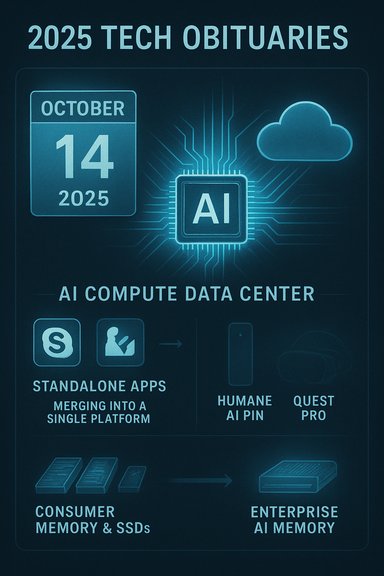
2025’s shutdowns clustered into four clear themes: scheduled lifecycle endings, strategic consolidation of standalone apps into platform stacks, the pruning of speculative hardware experiments, and supply‑side realignments that prioritized AI datacenter demand over consumer channels. Each category had predictable ripples: security risk for unsupported platforms, fewer choices for consumers, and rising prices or shortages for components. These patterns are not isolated anecdotes — they reflect how vendors allocate scarce engineering and manufacturing resources in the age of large AI customers.
This feature synthesizes the PCMag roundup, verifies major dates and technical specifications against vendor notices and independent reporting, and offers a practical playbook for Windows users, IT teams, and PC builders who need to navigate the fallout. The most consequential retirements — Windows 10’s end of support and several high‑profile platform and hardware sunsettings — are confirmed in primary vendor channels and by independent outlets; where PCMag cites financial figures or opaque motives, those items are flagged as reported rather than independently verified.
Notable examples:
The most visible example: Amazon quietly removed the “Download & Transfer via USB” option for Kindle purchases on February 26, 2025, a feature many used as a personal backup or a bridge to other e‑readers. Independent reporting documented the change and Amazon’s confirmation, and observers warned that losing this export option reduces consumers’ practical ownership. Similarly, Meta’s move to save development costs by discontinuing long‑tail mixed‑reality hardware and Google’s changes to upload/cast behaviors (e.g., Steam on ChromeOS losing support) are part of a broader trend in which convenience is preserved at the platform level while portability is curtailed. PCMag’s roundup catalogs these removals as part of a larger pattern that reduces redundancy but also user autonomy.
Caution: some retrospective pieces repeat monetary figures or internal motives that lack direct public confirmation. For example, PCMag referenced corporate donations and settlement figures in describing political activity and platform policy shifts; those claims should be treated as reported and checked against primary filings for confirmation.
Advocates and refurbishers stepped in to mitigate some harms, offering low‑cost upgrade paths and redistribution programs, but the scale of retirements in 2025 renewed calls for:
Source: PCMag The Final Shutdown: Pour One Out for the Tech That Died in 2025
 Background / Overview
2025’s shutdowns clustered into four clear themes: scheduled lifecycle endings, strategic consolidation of standalone apps into platform stacks, the pruning of speculative hardware experiments, and supply‑side realignments that prioritized AI datacenter demand over consumer channels. Each category had predictable ripples: security risk for unsupported platforms, fewer choices for consumers, and rising prices or shortages for components. These patterns are not isolated anecdotes — they reflect how vendors allocate scarce engineering and manufacturing resources in the age of large AI customers.This feature synthesizes the PCMag roundup, verifies major dates and technical specifications against vendor notices and independent reporting, and offers a practical playbook for Windows users, IT teams, and PC builders who need to navigate the fallout. The most consequential retirements — Windows 10’s end of support and several high‑profile platform and hardware sunsettings — are confirmed in primary vendor channels and by independent outlets; where PCMag cites financial figures or opaque motives, those items are flagged as reported rather than independently verified.
The tectonic moments
Windows 10: a calendar that forced choices
Microsoft’s decision to end mainstream support for Windows 10 on October 14, 2025 was a hard lifecycle event: after that date, routine security updates and feature patches for most Windows 10 editions ceased and users were steered to Windows 11 or to the Extended Security Updates (ESU) program as a temporary bridge. Microsoft’s official lifecycle pages confirm the date and the migration options. The practical difficulty is well understood: Windows 11 enforces stricter hardware requirements — notably TPM 2.0, UEFI/Secure Boot, and a list of supported CPUs — leaving many functionally fine machines ineligible for a straight in‑place upgrade. Microsoft documents the requirements and remediation steps to check or enable TPM and Secure Boot. Why this matters: when an OS that powers hundreds of millions of PCs stops receiving security fixes, institutions and households face three unattractive paths — pay for ESU (a temporary, paid option), purchase new hardware that meets Windows 11 requirements, or migrate to an alternative OS (ChromeOS Flex, Linux). That reality turned a software lifecycle into an immediate hardware and procurement problem for schools, small businesses, and budget‑constrained users. Independent reporting captured both the technical gatekeeping and the social consequences of the cutoff. Practical short list for Windows 10 holdouts:- Run Microsoft’s PC Health Check and vendor compatibility tools.
- Prioritize internet‑facing and mission‑critical endpoints for ESU or hardware refresh.
- Where upgrade isn’t feasible, prepare a migration plan to ChromeOS Flex or a supported Linux distribution and budget for application compatibility testing.
GPT‑4 retired from ChatGPT — model churn as operational risk
OpenAI removed GPT‑4 from the ChatGPT model picker on April 30, 2025 and made GPT‑4o the consumer‑facing successor; GPT‑4 remained available in the API for developers who needed continuity. OpenAI’s release notes document the change and the company’s rationale: GPT‑4o is a natively multimodal model with improved performance and lower latency. The operational lesson is stark: AI model deprecation is now a production‑scale lifecycle event. Organizations that embed model‑specific behavior into products must treat deprecation as a planned migration project — one that requires retesting, prompt redesign, and safety validation. The GPT‑4 → GPT‑4o transition is a clear example of how quickly behavior at the foundation of services can change and why portability and fallback paths belong in contracts and runbooks.Micron pivots away from consumer Crucial products
In December 2025 Micron announced it would exit the Crucial consumer memory and SSD business to prioritize high‑bandwidth memory and enterprise DRAM for AI data centers, effectively ending Crucial‑branded shipments by February 2026. Reuters covered the decision as part of a broader industry shift toward HBM and datacenter‑grade memory. This move illustrates how demand from hyperscale AI customers is reshaping component supply and pricing for consumer builders. Implication for PC builders: expect higher consumer DRAM and SSD prices and tighter availability in the near term, and add supply‑diversification or earlier procurement to build timelines.Platform consolidation and the death of standalone apps
2025 saw vendors fold small, low‑usage apps into larger platforms as a deliberate strategy to reduce duplication and increase user engagement on sticky properties. Two emblematic examples:- Skype: Microsoft retired the consumer Skype client in May 2025 and funneled users toward Microsoft Teams (Teams Free). Microsoft published a migration timeline and guidance for exporting data and preserving calling subscriptions.
- Zelle and other standalone utilities: Zelle shuttered its standalone app after usage migrated overwhelmingly into bank apps; Dropbox exited the password‑manager market; PlayStation ended its PlayStation Stars loyalty program. These moves reflect the economics of scale — maintaining small, low‑traffic apps is expensive relative to embedding the same features in a platform with millions of daily users.
Failed hardware experiments: novelty doesn’t buy daily utility
Hardware that tried to sell “AI as an appliance” struggled in 2025. The pattern was consistent: high price, marginal day‑to‑day utility compared with an existing smartphone or watch, and customer dissatisfaction that made continued investment uneconomic.Notable examples:
- Humane AI Pin: Humane sold key IP and personnel to HP and discontinued the Pin after poor reviews and weak sales; HP acquired Humane’s AI platform and patents in February 2025. Humane warned that devices would stop working when server support ended.
- Meta Quest Pro: Meta stopped selling the $1,500 Quest Pro as it refocused on more mass‑market headsets like Quest 3. The headset’s high price and limited broader adoption led to the line being wound down.
- Dyson Zone: Dyson acknowledged the Zone air‑purifying headphones weren’t commercially viable and wound the program down after limited uptake.
Cloud‑first control moves and the erosion of portability
A thread through many retirements was reduced owner control over purchased content and device features. Vendors removed offline or local export paths that once gave consumers more control.The most visible example: Amazon quietly removed the “Download & Transfer via USB” option for Kindle purchases on February 26, 2025, a feature many used as a personal backup or a bridge to other e‑readers. Independent reporting documented the change and Amazon’s confirmation, and observers warned that losing this export option reduces consumers’ practical ownership. Similarly, Meta’s move to save development costs by discontinuing long‑tail mixed‑reality hardware and Google’s changes to upload/cast behaviors (e.g., Steam on ChromeOS losing support) are part of a broader trend in which convenience is preserved at the platform level while portability is curtailed. PCMag’s roundup catalogs these removals as part of a larger pattern that reduces redundancy but also user autonomy.
Caution: some retrospective pieces repeat monetary figures or internal motives that lack direct public confirmation. For example, PCMag referenced corporate donations and settlement figures in describing political activity and platform policy shifts; those claims should be treated as reported and checked against primary filings for confirmation.
Policy, environment, and the e‑waste problem
Windows 10’s end of support and Windows 11’s hardware gating amplified e‑waste and equity concerns. Devices that are functionally useful but fail to meet a vendor’s security gating requirements are forced toward replacement, pressuring budgets for schools, nonprofits, and households.Advocates and refurbishers stepped in to mitigate some harms, offering low‑cost upgrade paths and redistribution programs, but the scale of retirements in 2025 renewed calls for:
- mandatory point‑of‑sale lifecycle disclosures so buyers understand software support windows at purchase;
- procurement rules that favor repairability and longer vendor support commitments;
- public funding or tax incentives to expand certified refurbishment programs for devices made obsolete by policy rather than performance.
Practical playbook: what to do now (condensed, actionable)
- Inventory and triage.
- Run PC Health Check to confirm Windows 11 eligibility and catalog devices by criticality and upgrade feasibility.
- Prioritize exposure.
- Put internet‑facing and mission‑critical Windows 10 endpoints into ESU or refresh them first. ESU is a temporary bridge, not a long‑term plan.
- Back up vendor‑tethered content.
- If you rely on features slated for removal (for example, the Kindle USB download option), export and archive content while the option is still available. Independent reporting and vendor prompts advised immediate action in Feb 2025.
- Build AI‑resilient integrations.
- When embedding LLMs, design abstraction layers so you can switch models or providers with minimal regression testing; budget for model deprecation and safety re‑validation. The GPT‑4 → GPT‑4o transition is a live example.
- Hedge component supply.
- If you build PCs or run small OEM projects, pre‑purchase critical components or diversify vendors as memory and GPU supply priorities shift toward AI datacenters. Micron’s pivot is an early indicator of this dynamic.
- Demand lifecycle transparency in procurement.
- Require minimum software‑support windows and exportable data clauses in contracts with cloud vendors and hardware suppliers. The year’s retirements show that service continuity cannot be assumed.
Strengths, risks, and the verdict
What worked in 2025- Hard choices exposed engineering discipline: pruning projects freed resources for higher‑return investments (AI infrastructure, core platforms). HP’s acquisition of Humane IP and Meta’s refocus on affordable VR illustrate purposeful reallocation.
- Consolidation simplified user journeys where adoption already favored integrated stacks (e.g., Zelle within banking apps, Skype → Teams).
- Reduced portability: vendor removals of export features and local backup paths weaken consumer control of purchased content. Amazon’s Kindle USB removal is a concrete example.
- Market concentration and supply shift: prioritizing AI datacenter customers can squeeze consumer markets (memory, GPUs), disadvantaging hobbyists and small builders. Micron’s Crucial exit epitomizes this risk.
- Fragile migration tooling: many shutdowns lacked seamless migration tools, placing heavy operational burden on users and IT teams to export, replatform, or manually preserve data. PCMag’s roundup noted numerous gaps in migration support across services.
- Some end‑of‑year stories repeated numbers or alleged motives (settlement amounts, donation ties, or internal allocations) without clear primary documentation. These should be flagged and verified against corporate filings, SEC reports, or regulatory disclosures before being treated as fact. PCMag’s compilation includes narrative context that sometimes references such secondary reporting; readers should treat those items cautiously.
The long view: what the 2025 obituaries tell us about the decade ahead
The 2025 obituaries are not merely a list of failed experiments and scheduled sunsets; they are a signal about how the industry will channel capital and engineering effort in the coming years.- The center of gravity has shifted toward AI compute and enterprise‑grade services. Expect continued concentration of supply, pricing pressure on consumer components, and a market that favors long‑term, high‑value enterprise contracts over low‑margin consumer SKUs. Micron’s shift is an instructive early move.
- Cloud convenience will coexist with reduced ownership. Vendors will preserve user experiences via cloud features while shrinking the number of exportable paths and local copies available to users. That trade‑off benefits scale and control, but it undermines consumer portability. Amazon’s Kindle change is one practical instance.
- Model and platform lifecycles are now operational risk. AI model deprecation can force costly migrations for businesses that hardcode behavior. Organizations must plan for model churn the same way they plan for major software upgrades.
- Policy and procurement matter. To counteract the social costs of forced obsolescence, policymakers and procurement teams should insist on clearer lifecycle disclosures, minimum support windows, and incentives for refurbishment and repair.
Conclusion
2025 closed chapters that shaped digital life for decades. The list of what “died” — from operating systems and storied services to experimental gadgets and consumer export options — is not just a roll call of failures and sunsettings. It is a map of market priorities: scale, margins, and AI compute now determine which products live and which are pruned. For consumers and IT professionals, the practical lesson is unchanged but sharpened: treat lifecycles as predictable sources of cost, insist on portability and contractual protections, and build migration plans before a vendor’s calendar forces one. PCMag’s roundup gives us the ledger; the real work now is to turn that ledger into strategies that preserve security, utility, and user autonomy in a world optimized for centralized compute and rapid model churn.Source: PCMag The Final Shutdown: Pour One Out for the Tech That Died in 2025
