

2025 closed like a slow-motion exhale across the tech industry: a year when familiar software, speculative gadgets, and long-lived services reached their finish line, sometimes on schedule and sometimes by executive fiat, and left users, IT shops, and policymakers grappling with security, ownership, and supply-chain consequences.
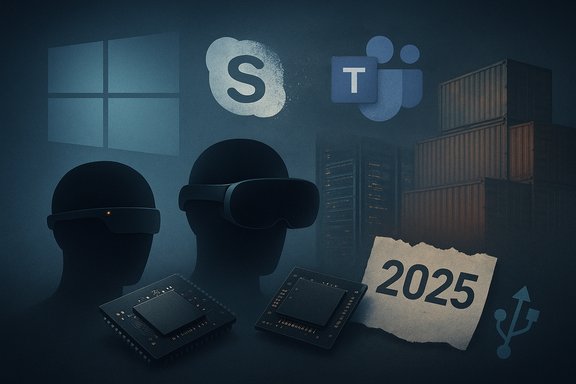
The PCMag Australia roundup that catalogued “the tech that died in 2025” is more than nostalgia; it is a useful lens for reading the industry’s priorities. The list includes calendar‑driven lifecycles (notably Windows 10’s end of support), platform consolidation (Skype → Teams), aborted hardware experiments (Humane AI Pin, Dyson Zone, Meta Quest Pro), and supply‑side realignments as vendors steer components toward AI data centers. Taken together, these exits reveal how companies allocate engineering and manufacturing resources when profits and scale matter more than maintaining peripheral consumer utilities.
This feature synthesizes that catalogue, verifies the most consequential claims against vendor notices and independent reporting, highlights emerging patterns, and outlines the practical implications for Windows users, IT professionals, and PC builders.
The devices and services that died in 2025 teach a simple, urgent lesson—durability requires planning. Whether the next big obituaries will be avoided or merely postponed will depend on whether vendors, regulators, and communities can rebalance short‑term market incentives with stewardship for security, ownership, and sustainability.
Source: PCMag Australia The Final Shutdown: Pour One Out for the Tech That Died in 2025
 Background
The PCMag Australia roundup that catalogued “the tech that died in 2025” is more than nostalgia; it is a useful lens for reading the industry’s priorities. The list includes calendar‑driven lifecycles (notably Windows 10’s end of support), platform consolidation (Skype → Teams), aborted hardware experiments (Humane AI Pin, Dyson Zone, Meta Quest Pro), and supply‑side realignments as vendors steer components toward AI data centers. Taken together, these exits reveal how companies allocate engineering and manufacturing resources when profits and scale matter more than maintaining peripheral consumer utilities.This feature synthesizes that catalogue, verifies the most consequential claims against vendor notices and independent reporting, highlights emerging patterns, and outlines the practical implications for Windows users, IT professionals, and PC builders.
Overview: the categories of death
- Scheduled lifecycle expirations — predictable but disruptive (Windows 10).
- Consolidation and feature folding — vendors collapsing small apps into larger platforms (Skype, Zelle standalone app, Dropbox password manager).
- Failed hardware experiments — high‑profile, high‑cost devices that failed to demonstrate daily utility (Humane AI Pin, Dyson Zone, Meta Quest Pro).
- Cloud‑first control moves — vendors narrowing export or offline options for purchased content (Kindle USB download removal).
- Supply reallocation to AI infrastructure — chip and memory makers prioritizing data‑center customers over retail (Micron / Crucial).
The tectonic moment: Windows 10 reaches end of support
On October 14, 2025 Microsoft officially ended mainstream support for Windows 10, a move that immediately shifted millions of installed machines into a higher‑risk state unless owners enrolled in a narrowly scoped Extended Security Updates (ESU) program or upgraded hardware to meet Windows 11 requirements. This is a hard lifecycle event documented on Microsoft’s support and lifecycle pages. Why this mattered:- Security implications: After the EOL date, most consumer Windows 10 installations no longer received routine security patches, raising exposure to newly discovered vulnerabilities. Microsoft’s guidance explicitly recommends upgrading or enrolling in ESU.
- Hardware gating: Windows 11 requires platform features (TPM 2.0, Secure Boot, firmware expectations and a constrained CPU compatibility list) that left many otherwise functional PCs ineligible for a free in‑place upgrade. The hardware gate turned a software lifecycle into a hardware replacement decision.
- Operational and environmental effects: Schools, nonprofits, and small businesses with constrained budgets faced three unattractive options—buy ESU, replace hardware, or accept increased risk—creating immediate procurement and e‑waste pressures. Independent coverage and community refurbish efforts documented the scramble that followed.
- Run the PC Health Check or vendor compatibility tools to determine Windows 11 eligibility.
- For ineligible but still useful machines, evaluate ChromeOS Flex or modern Linux distros as pragmatic stopgaps.
- Prioritize internet‑facing and mission‑critical endpoints for ESU or hardware refresh funding.
Platform consolidation and the death of standalone apps
2025 accelerated a trend already in motion: vendors folding standalone, low‑usage apps into larger, stickier platforms.- Skype: Microsoft retired the consumer Skype client in May 2025 and urged users to migrate to Microsoft Teams Free; Microsoft provided transition guidance and export tools for chats and contacts. That retirement was a deliberate consolidation toward a single collaboration stack.
- Zelle standalone app: With the vast majority of transactions already happening inside bank apps, Zelle shuttered its standalone app to reduce duplication.
- Dropbox Password Manager and other small paid utilities: Vendors prioritized core products and killed peripheral offerings that didn’t scale or affordably attract users. This consolidation improved integration for platforms that survived, but reduced independent choices for consumers.
Model churn and AI‑driven product decisions: GPT‑4’s retirement from ChatGPT
In April 2025 OpenAI removed GPT‑4 from ChatGPT’s web model picker and replaced it with GPT‑4o as the default interactive model; GPT‑4 remained available to developers via the API. This deprecation was announced in the ChatGPT release notes and support pages and independently reported across tech press. The move illustrates how AI providers can—and will—deprecate widely used models on timelines that matter to millions of users. Operational consequences:- For developers and businesses that embed specific model behaviors, model deprecation is not a minor upgrade—it can necessitate retesting, prompt redesign, and safety validation. The pace of AI model evolution means that systems depending on a specific model must budget for migration costs and regression testing.
- For end users, the practical experience can be abrupt (different response style, changed multimodal capabilities), and enterprises must insist on portability clauses and clear deprecation notice windows when contracting with AI vendors.
Failed hardware experiments and the difficulty of selling “AI devices”
Not every death was planned; many were the result of poor product‑market fit.- Humane AI Pin: The AI Pin was an ambitious wearable that never achieved mainstream traction and was sold in a deal where HP acquired key IP and patents. The device and service were discontinued as HP focused on extracting IP and AI capabilities rather than sustaining a low‑volume gadget.
- Meta Quest Pro: Meta discontinued its high‑end $1,500 Quest Pro model in early 2025, concentrating on more affordable headsets in its lineup. The Quest Pro’s feature set demonstrated capability but not a clear consumer market at that price point.
- Dyson Zone: Dyson acknowledged that the air‑purifying headphone hybrid didn’t make business sense to continue, despite being an innovative experiment.
Ownership erosion: the Kindle USB download removal and cloud entanglement
Small feature removals can have outsized effects on user control. Amazon’s removal of the “Download & Transfer via USB” option for Kindle purchases on February 26, 2025 closed one of the last easy ways to maintain local copies of purchased ebooks. Independent coverage documented the deadline and the practical impact on users who wanted offline archives of purchases. Why this matters:- Users who value offline ownership or long‑term archival options see the removal as a reduction in control. It also complicates migrations for users who rely on older devices or third‑party ebook ecosystems.
- For practitioners, the advice is simple and urgent: take local backups while vendor export channels exist and plan for reduced portability over time.
Supply shocks and the Crucial exit: memory for AI vs. consumers
A structural story underpinned several product deaths: the AI compute boom is reshaping component economics. Micron’s December 2025 announcement that it would exit the Crucial consumer business to prioritize AI data‑center customers—and that it would continue shipments through fiscal Q2 (through February 2026)—is a clear example of supply reallocation to higher‑margin, capacity‑hungry enterprise customers. Micron framed the decision around meeting AI‑driven demand for memory and storage. Consequences for the consumer PC market:- Higher retail DRAM and SSD prices and greater volatility for DIY builders and small OEMs.
- Longer lead times for certain capacity points as suppliers allocate wafers to large enterprise customers under NCNR contracts.
- Potential consolidation in the consumer components market that limits choices for hobbyists and smaller system integrators.
Strengths: the business case for ruthless focus
There are positive arguments for the pruning we observed in 2025:- Resource concentration: Companies that trimmed underused projects freed engineers and capital to invest where scale matters—cloud services, enterprise AI, and hardware that supports their strategic roadmap.
- Simpler product portfolios: Embedding functionality into core platforms reduces the engineering overhead of supporting many low‑value standalone apps.
- Improved integration: In some cases, consolidation resulted in deeper integration and better security posture for surviving platforms.
Risks and blind spots
Despite the business logic, multiple systemic risks emerged from the year’s retirements:- Eroding portability and user ownership: Cloud‑first moves that remove local export options (Kindle USB removal) reduce consumer control and raise long‑term archival questions.
- Concentration risk: Supply decisions that favor AI data centers (Micron) threaten consumer markets with price shocks and shortages.
- Operational fragility from model churn: Rapid model deprecation imposes real costs on businesses that embed models without migration plans. The retirement of GPT‑4 from ChatGPT is a cautionary example.
- Unclear or unverified motives in retrospective narratives: Some retrospective pieces assign monetary motives or political linkages (for example, claimed donations or settlement values cited without vendor confirmation). Such claims should be flagged as reported rather than definitively verified. Where precise monetary or political linkages appear in secondary reporting, those items require corroboration in primary corporate filings—if they exist at all.
Practical guidance: what readers should do now
For individual users:- Inventory hardware and software. Determine which machines are eligible for Windows 11 and which are not.
- Back up purchased content while vendor export options still exist. For Kindle owners, that meant acting before February 26, 2025; moving forward, act early whenever vendors announce export removals.
- Consider ChromeOS Flex or a contemporary Linux distro for older machines that can’t upgrade.
- Treat software and model lifecycles as fixed line items in budgets.
- Build migration timelines that include testing, rollback plans, and vendor portability guarantees.
- Require lifecycle-disclosure and supply‑risk clauses in procurement contracts to avoid last‑minute shocks.
- Insist on point‑of‑sale lifecycle disclosures and minimum software support windows aligned with typical hardware life.
- Incentivize repairability and refurbishment in procurement to mitigate e‑waste and preserve access for underserved communities.
Where the record was thin — flagged claims
The PCMag compilation includes a number of colorful details—settlement figures, political donations, and internal corporate motives—that are sometimes reported without public filings to back them up. Those monetary claims and alleged political linkages should be treated with caution unless corroborated by primary corporate statements, official filings, or direct vendor notices. This piece verified the most load‑bearing dates and product exits against vendor pages and independent reporting, and flagged narrative attributions that lack primary confirmation.The long view: what 2025’s obituaries signal for the decade ahead
2025’s retirements are an early structural indicator that the center of gravity in tech is shifting toward centralized AI compute and enterprise services. The consequences will include:- A steady erosion of small, standalone consumer utilities as vendors double down on scalable platforms.
- Continued supply‑chain prioritization of data‑center customers, with consumer availability and prices more volatile.
- Faster model churn in AI, making portability, testing, and operational governance essential for any serious adopter.
Conclusion
The “final shutdowns” of 2025 were not a single event but a revealing chorus: scheduled end‑of‑life calendars, strategic consolidations, gadget failures, and supply‑chain reallocation together trace where the industry places its bets. For consumers and IT teams the takeaway is pragmatic: treat lifecycles as predictable costs, demand portability and clear service windows at purchase, and build migration and contingency plans into procurement and operations. For policymakers, the year is a reminder that software lifecycles and supply allocation are civic concerns that merit clearer rules and stronger consumer protections.The devices and services that died in 2025 teach a simple, urgent lesson—durability requires planning. Whether the next big obituaries will be avoided or merely postponed will depend on whether vendors, regulators, and communities can rebalance short‑term market incentives with stewardship for security, ownership, and sustainability.
Source: PCMag Australia The Final Shutdown: Pour One Out for the Tech That Died in 2025
