

AI chip shortages are forcing enterprise technology buyers in 2026 to treat artificial intelligence capacity as a constrained infrastructure resource rather than a normal procurement line item, because the bottlenecks now span GPUs, advanced logic manufacturing, high-bandwidth memory, packaging, lithography, data center power, and cloud allocation. The old shorthand — “we need more GPUs” — is no longer adequate. The real problem is that the AI supply chain has become a stack of scarce layers, and a delay in any one of them can turn an approved project into a stranded pilot. For CIOs, architects, and Windows-heavy enterprise shops trying to operationalize AI, the lesson is blunt: capacity planning is now strategy.
The enterprise AI crunch began life as a familiar story about accelerator scarcity. Nvidia GPUs were hard to get, cloud instances were rationed, and every procurement conversation seemed to end with the same question: how many H100s, H200s, or Blackwell-class systems can we actually secure? That framing was useful, but it is now too narrow.
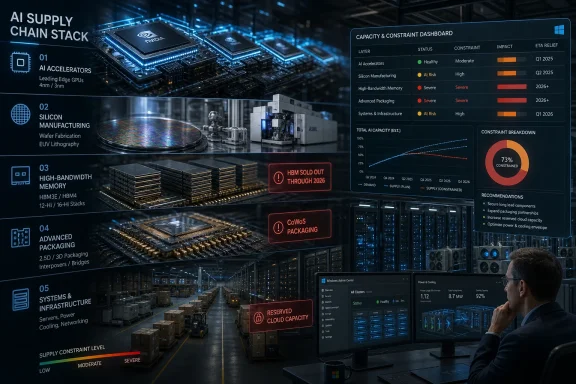
Modern AI accelerators are not single scarce objects. They are the visible end product of a tightly coupled manufacturing chain that includes leading-edge wafers, high-bandwidth memory, interposers, substrates, advanced packaging, firmware, networking, power delivery, and rack-scale thermal design. A hyperscaler may order GPUs, but what it is really buying is priority across a half-dozen industrial bottlenecks.
That distinction matters because enterprise buyers are accustomed to thinking in terms of vendor selection. If one server SKU is delayed, they look for another. If one cloud region is full, they try a different one. AI infrastructure does not always allow that kind of substitution, because the same upstream constraints feed many of the supposedly separate downstream options.
The market has moved from shortage as an inconvenience to shortage as an architectural force. It affects which models can be trained, where inference can be placed, how much latency can be tolerated, and whether a business case survives contact with real infrastructure pricing. The chip is no longer just a component; it is the gating factor for the AI roadmap.
The company said in early 2025 that revenue tied to AI-related servers and processors had more than tripled in 2024 and was expected to double again in 2025. Later reporting indicated that TSMC had raised its five-year AI accelerator revenue growth forecast from the mid-40 percent range to the mid-to-high 50 percent range. That kind of revision is not background noise; it is a signal that demand keeps outrunning even aggressive planning assumptions.
For enterprises, the practical implication is that AI capacity is being allocated in a market where hyperscalers, chip designers, sovereign governments, and device makers are all competing for pieces of the same production base. A company that assumes cloud AI capacity will expand smoothly because “the cloud always scales” is importing an old abstraction into a new physical reality. Cloud elasticity still exists, but it now rests on a supply chain with very visible seams.
TSMC’s expansion in Arizona, backed by a finalized $6.6 billion CHIPS Act award in November 2024 and later folded into a much larger U.S. investment plan, is important precisely because policymakers understand the concentration risk. But it is not a magic wand. Domestic fabs take years to ramp, process nodes differ, packaging capacity must also expand, and Taiwan remains central to leading-edge chip production.
This is the uncomfortable middle ground for enterprise planners. The supply chain is diversifying, but not fast enough to make near-term AI infrastructure feel ordinary. The system is becoming more resilient over the long run while remaining tight in the procurement windows that matter for projects being budgeted today.
Enterprise IT has spent decades abstracting hardware away. Virtualization abstracted servers, cloud abstracted data centers, and containers abstracted runtime environments. AI is dragging the physical world back into the room.
A model rollout may be approved by a business unit, designed by a data science team, and deployed through a cloud console, but the capacity behind it can still depend on a lithography tool whose supply is measured in extraordinarily expensive machines, long manufacturing cycles, and geopolitical permission structures. That is not the normal rhythm of software procurement.
The result is a strange inversion. Enterprises that once treated hardware as a commodity now have to understand enough about the semiconductor stack to ask better questions of their vendors. They do not need to become lithography experts, but they do need to know when “available capacity” is a sales forecast, a reserved allocation, or a hopeful extrapolation from a supply chain already running hot.
Micron has said its HBM production is sold out through 2026, and the broader memory market has tightened as AI data centers absorb more advanced memory supply. That has consequences beyond the accelerator market. Device makers, server OEMs, and enterprise hardware buyers all operate in a memory ecosystem being repriced around AI demand.
This is where some AI business cases begin to wobble. A company may calculate the cost of an inference service using today’s cloud instance prices, then discover six months later that reserved capacity is less available, memory-heavy systems carry premiums, or on-premises server quotes have shifted. The model did not change. The economics underneath it did.
HBM also complicates substitution. An enterprise cannot simply swap in any accelerator and expect the same performance if memory bandwidth, capacity, software stack maturity, and model optimization differ. The shortage therefore reinforces the advantage of buyers who can design workloads with portability in mind. Those who hard-code their AI strategy around one accelerator class may find that their technical elegance has become a procurement liability.
For WindowsForum readers, the analogy is not hard to grasp. This is not unlike the difference between having CPU cycles available and having the right storage, memory, and I/O profile for a production workload. AI amplifies that lesson at the data center scale.
This is a difficult concept for non-specialists because packaging used to sound like the end of the process, a kind of industrial wrapping. In modern AI silicon, packaging is part of the product’s performance envelope. The distance between compute and memory, the density of interconnects, the size of the interposer, and the ability to route power and signals across enormous packages all affect what the accelerator can do.
That turns the packaging line into a strategic choke point. A chip designer may have a brilliant architecture, a foundry slot, and eager customers, yet still be limited by how many large packages can be assembled, tested, and delivered. The market is not just waiting for more wafers. It is waiting for more successfully packaged systems.
TSMC has emphasized that CoWoS remains important for the largest AI processor packages even as newer panel-level packaging approaches develop. That is a polite way of saying the future is not arriving all at once. Alternative packaging approaches may improve area efficiency and long-term scalability, but the present market still depends heavily on technologies and facilities that are already under pressure.
This has direct consequences for enterprise rollouts. If a cloud provider cannot get enough finished accelerators, it cannot offer enough instances. If a server vendor cannot secure enough packaged parts, it cannot shorten lead times. If a lab or enterprise cluster build depends on a specific accelerator generation, the delay may come from a packaging bottleneck the buyer never sees on the invoice.
Cloud providers are competing for accelerators from the same ecosystem that supplies server vendors, AI labs, national supercomputing programs, and large technology companies building their own model infrastructure. Their custom silicon efforts are partly about performance and cost, but they are also about supply leverage. If a hyperscaler can shift some workloads to its own AI chips, it reduces dependence on the same constrained merchant accelerator market everyone else is chasing.
Enterprise buyers feel this in subtle ways before they feel it dramatically. The preferred instance type is unavailable in the preferred region. Reserved capacity requires longer commitments. Pricing assumptions move. A pilot runs acceptably on bursty capacity, but production needs a guaranteed footprint that procurement cannot secure without changing architecture or budget.
The pressure is especially awkward for organizations trying to move from AI experimentation to AI operations. Pilots are forgiving. Production systems are not. A chatbot for internal knowledge search, a developer assistant, a document processing pipeline, or a security analytics model may all begin as proof-of-concept workloads, but once employees or customers rely on them, intermittent capacity becomes a business problem.
This is where AI starts to resemble other mission-critical infrastructure. The enterprise must define service levels, capacity buffers, fallback paths, and cost ceilings. Treating accelerator access as a best-effort cloud feature is not enough once AI becomes embedded in workflows.
A private AI cluster depends on accelerator availability, HBM supply, server integration, high-speed networking, storage throughput, rack density, power delivery, cooling, and facilities planning. It also requires operational skill. Buying GPUs is not the same as running a reliable AI platform.
The old data center playbook only partially applies. AI clusters are dense, hot, power hungry, and sensitive to network topology. Training workloads can punish weak interconnects, while inference workloads may demand a different balance of latency, throughput, and utilization. The infrastructure has to be designed around the workload rather than purchased as a generic compute pool.
For Windows-centric enterprises, this creates an additional layer of planning. Many organizations will still run Windows endpoints, Microsoft 365, Entra ID, Intune, Defender, SQL Server, and Windows Server-based infrastructure around AI systems that may themselves live on Linux-heavy accelerator clusters. The integration work is not glamorous, but it is where AI becomes usable inside the business.
Private AI therefore demands honesty. It can offer control, but not immunity. It may reduce exposure to cloud price swings while increasing exposure to hardware lead times and facilities constraints. It can improve data governance while creating a new dependency on scarce infrastructure talent.
That risk is not theoretical. If an enterprise optimizes heavily for one GPU family and the next procurement cycle cannot secure enough of it, migration may require software changes, model revalidation, performance retuning, and operational retraining. If it commits entirely to one cloud provider’s AI stack, it may discover that the best technical integration also narrows its bargaining power when capacity tightens.
The answer is not naïve multi-cloud maximalism. Running serious AI workloads across many platforms can be expensive and operationally messy. But enterprises need deliberate optionality: model portability where practical, abstraction layers that do not destroy performance, and procurement strategies that avoid putting every production workload behind one constrained supply path.
This is why custom AI silicon from hyperscalers matters to enterprise buyers even if they never touch the chip directly. Google TPUs, AWS Trainium and Inferentia, Microsoft’s Maia efforts, and other in-house accelerator programs are attempts to reshape the capacity equation. They may not replace Nvidia-class GPUs across all workloads, but they can create more lanes in a traffic jam.
The enterprise version of that strategy is more modest but just as important. Buyers should evaluate whether their workloads truly require the most expensive accelerator class, whether smaller or quantized models can meet business goals, and whether inference can be distributed across different hardware tiers. In an era of scarcity, efficiency is not a virtue signal. It is a sourcing strategy.
That transition exposes the full cost stack. Compute hours are only the beginning. Enterprises must account for data preparation, storage, networking, observability, security review, model evaluation, inference scaling, redundancy, compliance, and human oversight. When accelerator supply is tight, the compute portion becomes more volatile and harder to treat as a predictable commodity.
This can distort internal politics. Business units may see AI as a software feature and expect SaaS-like marginal costs. Infrastructure teams see a constrained compute platform. Finance sees uncertain unit economics. Security teams see new data flows. Procurement sees vendors asking for longer commitments in exchange for access to scarce capacity.
The result is that some projects will not fail technically; they will fail economically. A model may work, but not at the latency, scale, or cost the business requires. Another may be valuable, but not valuable enough to justify reserved accelerator capacity during a shortage. A third may be delayed because the enterprise cannot get the hardware, cloud allocation, or power envelope it needs.
This is not a reason to abandon AI. It is a reason to stop pretending that every pilot deserves to become a platform. The bottleneck forces prioritization, and prioritization is exactly what many enterprise AI portfolios have avoided.
Microsoft, like every hyperscaler, must balance enormous demand for AI services against accelerator supply, data center power, and regional capacity. The company can hide much of that complexity from customers, but not all of it. Pricing tiers, feature availability, regional rollout schedules, and usage limits are all ways infrastructure reality can surface in a product experience.
This matters because Microsoft’s pitch is that AI will become ambient across the productivity and security stack. If that vision holds, enterprises will not think of AI as a separate cluster project. They will think of it as a layer inside Word, Excel, Teams, Windows, Visual Studio, Power Platform, Sentinel, and Defender. The capacity demand then becomes broad, persistent, and difficult to forecast.
The operational question for IT is therefore not just “which AI tool should we buy?” It is “which workflows become dependent on AI responses, and what happens when cost, policy, latency, or availability changes?” That is a governance issue as much as a procurement issue.
Windows administrators have seen versions of this movie before. Cloud identity, endpoint management, and SaaS productivity all moved critical functions outside the local data center. AI extends that dependency into compute-intensive reasoning and generation. The difference is that the backend resource is not just ordinary cloud capacity; it is among the most contested infrastructure in technology.
That means asking harder questions at the start. Does the workload require frontier-scale models, or will a smaller model work? Is the expected usage bursty or steady? Can inference run asynchronously? What latency is actually necessary? How portable is the workload across clouds, chips, and model providers? How much of the value depends on proprietary data that cannot easily move?
These questions sound technical, but they are business questions in disguise. A fraud detection model, a developer assistant, a customer support bot, and a document summarization pipeline do not need the same infrastructure. Treating them as generic “AI workloads” is how companies overpay, under-provision, or both.
Scarcity also rewards boring engineering. Caching, batching, retrieval optimization, model compression, quantization, workload scheduling, and careful prompt design can reduce demand for scarce accelerators. None of these techniques has the glamour of announcing a massive AI transformation program, but they may decide whether that program can run within budget.
The next phase of enterprise AI will therefore be less about access to demos and more about operational discipline. The winners will not simply be the companies with the most GPUs. They will be the companies that know which problems deserve them.
A useful enterprise AI plan should now make a few things explicit:
The AI boom is turning chips, memory, packaging, and power into board-level technology concerns, and enterprise IT will have to respond with a more physical understanding of the cloud than the last decade encouraged. The companies that treat today’s bottlenecks as a passing GPU shortage will keep being surprised by lead times, price shifts, and deployment compromises. The companies that treat them as the new terrain of AI infrastructure will build more selectively, negotiate more intelligently, and arrive at production with fewer illusions.
 The GPU Shortage Has Outgrown the GPU
The enterprise AI crunch began life as a familiar story about accelerator scarcity. Nvidia GPUs were hard to get, cloud instances were rationed, and every procurement conversation seemed to end with the same question: how many H100s, H200s, or Blackwell-class systems can we actually secure? That framing was useful, but it is now too narrow.Modern AI accelerators are not single scarce objects. They are the visible end product of a tightly coupled manufacturing chain that includes leading-edge wafers, high-bandwidth memory, interposers, substrates, advanced packaging, firmware, networking, power delivery, and rack-scale thermal design. A hyperscaler may order GPUs, but what it is really buying is priority across a half-dozen industrial bottlenecks.
That distinction matters because enterprise buyers are accustomed to thinking in terms of vendor selection. If one server SKU is delayed, they look for another. If one cloud region is full, they try a different one. AI infrastructure does not always allow that kind of substitution, because the same upstream constraints feed many of the supposedly separate downstream options.
The market has moved from shortage as an inconvenience to shortage as an architectural force. It affects which models can be trained, where inference can be placed, how much latency can be tolerated, and whether a business case survives contact with real infrastructure pricing. The chip is no longer just a component; it is the gating factor for the AI roadmap.
TSMC Is the Factory Floor Beneath the AI Boom
Taiwan Semiconductor Manufacturing Co. has become the industrial proxy for AI demand because so much of the world’s most advanced compute silicon depends on its process technology. When TSMC’s AI-related server and processor revenue surges, it is not merely a supplier having a good quarter. It is evidence that the AI buildout is absorbing the most advanced manufacturing capacity on the planet.The company said in early 2025 that revenue tied to AI-related servers and processors had more than tripled in 2024 and was expected to double again in 2025. Later reporting indicated that TSMC had raised its five-year AI accelerator revenue growth forecast from the mid-40 percent range to the mid-to-high 50 percent range. That kind of revision is not background noise; it is a signal that demand keeps outrunning even aggressive planning assumptions.
For enterprises, the practical implication is that AI capacity is being allocated in a market where hyperscalers, chip designers, sovereign governments, and device makers are all competing for pieces of the same production base. A company that assumes cloud AI capacity will expand smoothly because “the cloud always scales” is importing an old abstraction into a new physical reality. Cloud elasticity still exists, but it now rests on a supply chain with very visible seams.
TSMC’s expansion in Arizona, backed by a finalized $6.6 billion CHIPS Act award in November 2024 and later folded into a much larger U.S. investment plan, is important precisely because policymakers understand the concentration risk. But it is not a magic wand. Domestic fabs take years to ramp, process nodes differ, packaging capacity must also expand, and Taiwan remains central to leading-edge chip production.
This is the uncomfortable middle ground for enterprise planners. The supply chain is diversifying, but not fast enough to make near-term AI infrastructure feel ordinary. The system is becoming more resilient over the long run while remaining tight in the procurement windows that matter for projects being budgeted today.
Lithography Turns Industrial Policy Into an IT Problem
Extreme ultraviolet lithography sounds far removed from a CIO’s weekly priorities, but it now sits uncomfortably close to enterprise infrastructure planning. EUV systems are essential for many leading-edge chips, and ASML in the Netherlands remains the only commercial supplier of the machines used at that class of manufacturing. The fact that ASML has said it has never shipped EUV systems to China is not a trivia point; it is a reminder that AI compute is shaped by export controls, geopolitics, and industrial chokepoints as much as by software demand.Enterprise IT has spent decades abstracting hardware away. Virtualization abstracted servers, cloud abstracted data centers, and containers abstracted runtime environments. AI is dragging the physical world back into the room.
A model rollout may be approved by a business unit, designed by a data science team, and deployed through a cloud console, but the capacity behind it can still depend on a lithography tool whose supply is measured in extraordinarily expensive machines, long manufacturing cycles, and geopolitical permission structures. That is not the normal rhythm of software procurement.
The result is a strange inversion. Enterprises that once treated hardware as a commodity now have to understand enough about the semiconductor stack to ask better questions of their vendors. They do not need to become lithography experts, but they do need to know when “available capacity” is a sales forecast, a reserved allocation, or a hopeful extrapolation from a supply chain already running hot.
High-Bandwidth Memory Is Where AI Ambition Meets Physics
If logic manufacturing is one bottleneck, high-bandwidth memory is another. HBM sits physically close to AI processors and feeds them data at rates conventional memory architectures cannot match. Large-model training and high-throughput inference are not just compute hungry; they are memory-bandwidth hungry.Micron has said its HBM production is sold out through 2026, and the broader memory market has tightened as AI data centers absorb more advanced memory supply. That has consequences beyond the accelerator market. Device makers, server OEMs, and enterprise hardware buyers all operate in a memory ecosystem being repriced around AI demand.
This is where some AI business cases begin to wobble. A company may calculate the cost of an inference service using today’s cloud instance prices, then discover six months later that reserved capacity is less available, memory-heavy systems carry premiums, or on-premises server quotes have shifted. The model did not change. The economics underneath it did.
HBM also complicates substitution. An enterprise cannot simply swap in any accelerator and expect the same performance if memory bandwidth, capacity, software stack maturity, and model optimization differ. The shortage therefore reinforces the advantage of buyers who can design workloads with portability in mind. Those who hard-code their AI strategy around one accelerator class may find that their technical elegance has become a procurement liability.
For WindowsForum readers, the analogy is not hard to grasp. This is not unlike the difference between having CPU cycles available and having the right storage, memory, and I/O profile for a production workload. AI amplifies that lesson at the data center scale.
Advanced Packaging Has Become the Hidden Queue
The least visible bottleneck may be the most important one. Advanced AI accelerators increasingly combine compute dies and HBM stacks in tightly integrated packages. TSMC’s CoWoS technology has become central to that integration, and the packaging step can constrain shipments even when wafer production is available.This is a difficult concept for non-specialists because packaging used to sound like the end of the process, a kind of industrial wrapping. In modern AI silicon, packaging is part of the product’s performance envelope. The distance between compute and memory, the density of interconnects, the size of the interposer, and the ability to route power and signals across enormous packages all affect what the accelerator can do.
That turns the packaging line into a strategic choke point. A chip designer may have a brilliant architecture, a foundry slot, and eager customers, yet still be limited by how many large packages can be assembled, tested, and delivered. The market is not just waiting for more wafers. It is waiting for more successfully packaged systems.
TSMC has emphasized that CoWoS remains important for the largest AI processor packages even as newer panel-level packaging approaches develop. That is a polite way of saying the future is not arriving all at once. Alternative packaging approaches may improve area efficiency and long-term scalability, but the present market still depends heavily on technologies and facilities that are already under pressure.
This has direct consequences for enterprise rollouts. If a cloud provider cannot get enough finished accelerators, it cannot offer enough instances. If a server vendor cannot secure enough packaged parts, it cannot shorten lead times. If a lab or enterprise cluster build depends on a specific accelerator generation, the delay may come from a packaging bottleneck the buyer never sees on the invoice.
Cloud Capacity Is No Longer an Infinite Shock Absorber
For years, cloud computing gave enterprises a convenient answer to uncertain demand: rent first, commit later, scale as needed. AI weakens that model because the most desirable accelerator capacity is not infinitely elastic. It is planned, reserved, regionally constrained, and increasingly subject to strategic allocation.Cloud providers are competing for accelerators from the same ecosystem that supplies server vendors, AI labs, national supercomputing programs, and large technology companies building their own model infrastructure. Their custom silicon efforts are partly about performance and cost, but they are also about supply leverage. If a hyperscaler can shift some workloads to its own AI chips, it reduces dependence on the same constrained merchant accelerator market everyone else is chasing.
Enterprise buyers feel this in subtle ways before they feel it dramatically. The preferred instance type is unavailable in the preferred region. Reserved capacity requires longer commitments. Pricing assumptions move. A pilot runs acceptably on bursty capacity, but production needs a guaranteed footprint that procurement cannot secure without changing architecture or budget.
The pressure is especially awkward for organizations trying to move from AI experimentation to AI operations. Pilots are forgiving. Production systems are not. A chatbot for internal knowledge search, a developer assistant, a document processing pipeline, or a security analytics model may all begin as proof-of-concept workloads, but once employees or customers rely on them, intermittent capacity becomes a business problem.
This is where AI starts to resemble other mission-critical infrastructure. The enterprise must define service levels, capacity buffers, fallback paths, and cost ceilings. Treating accelerator access as a best-effort cloud feature is not enough once AI becomes embedded in workflows.
Private AI Clusters Do Not Escape the Supply Chain
Some organizations look at cloud scarcity and decide the answer is private infrastructure. That can be the right move for predictable workloads, sensitive data, or long-term cost control. But it does not eliminate the bottleneck; it simply moves the enterprise closer to it.A private AI cluster depends on accelerator availability, HBM supply, server integration, high-speed networking, storage throughput, rack density, power delivery, cooling, and facilities planning. It also requires operational skill. Buying GPUs is not the same as running a reliable AI platform.
The old data center playbook only partially applies. AI clusters are dense, hot, power hungry, and sensitive to network topology. Training workloads can punish weak interconnects, while inference workloads may demand a different balance of latency, throughput, and utilization. The infrastructure has to be designed around the workload rather than purchased as a generic compute pool.
For Windows-centric enterprises, this creates an additional layer of planning. Many organizations will still run Windows endpoints, Microsoft 365, Entra ID, Intune, Defender, SQL Server, and Windows Server-based infrastructure around AI systems that may themselves live on Linux-heavy accelerator clusters. The integration work is not glamorous, but it is where AI becomes usable inside the business.
Private AI therefore demands honesty. It can offer control, but not immunity. It may reduce exposure to cloud price swings while increasing exposure to hardware lead times and facilities constraints. It can improve data governance while creating a new dependency on scarce infrastructure talent.
Vendor Lock-In Now Has a Supply-Chain Dimension
Enterprise IT already understands software lock-in. The AI era adds a new kind: capacity lock-in. A company can become dependent not only on an API or model provider, but on a particular accelerator architecture, cloud region, memory profile, or deployment model.That risk is not theoretical. If an enterprise optimizes heavily for one GPU family and the next procurement cycle cannot secure enough of it, migration may require software changes, model revalidation, performance retuning, and operational retraining. If it commits entirely to one cloud provider’s AI stack, it may discover that the best technical integration also narrows its bargaining power when capacity tightens.
The answer is not naïve multi-cloud maximalism. Running serious AI workloads across many platforms can be expensive and operationally messy. But enterprises need deliberate optionality: model portability where practical, abstraction layers that do not destroy performance, and procurement strategies that avoid putting every production workload behind one constrained supply path.
This is why custom AI silicon from hyperscalers matters to enterprise buyers even if they never touch the chip directly. Google TPUs, AWS Trainium and Inferentia, Microsoft’s Maia efforts, and other in-house accelerator programs are attempts to reshape the capacity equation. They may not replace Nvidia-class GPUs across all workloads, but they can create more lanes in a traffic jam.
The enterprise version of that strategy is more modest but just as important. Buyers should evaluate whether their workloads truly require the most expensive accelerator class, whether smaller or quantized models can meet business goals, and whether inference can be distributed across different hardware tiers. In an era of scarcity, efficiency is not a virtue signal. It is a sourcing strategy.
AI Economics Are Being Rewritten After the Pilot
The most dangerous moment in an enterprise AI project is no longer the demo. Demos have become easy. The dangerous moment is the transition from a small, subsidized, or opportunistically provisioned workload to a production service with real usage patterns and real capacity requirements.That transition exposes the full cost stack. Compute hours are only the beginning. Enterprises must account for data preparation, storage, networking, observability, security review, model evaluation, inference scaling, redundancy, compliance, and human oversight. When accelerator supply is tight, the compute portion becomes more volatile and harder to treat as a predictable commodity.
This can distort internal politics. Business units may see AI as a software feature and expect SaaS-like marginal costs. Infrastructure teams see a constrained compute platform. Finance sees uncertain unit economics. Security teams see new data flows. Procurement sees vendors asking for longer commitments in exchange for access to scarce capacity.
The result is that some projects will not fail technically; they will fail economically. A model may work, but not at the latency, scale, or cost the business requires. Another may be valuable, but not valuable enough to justify reserved accelerator capacity during a shortage. A third may be delayed because the enterprise cannot get the hardware, cloud allocation, or power envelope it needs.
This is not a reason to abandon AI. It is a reason to stop pretending that every pilot deserves to become a platform. The bottleneck forces prioritization, and prioritization is exactly what many enterprise AI portfolios have avoided.
Windows Shops Will Feel the Crunch Through Microsoft’s Stack
For many WindowsForum readers, AI infrastructure will arrive through Microsoft’s ecosystem before it arrives as a bare-metal cluster. Copilot services, Azure AI, Windows developer tooling, Microsoft 365 integrations, GitHub Copilot, Defender enhancements, and Azure-hosted model endpoints are the practical front doors. That makes Microsoft’s capacity planning an enterprise concern.Microsoft, like every hyperscaler, must balance enormous demand for AI services against accelerator supply, data center power, and regional capacity. The company can hide much of that complexity from customers, but not all of it. Pricing tiers, feature availability, regional rollout schedules, and usage limits are all ways infrastructure reality can surface in a product experience.
This matters because Microsoft’s pitch is that AI will become ambient across the productivity and security stack. If that vision holds, enterprises will not think of AI as a separate cluster project. They will think of it as a layer inside Word, Excel, Teams, Windows, Visual Studio, Power Platform, Sentinel, and Defender. The capacity demand then becomes broad, persistent, and difficult to forecast.
The operational question for IT is therefore not just “which AI tool should we buy?” It is “which workflows become dependent on AI responses, and what happens when cost, policy, latency, or availability changes?” That is a governance issue as much as a procurement issue.
Windows administrators have seen versions of this movie before. Cloud identity, endpoint management, and SaaS productivity all moved critical functions outside the local data center. AI extends that dependency into compute-intensive reasoning and generation. The difference is that the backend resource is not just ordinary cloud capacity; it is among the most contested infrastructure in technology.
Scarcity Will Separate Serious AI Plans From Slideware
The upside of a constrained market is that it punishes vague strategy. Enterprises can no longer afford AI roadmaps that assume infinite capacity, falling prices, and frictionless deployment. The organizations that do well will be the ones that connect use cases to infrastructure reality early.That means asking harder questions at the start. Does the workload require frontier-scale models, or will a smaller model work? Is the expected usage bursty or steady? Can inference run asynchronously? What latency is actually necessary? How portable is the workload across clouds, chips, and model providers? How much of the value depends on proprietary data that cannot easily move?
These questions sound technical, but they are business questions in disguise. A fraud detection model, a developer assistant, a customer support bot, and a document summarization pipeline do not need the same infrastructure. Treating them as generic “AI workloads” is how companies overpay, under-provision, or both.
Scarcity also rewards boring engineering. Caching, batching, retrieval optimization, model compression, quantization, workload scheduling, and careful prompt design can reduce demand for scarce accelerators. None of these techniques has the glamour of announcing a massive AI transformation program, but they may decide whether that program can run within budget.
The next phase of enterprise AI will therefore be less about access to demos and more about operational discipline. The winners will not simply be the companies with the most GPUs. They will be the companies that know which problems deserve them.
The Procurement Memo Now Belongs in the Architecture Review
The near-term lesson for IT leaders is that AI capacity must be planned like a strategic dependency, not purchased like a commodity server refresh. That does not mean every company needs to become a semiconductor analyst. It does mean infrastructure, procurement, finance, security, and application teams need to share the same assumptions before production commitments are made.A useful enterprise AI plan should now make a few things explicit:
- It should identify which workloads require premium accelerator capacity and which can run on cheaper, more available infrastructure.
- It should treat cloud AI capacity as a reservable and potentially constrained resource rather than an always-on utility.
- It should preserve some flexibility across model providers, accelerator types, and deployment locations where the business case allows it.
- It should include realistic lead times for private infrastructure, including power, cooling, networking, and operational staffing.
- It should revisit project economics after pilots, because production inference can expose costs that demos conceal.
- It should track memory and packaging constraints as part of AI infrastructure risk, not as distant semiconductor trivia.
The AI boom is turning chips, memory, packaging, and power into board-level technology concerns, and enterprise IT will have to respond with a more physical understanding of the cloud than the last decade encouraged. The companies that treat today’s bottlenecks as a passing GPU shortage will keep being surprised by lead times, price shifts, and deployment compromises. The companies that treat them as the new terrain of AI infrastructure will build more selectively, negotiate more intelligently, and arrive at production with fewer illusions.
References
- Primary source: eWeek
Published: 2026-06-29T16:50:16.772279
AI Chip Bottlenecks Put Enterprise Plans Under Pressure | eWeek
AI chip supply constraints are affecting enterprise GPU access, cloud pricing, infrastructure planning, and vendor strategy as memory and packaging bottlenecks grow. www.eweek.com
- Related coverage: indmoney.com
TSMC's Hidden Bottleneck & AI Chip Supply Squeeze Explained
TSMC’s CoWoS advanced packaging is the hidden bottleneck behind AI chips. See how it affects Nvidia, Broadcom, hyperscalers and AI hardware supply.www.indmoney.com - Related coverage: tomshardware.com
Analyzing TSMC's fab expansion roadmap — multi-fab N2 ramp, CoWoS, SoIC, and uncorking bottlenecks | Tom's Hardware
TSMC kicks off unprecedented capacity expansion plan.www.tomshardware.com - Related coverage: techtimes.com
AI Chip Shortage Will Last Years, TSMC Warns: Why Stable Pricing Still Means 2026 Increases
Taiwan Semiconductor Manufacturing Co. Chairman and CEO C.C. Wei told shareholders at the company’s June 4 annual meeting in Hsinchu that the AI chip shortage will persist for years and that TSMCwww.techtimes.com - Related coverage: chip.jarvisbox.app
What is HBM3e — and Why Does It Bottleneck AI Deployment? — jarvisbox · chip
HBM3e delivers over 1.2 TB/s per stack via a 1024-bit interface. It powers NVIDIA H200 and B200, but supply is sold out through 2026 and TSMC CoWoS packaging adds a second independent bottleneck.chip.jarvisbox.app - Related coverage: techspot.com
TSMC unveils plans for giant AI chips to meet surging compute demands | TechSpot
Today's high-end processors, especially those powering data centers and AI workloads, already rely on multi-chiplet designs to meet soaring demands for performance and memory bandwidth. TSMC's current...www.techspot.com
- Related coverage: techcrunch.com
US to award TSMC $6.6B in grants, $5B in loans to step up chip manufacturing in Arizona | TechCrunch
TSMC is getting the grant under the CHIPS Act, in the latest step by the U.S. to reshore domestic chip manufacturing.techcrunch.com - Related coverage: techxplore.com
