

eWeek’s 2026 chatbot comparison frames ChatGPT, Gemini, Copilot, Perplexity, Claude, Grok, DeepSeek, Meta AI, Duck.ai, Zapier Agents, Poe, and Pi as a market that has moved from scripted chat into workflow software. The important shift is not that chatbots got smarter; it is that they stopped competing as chat windows and started competing as operating environments. For Windows users, sysadmins, developers, and IT buyers, the question is no longer “which bot answers best?” It is “which vendor do I trust to sit between me and my work?”
The old chatbot category was easy to dismiss because it lived at the edge of work. It answered a question, generated a paragraph, maybe summarized a page, and then politely got out of the way. The 2026 chatbot market described by eWeek is something else entirely: a layer that wants access to your documents, inboxes, calendars, code, browser tabs, meetings, spreadsheets, social feeds, and automation stack.
That is why the comparison reads less like a software roundup and more like a hiring matrix. ChatGPT is the generalist power user. Gemini is the Google Workspace insider. Copilot is the Microsoft 365 staff assistant. Perplexity is the research librarian. Claude is the long-form analyst. Grok is the social-web monitor. DeepSeek is the budget technical specialist. Meta AI is the casual creator embedded in the apps where non-technical users already live.
The stakes are higher than in earlier software wars because the assistant does not merely store your work; it interprets it. A browser can show you a page without understanding your intent. A chatbot summarizes your inbox, infers your priorities, drafts your response, and may soon trigger the next step. That makes the assistant market more intimate than search, more operational than office suites, and more difficult to swap than almost any single app.
For WindowsForum readers, this is the real story hiding underneath the consumer-friendly “best chatbot” framing. The AI assistant is becoming the front end to personal computing. The winner will not necessarily be the model with the prettiest prose or the highest benchmark score, but the one that becomes unavoidable inside the work people already do.
That breadth is why ChatGPT keeps its default status. It is the tool people try first when they do not know which tool they need. eWeek’s framing of ChatGPT as best for complex tasks captures the service’s core advantage: it is not merely a writer, coder, tutor, or search assistant, but a plausible first stop for all of them.
The reported scale matters too. A service approaching a billion weekly users is not just popular; it becomes a shared cultural interface. People learn its habits, design workflows around its strengths, and compare competitors against it by reflex. That network effect does not guarantee technical superiority, but it does create a kind of software gravity that rivals must escape.
The drawback is the same one that dogs every generalist platform. ChatGPT can be astonishingly useful and still occasionally generic, overconfident, or wrong in precisely the way a fluent assistant can be dangerous. Its polished language can make uncertainty sound finished. For IT pros, that means ChatGPT is often a strong starting point, but rarely a system of record.
That makes Gemini’s “best value overall” positioning credible, especially for users who live in Google’s ecosystem. The value is not simply model access; it is reduced friction. When an assistant can summarize email, generate a document, analyze a spreadsheet, and reference live web results without forcing a context switch, the line between chatbot and productivity suite starts to disappear.
Gemini also benefits from Google’s oldest advantage: search habits. Users already expect Google to mediate the web, so a Gemini answer that draws from live information feels like an extension of familiar behavior rather than a new platform bet. For research-heavy users, that can be more compelling than a chatbot that must bolt web access onto a separate conversational interface.
The tradeoff is strategic dependence. Gemini is most attractive when you accept Google as the environment. Outside that environment, it can feel less like a universal assistant and more like a brilliant extension cord that happens to fit one wall socket best.
That is a powerful position. A chatbot that understands the spreadsheet open in front of you, the meeting you just missed, or the Word document you are drafting is fundamentally different from a chatbot waiting in another tab. Copilot’s advantage is context, and context is what turns generative AI from novelty into labor-saving software.
But Copilot also exposes Microsoft’s biggest AI challenge: enterprise users do not reward magic tricks; they reward reliability. A consumer may forgive a weird answer if the tool is fun. A finance department, legal team, or admin group wants predictable behavior, permission boundaries, auditability, and outputs that do not create more work than they save.
That is why Copilot’s future likely depends less on flashy chatbot demos than on boring execution. Meeting summaries must be accurate. Excel analysis must be explainable. Document generation must respect policy. Tenant data must stay properly scoped. In enterprise AI, the assistant does not need to be charming; it needs to be trustworthy at scale.
That makes Perplexity especially useful in a market where fluent nonsense remains a persistent problem. Its citations and research workflow appeal to students, journalists, analysts, and professionals who need to verify claims rather than merely generate prose. The point is not that Perplexity is never wrong; it is that it acknowledges the verification loop as part of the product.
The ability to use different underlying models also changes the user’s mental model. Instead of treating “the AI” as a single oracle, Perplexity encourages the idea that models are interchangeable reasoning engines layered over a research system. That is a healthier framing for serious work.
Its weakness is that it can feel narrow compared with broader assistants. Perplexity is excellent when the job is to find, compare, and summarize information. It is less compelling when the job becomes long creative collaboration, emotional tone, software automation, or deep integration into office workflows.
Anthropic’s emphasis on safety and “Constitutional AI” also gives Claude a distinct brand. In a market full of assistants promising raw capability, Claude sells restraint, clarity, and carefulness. That appeals to organizations and individuals who want a model that feels less eager to perform and more inclined to reason through the assignment.
The large context window remains a major practical advantage. The ability to ingest long documents, codebases, transcripts, or research packets changes what users can ask from a chatbot. Instead of chopping work into fragments and hoping the model remembers, users can hand over a much larger body of material and ask for synthesis.
The limitation is ecosystem gravity. Claude may be excellent at writing and analysis, but it does not own the office suite, the browser, the operating system, or the social graph. That leaves Anthropic competing on quality in a market where distribution may decide more than elegance.
That gives Grok a natural role in social media research and trend monitoring. It can be valuable for communications teams, journalists, marketers, and analysts who need to understand what people are saying before that conversation hardens into a mainstream narrative. In that sense, Grok is less a universal assistant than a radar screen.
Its looser tone and moderation style are part of the brand, but also part of the risk. A system that feels edgy can be refreshing in a sanitized market, yet enterprise buyers tend to hear “edgy” and think “unpredictable.” That limits where Grok can travel inside regulated or reputation-sensitive organizations.
The deeper question is whether real-time social access is enough to build an enduring assistant business. It is a powerful data advantage, but not the same thing as owning documents, email, operating systems, or development workflows. Grok may win the moment; other assistants may still win the workday.
For developers, math-heavy users, and technically capable teams, that matters enormously. A strong reasoning model that can be self-hosted or integrated cheaply into custom workflows changes the cost structure of AI adoption. Instead of treating every token as a premium cloud-metered expense, teams can begin asking where local or cheaper inference makes sense.
This is particularly relevant for privacy-conscious developers. Running models locally or in controlled infrastructure can reduce exposure of sensitive code, internal documents, or customer data. For some organizations, that may matter more than having the most polished consumer chatbot UI.
The caveats are real. Chinese-hosted AI services raise data-governance, censorship, and geopolitical questions that Western enterprises cannot hand-wave away. DeepSeek may be a technical bargain, but the deployment model matters. The safest version of its promise may be the one organizations control themselves.
That makes accessibility the product. A user who would never subscribe to an AI service may still ask Meta AI for a caption, image, message rewrite, or quick answer because it is already sitting inside the app. The friction is near zero, and in consumer software, near-zero friction can beat superior capability.
Meta’s emphasis on image and short-form video generation also fits its empire. Instagram and Facebook are visual feeds, not enterprise document repositories. An assistant that creates shareable media inside those environments is not a toy bolted onto the side; it is a logical extension of the platform.
The downside is that casual ubiquity does not equal professional depth. Meta AI is unlikely to replace Claude for document analysis, Copilot for Microsoft 365 work, or Perplexity for citation-heavy research. Its power lies in making AI normal for users who do not think of themselves as AI users.
Duck.ai speaks to privacy anxiety. Users want access to powerful models without handing over identity, IP metadata, and behavioral trails to every model provider. That concern will only grow as assistants move closer to sensitive personal and professional data.
Zapier Agents points toward automation. Chat alone is not the destination; action is. The next meaningful assistant will not only draft a response or summarize a ticket but update the CRM, file the report, notify the team, schedule the follow-up, and close the loop.
Poe reflects model fatigue. As the number of serious models multiplies, users may prefer a switching layer over permanent allegiance. That is especially true for enthusiasts and professionals who know that one model may write better, another may code better, and a third may search better.
Pi represents the emotional side of AI adoption. Not every chatbot session is about productivity. Some users want reassurance, reflection, or companionship. That makes many technologists uncomfortable, but it is part of the market whether enterprises like it or not.
Distribution gives Google, Microsoft, and Meta enormous leverage. They do not need every user to choose an assistant from scratch; they can place one inside products users already open every day. That is how defaults become habits, and habits become infrastructure.
Trust gives OpenAI, Anthropic, Perplexity, and privacy-focused tools their opening. If users believe the bundled assistant is too invasive, too generic, too constrained, or too unreliable, they will reach for a specialist. In AI, trust is not an abstract virtue. It is the difference between asking for a dinner recipe and uploading a legal brief.
For Windows users, the choice will rarely be ideological. Many will use Copilot at work, ChatGPT for general problem-solving, Perplexity for research, Claude for long documents, Gemini when working in Google accounts, and Meta AI for casual creation. The future is less likely to be one assistant than a messy portfolio of them.
If your work lives in Microsoft 365, Copilot deserves serious evaluation because context beats copy-and-paste. If your work lives in Gmail and Google Docs, Gemini will often feel more natural than a standalone model. If your work is research, Perplexity’s source-forward design matters. If your work is long-form writing or large-document synthesis, Claude has a strong claim. If your work is varied and unpredictable, ChatGPT remains the safest default.
The other mistake is treating AI assistants as purely personal tools. In organizations, every chatbot choice is also a data-policy choice. What can the model access? What is logged? What can be used for training? How are permissions inherited? Can admins audit usage? Can outputs be retained, exported, or deleted?
Those questions are not glamorous, but they are the questions that determine whether AI becomes infrastructure or shadow IT. The consumer chatbot era rewarded experimentation. The enterprise assistant era will reward governance.
Source: eWeek AI Chatbot Cheat Sheet: Comparing ChatGPT, Gemini, Copilot, and More
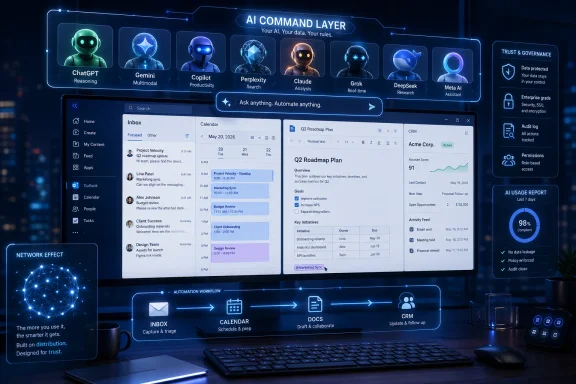 The Chatbot Has Become the New Productivity Shell
The old chatbot category was easy to dismiss because it lived at the edge of work. It answered a question, generated a paragraph, maybe summarized a page, and then politely got out of the way. The 2026 chatbot market described by eWeek is something else entirely: a layer that wants access to your documents, inboxes, calendars, code, browser tabs, meetings, spreadsheets, social feeds, and automation stack.That is why the comparison reads less like a software roundup and more like a hiring matrix. ChatGPT is the generalist power user. Gemini is the Google Workspace insider. Copilot is the Microsoft 365 staff assistant. Perplexity is the research librarian. Claude is the long-form analyst. Grok is the social-web monitor. DeepSeek is the budget technical specialist. Meta AI is the casual creator embedded in the apps where non-technical users already live.
The stakes are higher than in earlier software wars because the assistant does not merely store your work; it interprets it. A browser can show you a page without understanding your intent. A chatbot summarizes your inbox, infers your priorities, drafts your response, and may soon trigger the next step. That makes the assistant market more intimate than search, more operational than office suites, and more difficult to swap than almost any single app.
For WindowsForum readers, this is the real story hiding underneath the consumer-friendly “best chatbot” framing. The AI assistant is becoming the front end to personal computing. The winner will not necessarily be the model with the prettiest prose or the highest benchmark score, but the one that becomes unavoidable inside the work people already do.
ChatGPT Is Still the Default Because It Refuses to Stay in One Lane
ChatGPT remains the gravitational center of the market because it is not optimized around one company’s productivity suite. That sounds like a weakness until you watch how people actually use AI. A user might ask for a PowerShell script, summarize a PDF, draft a resignation letter, troubleshoot a router, generate an image, compare product options, and plan a lesson for a child in the same afternoon.That breadth is why ChatGPT keeps its default status. It is the tool people try first when they do not know which tool they need. eWeek’s framing of ChatGPT as best for complex tasks captures the service’s core advantage: it is not merely a writer, coder, tutor, or search assistant, but a plausible first stop for all of them.
The reported scale matters too. A service approaching a billion weekly users is not just popular; it becomes a shared cultural interface. People learn its habits, design workflows around its strengths, and compare competitors against it by reflex. That network effect does not guarantee technical superiority, but it does create a kind of software gravity that rivals must escape.
The drawback is the same one that dogs every generalist platform. ChatGPT can be astonishingly useful and still occasionally generic, overconfident, or wrong in precisely the way a fluent assistant can be dangerous. Its polished language can make uncertainty sound finished. For IT pros, that means ChatGPT is often a strong starting point, but rarely a system of record.
Gemini Wins When the Web and Workspace Become the Same Place
Google Gemini’s pitch is brutally practical: the assistant is most useful when it is sitting inside the tools where your work already lives. Gmail, Docs, Sheets, Drive, Search, Android, Chrome, and YouTube form a surface area few rivals can match. If ChatGPT is the universal consultant, Gemini is the employee who already has a badge for the building.That makes Gemini’s “best value overall” positioning credible, especially for users who live in Google’s ecosystem. The value is not simply model access; it is reduced friction. When an assistant can summarize email, generate a document, analyze a spreadsheet, and reference live web results without forcing a context switch, the line between chatbot and productivity suite starts to disappear.
Gemini also benefits from Google’s oldest advantage: search habits. Users already expect Google to mediate the web, so a Gemini answer that draws from live information feels like an extension of familiar behavior rather than a new platform bet. For research-heavy users, that can be more compelling than a chatbot that must bolt web access onto a separate conversational interface.
The tradeoff is strategic dependence. Gemini is most attractive when you accept Google as the environment. Outside that environment, it can feel less like a universal assistant and more like a brilliant extension cord that happens to fit one wall socket best.
Copilot’s Strength Is Also Its Trap
Microsoft Copilot should be the easiest sell in enterprise technology. It lives where office work lives: Word, Excel, PowerPoint, Outlook, Teams, Windows, and Microsoft 365. For organizations already paying Microsoft for identity, compliance, email, endpoint management, collaboration, and cloud services, Copilot looks less like a new vendor and more like an additional capability inside the existing estate.That is a powerful position. A chatbot that understands the spreadsheet open in front of you, the meeting you just missed, or the Word document you are drafting is fundamentally different from a chatbot waiting in another tab. Copilot’s advantage is context, and context is what turns generative AI from novelty into labor-saving software.
But Copilot also exposes Microsoft’s biggest AI challenge: enterprise users do not reward magic tricks; they reward reliability. A consumer may forgive a weird answer if the tool is fun. A finance department, legal team, or admin group wants predictable behavior, permission boundaries, auditability, and outputs that do not create more work than they save.
That is why Copilot’s future likely depends less on flashy chatbot demos than on boring execution. Meeting summaries must be accurate. Excel analysis must be explainable. Document generation must respect policy. Tenant data must stay properly scoped. In enterprise AI, the assistant does not need to be charming; it needs to be trustworthy at scale.
Perplexity Understands That Search Is Not Dead, It Is Being Repackaged
Perplexity’s rise is a reminder that many users do not want a companion; they want an answer with receipts. Its identity as an answer engine rather than a conversational buddy is a meaningful distinction. The product is built around retrieval, synthesis, and source-backed responses, not simulated personality.That makes Perplexity especially useful in a market where fluent nonsense remains a persistent problem. Its citations and research workflow appeal to students, journalists, analysts, and professionals who need to verify claims rather than merely generate prose. The point is not that Perplexity is never wrong; it is that it acknowledges the verification loop as part of the product.
The ability to use different underlying models also changes the user’s mental model. Instead of treating “the AI” as a single oracle, Perplexity encourages the idea that models are interchangeable reasoning engines layered over a research system. That is a healthier framing for serious work.
Its weakness is that it can feel narrow compared with broader assistants. Perplexity is excellent when the job is to find, compare, and summarize information. It is less compelling when the job becomes long creative collaboration, emotional tone, software automation, or deep integration into office workflows.
Claude Owns the White Space Between Writer and Analyst
Claude’s reputation has always rested on a particular kind of polish. It tends to produce prose that feels less like a template and more like a thoughtful draft. That matters more than skeptics admit, because writing quality is not decoration when the work product is a memo, article, legal summary, policy draft, or executive brief.Anthropic’s emphasis on safety and “Constitutional AI” also gives Claude a distinct brand. In a market full of assistants promising raw capability, Claude sells restraint, clarity, and carefulness. That appeals to organizations and individuals who want a model that feels less eager to perform and more inclined to reason through the assignment.
The large context window remains a major practical advantage. The ability to ingest long documents, codebases, transcripts, or research packets changes what users can ask from a chatbot. Instead of chopping work into fragments and hoping the model remembers, users can hand over a much larger body of material and ask for synthesis.
The limitation is ecosystem gravity. Claude may be excellent at writing and analysis, but it does not own the office suite, the browser, the operating system, or the social graph. That leaves Anthropic competing on quality in a market where distribution may decide more than elegance.
Grok Turns the Social Firehose Into a Product Feature
Grok’s differentiator is not subtle: it is tied to X and therefore closer to the churn of social conversation than most rivals. For users tracking breaking narratives, public sentiment, viral claims, influencer behavior, or political discourse, that connection is genuinely useful. News often hits social platforms before it becomes a cleanly written article.That gives Grok a natural role in social media research and trend monitoring. It can be valuable for communications teams, journalists, marketers, and analysts who need to understand what people are saying before that conversation hardens into a mainstream narrative. In that sense, Grok is less a universal assistant than a radar screen.
Its looser tone and moderation style are part of the brand, but also part of the risk. A system that feels edgy can be refreshing in a sanitized market, yet enterprise buyers tend to hear “edgy” and think “unpredictable.” That limits where Grok can travel inside regulated or reputation-sensitive organizations.
The deeper question is whether real-time social access is enough to build an enduring assistant business. It is a powerful data advantage, but not the same thing as owning documents, email, operating systems, or development workflows. Grok may win the moment; other assistants may still win the workday.
DeepSeek Proves the Model Race Is Also a Cost Race
DeepSeek’s importance is not limited to its chatbot interface. Its larger impact is psychological and economic. It showed that high-capability models do not have to be the exclusive product of the richest American labs, and that open or lower-cost alternatives can reshape expectations around pricing, deployment, and control.For developers, math-heavy users, and technically capable teams, that matters enormously. A strong reasoning model that can be self-hosted or integrated cheaply into custom workflows changes the cost structure of AI adoption. Instead of treating every token as a premium cloud-metered expense, teams can begin asking where local or cheaper inference makes sense.
This is particularly relevant for privacy-conscious developers. Running models locally or in controlled infrastructure can reduce exposure of sensitive code, internal documents, or customer data. For some organizations, that may matter more than having the most polished consumer chatbot UI.
The caveats are real. Chinese-hosted AI services raise data-governance, censorship, and geopolitical questions that Western enterprises cannot hand-wave away. DeepSeek may be a technical bargain, but the deployment model matters. The safest version of its promise may be the one organizations control themselves.
Meta AI Is the Assistant for People Who Never Asked for One
Meta AI’s strategy is almost the inverse of enterprise AI. It does not ask users to adopt a new professional workflow; it appears inside WhatsApp, Instagram, Facebook, and related consumer surfaces. For billions of people, that is where communication, social planning, casual creation, and lightweight search already happen.That makes accessibility the product. A user who would never subscribe to an AI service may still ask Meta AI for a caption, image, message rewrite, or quick answer because it is already sitting inside the app. The friction is near zero, and in consumer software, near-zero friction can beat superior capability.
Meta’s emphasis on image and short-form video generation also fits its empire. Instagram and Facebook are visual feeds, not enterprise document repositories. An assistant that creates shareable media inside those environments is not a toy bolted onto the side; it is a logical extension of the platform.
The downside is that casual ubiquity does not equal professional depth. Meta AI is unlikely to replace Claude for document analysis, Copilot for Microsoft 365 work, or Perplexity for citation-heavy research. Its power lies in making AI normal for users who do not think of themselves as AI users.
The Smaller Tools Reveal the Market’s Unfinished Edges
The “quick hits” in eWeek’s roundup are more revealing than they first appear. Duck.ai, Zapier Agents, Poe, and Pi are not merely also-rans; they represent unresolved tensions in the mainstream platforms. Each exists because the biggest assistants still leave something important underserved.Duck.ai speaks to privacy anxiety. Users want access to powerful models without handing over identity, IP metadata, and behavioral trails to every model provider. That concern will only grow as assistants move closer to sensitive personal and professional data.
Zapier Agents points toward automation. Chat alone is not the destination; action is. The next meaningful assistant will not only draft a response or summarize a ticket but update the CRM, file the report, notify the team, schedule the follow-up, and close the loop.
Poe reflects model fatigue. As the number of serious models multiplies, users may prefer a switching layer over permanent allegiance. That is especially true for enthusiasts and professionals who know that one model may write better, another may code better, and a third may search better.
Pi represents the emotional side of AI adoption. Not every chatbot session is about productivity. Some users want reassurance, reflection, or companionship. That makes many technologists uncomfortable, but it is part of the market whether enterprises like it or not.
The Real Comparison Is Distribution Versus Trust
The chatbot wars are often discussed as if the best model will win. That is unlikely. The more probable outcome is that different assistants win different layers of the stack: one in search, one in office productivity, one in coding, one in social media, one in personal companionship, and several in enterprise automation.Distribution gives Google, Microsoft, and Meta enormous leverage. They do not need every user to choose an assistant from scratch; they can place one inside products users already open every day. That is how defaults become habits, and habits become infrastructure.
Trust gives OpenAI, Anthropic, Perplexity, and privacy-focused tools their opening. If users believe the bundled assistant is too invasive, too generic, too constrained, or too unreliable, they will reach for a specialist. In AI, trust is not an abstract virtue. It is the difference between asking for a dinner recipe and uploading a legal brief.
For Windows users, the choice will rarely be ideological. Many will use Copilot at work, ChatGPT for general problem-solving, Perplexity for research, Claude for long documents, Gemini when working in Google accounts, and Meta AI for casual creation. The future is less likely to be one assistant than a messy portfolio of them.
The Practical Choice Is Now About Where the Work Lives
The easiest mistake is to rank chatbots as if all users share the same context. They do not. The best assistant for a solo developer is not necessarily the best assistant for a law firm, school district, marketing agency, help desk, or retiree managing family photos and travel plans.If your work lives in Microsoft 365, Copilot deserves serious evaluation because context beats copy-and-paste. If your work lives in Gmail and Google Docs, Gemini will often feel more natural than a standalone model. If your work is research, Perplexity’s source-forward design matters. If your work is long-form writing or large-document synthesis, Claude has a strong claim. If your work is varied and unpredictable, ChatGPT remains the safest default.
The other mistake is treating AI assistants as purely personal tools. In organizations, every chatbot choice is also a data-policy choice. What can the model access? What is logged? What can be used for training? How are permissions inherited? Can admins audit usage? Can outputs be retained, exported, or deleted?
Those questions are not glamorous, but they are the questions that determine whether AI becomes infrastructure or shadow IT. The consumer chatbot era rewarded experimentation. The enterprise assistant era will reward governance.
The 2026 Chatbot Map Has a Clear Shape
The most useful reading of the current market is not that one bot is “best,” but that each major player is trying to own a different definition of assistance. The winners will be the tools that match capability to context without forcing users to rebuild their work around the chatbot.- ChatGPT remains the strongest general-purpose assistant for users who need one tool to handle writing, coding, analysis, brainstorming, and multimodal work across many contexts.
- Gemini is most compelling for people and teams already committed to Google Workspace, where search, documents, email, and AI can collapse into one workflow.
- Copilot is the most strategically important assistant for Windows and Microsoft 365 environments, but its value depends on reliable enterprise execution rather than demo-stage cleverness.
- Perplexity is the clearest choice when verifiable research and source-backed answers matter more than personality or creative collaboration.
- Claude continues to stand out for long-form writing, document analysis, and careful synthesis, even without the same platform distribution as Microsoft, Google, or Meta.
- DeepSeek, Duck.ai, Zapier Agents, Poe, Pi, Grok, and Meta AI show that price, privacy, automation, aggregation, emotional tone, social data, and consumer distribution are all becoming separate battlegrounds.
Source: eWeek AI Chatbot Cheat Sheet: Comparing ChatGPT, Gemini, Copilot, and More
