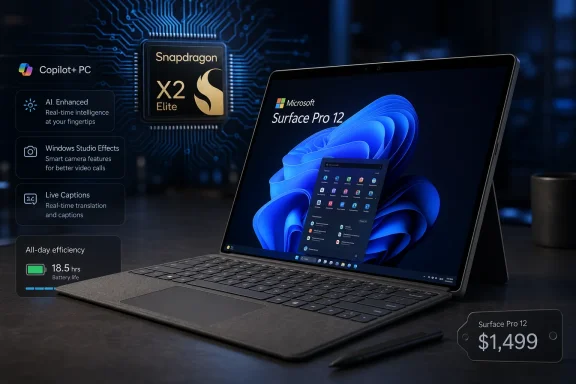
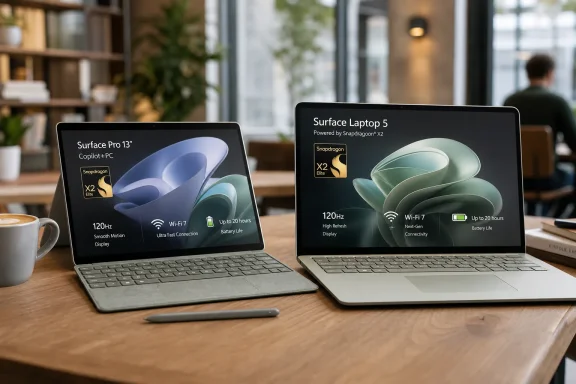
Microsoft is launching new 2026 Surface Pro and Surface Laptop models with Qualcomm Snapdragon X2 chips, starting at $1,499 and $1,599 respectively in the United States, positioning its flagship Windows-on-Arm PCs well above the entry prices of their 2024 predecessors. That price jump is not an accident of supply chains, tariffs, or spec-sheet inflation. It is the strategy. Surface is no longer trying very hard to be the Windows laptop most people buy; it is trying to be the Windows laptop that tells the rest of the PC industry where Microsoft wants the platform to go.
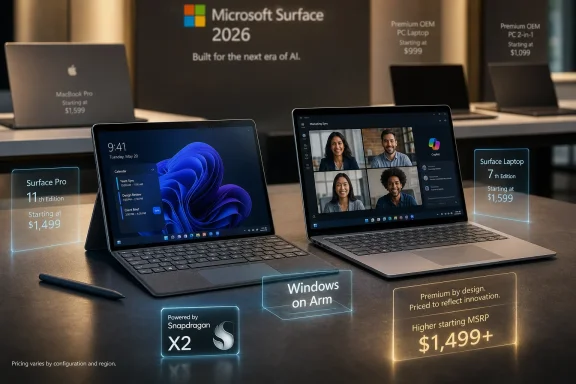
The most important thing about the new Surface lineup is not the Snapdragon X2 silicon, the webcam, the brighter display, or the detachable keyboard promotion. It is the starting price. A Surface Pro that once entered the Copilot+ era at $999 now begins at $1,499, while the Surface Laptop rises from the same former psychological floor to $1,599.
That takes Surface out of the casual “maybe I’ll try one” range and places it squarely in the territory of MacBook Pro shoppers, premium ThinkPad buyers, and IT departments that treat device cost as part of a broader lifecycle calculation. Microsoft knows this. Brett Ostrum, Microsoft’s corporate vice president for Surface Devices, told PCWorld the company is aware of pricing pressure and has plans for lower price points, but that this launch is about Pro and Laptop.
That distinction matters because Microsoft has spent more than a decade trying to make Surface mean several things at once. It was a Windows tablet proof-of-concept, then an ultrabook alternative, then a design reference, then a premium consumer brand, then a business fleet device. In 2026, the message is narrower: Surface is Microsoft’s premium Windows hardware argument, not its answer to every PC buyer.
The company’s bet is that the Windows ecosystem can fight the price war without Surface joining the knife fight. Dell, Lenovo, HP, Asus, Acer, and the rest can chase back-to-school bundles, Costco configurations, holiday markdowns, and $799 MacBook-adjacent comparisons. Surface’s job is to make Windows-on-Arm look serious enough that those companies keep investing.
Instead, Surface remains a productivity-first machine: thin, controlled, quiet, camera-forward, battery-conscious, and deeply tied to Windows’ Copilot+ direction. The Surface Laptop gets 16GB, 24GB, 32GB, and 64GB memory options, plus removable PCIe Gen 4 storage that reaches 2TB on the Laptop line. The Surface Pro follows the same basic pattern but tops out without the 2TB option.
On paper, that is more aggressive than the old stereotype of Surface as a beautiful device with conservative internals. Microsoft is not offering an 8GB version of these premium models, and Ostrum’s comments suggest the company understands that 8GB has become a fault line in Windows PC credibility. He did not announce an 8GB Surface, but he did say Microsoft is working to make 8GB solutions viable for the OEM ecosystem.
That phrasing is doing a lot of work. It implies Microsoft knows low-cost Windows PCs still need a path forward, but it does not want its flagship Surface launch defined by the compromises required to get there. In other words, Microsoft is letting the OEMs absorb the awkward middle ground while Surface sells the dream.
Microsoft’s answer is not raw novelty. The designs are familiar, bordering on conservative. The Surface Pro remains the Surface Pro, a tablet-laptop hybrid whose brilliance and awkwardness have been inseparable since the line matured. The Surface Laptop remains a clean clamshell with Microsoft’s particular taste for restraint.
The upgrades are therefore concentrated in the experience rather than the silhouette. The 15-inch Surface Laptop moves to a sharper 3,270-by-2,180 display at 262 pixels per inch, with Dolby Vision IQ and a claimed 600 nits of peak brightness in SDR and HDR. The 13.8-inch model adds a Jade color. The Surface Pro keeps an OLED option, while Microsoft pares back some color choices and leans on keyboard bundles to soften the price shock.
The webcam story is more interesting than it sounds. Microsoft is emphasizing MIPI camera technology, an area where Arm-based PCs and MacBooks benefit from the smartphone supply chain. PCWorld reports that Microsoft is claiming top integrated webcam status from DXOMark for the 13.8-inch Laptop, even though the Laptop uses a 1080p camera and the Pro goes up to 1440p. That says something about where laptop differentiation has moved: image processing, sensors, microphones, and video-call reliability now matter as much as a faster benchmark run for many buyers.
The Snapdragon X2 generation appears to be pushing performance harder than the original X Elite wave. That is not a criticism by itself. Windows-on-Arm needed more than efficiency; it needed enough sustained speed to make buyers stop treating compatibility and performance as separate apologies. But the more Qualcomm and Microsoft chase high-end laptop credibility, the more they inherit high-end laptop expectations.
A 13-hour real-world streaming result, like the Asus Snapdragon X2 Elite Extreme test PCWorld referenced, would still be excellent. But it would also demonstrate the gap between platform storytelling and lived experience. Buyers do not purchase “up to” battery life; they purchase a machine they hope will survive travel days, meetings, Teams calls, browser abuse, and the occasional charger left at home.
That is where Surface has an opportunity. If Microsoft can deliver a machine that feels predictably long-lived rather than merely spectacular in a lab, the premium argument becomes more convincing. If battery life lands as just good while prices land as great-big-number high, the old Surface complaint returns: lovely hardware, Microsoft pricing, buyer skepticism.
Surface has always been an oddity because Microsoft competes with its own partners while insisting it is helping them. That contradiction made OEMs nervous in the early Surface years, especially when Microsoft seemed to be building the kind of premium Windows hardware many PC vendors had failed to make consistently. But the arrangement has stabilized into a kind of choreography.
Microsoft demonstrates the idealized version. OEMs industrialize, diversify, discount, and sometimes improve on it. Surface does not need to win unit-share battles if it can make the platform more attractive. That logic is even stronger with Windows-on-Arm, where the entire ecosystem still needs reassurance: app developers, IT buyers, peripheral vendors, game makers, and consumers burned by earlier Arm promises.
The Snapdragon X2 Surface machines are therefore less a product launch than a confidence ritual. Microsoft is saying that Arm is not a side project, not a developer curiosity, and not just a battery-life stunt. It is a premium Windows path.
This is where Apple and Microsoft remain philosophically opposed. Apple uses control to simplify choice and protect margins. Microsoft uses breadth to create pressure from every angle. If Apple slots a MacBook into a particular price band, Microsoft wants Dell above it, Lenovo below it, Asus beside it, HP bundled against it, and Surface floating above as the platform’s prestige marker.
That can work, but only if the Windows machines feel coherent. The danger is that Windows buyers see not a coordinated sandwich but a confusing deli counter: Arm here, Intel there, Copilot+ on one sticker, non-Copilot+ on another, OLED in one configuration, 8GB in a cheaper model, and a dozen promotional prices that make MSRP feel fictional.
Surface is supposed to cut through that noise. It is the machine that says, “This is what Microsoft thinks a modern Windows PC should be.” In 2026, that machine is expensive, Arm-based, AI-capable, camera-conscious, and productivity-focused. The clarity is useful. The price is the tax.
Windows gaming laptops are one of the PC market’s great success stories: messy, loud, thermally ambitious, RGB-lit, and often far more innovative than polite premium ultrabooks. Microsoft does not need to prove Windows can game. Nvidia, AMD, Intel, Asus, Lenovo, Razer, MSI, Alienware, and countless boutique configurations do that every day.
Surface’s absence from gaming is therefore not a gap; it is a declaration of scope. Microsoft wants Surface to lead where Windows needs help, not where Windows is already dominant. That means touch, pen, haptics, Windows Hello, webcams, Arm silicon, and the modern hybrid-work baseline.
The irony is that Microsoft owns Xbox and understands games as well as any platform company. But a Surface gaming laptop would muddy the brand’s current role. It would invite questions about GPUs, thermals, upgradeability, and price-performance ratios that Surface is not designed to win.
That is especially true as the Copilot+ PC story matures. If the AI PC baseline requires certain NPUs, memory configurations, and silicon generations, the low end becomes harder to serve without either diluting the brand or delaying adoption. Microsoft has to keep pushing hardware forward without making Windows feel like it has abandoned normal buyers.
This is the tension behind 8GB devices. On one hand, shipping a premium Surface with 8GB of RAM in 2026 would be a self-own. On the other hand, Windows remains a mass-market operating system, and mass-market price points still matter. If Microsoft leaves that field entirely to OEMs, it needs those OEMs to execute well.
A smaller Surface Laptop or Surface Pro could become the compromise: not cheap in the Chromebook sense, but less punishing than the flagship models. The danger is that “lower-cost Surface” increasingly means “formerly normal-priced Surface.” Microsoft will have to be careful not to confuse price segmentation with price inflation wearing a nicer shirt.
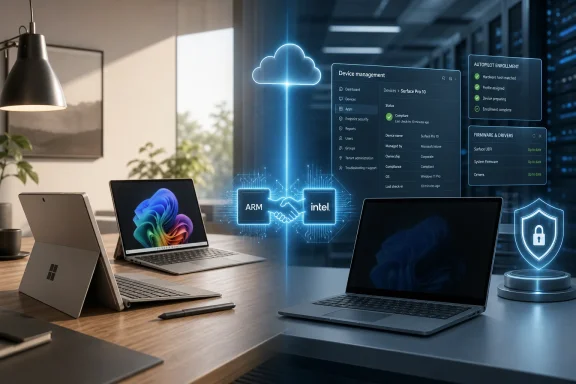
But Windows-on-Arm still asks enterprise IT to think harder. App compatibility is better than it used to be, but “better” is not the same as invisible. Driver support, VPN clients, security tools, line-of-business applications, virtualization workflows, and weird legacy utilities remain the places where architecture transitions reveal themselves.
Microsoft wants Surface to make Arm feel normal. IT departments will decide whether it is normal enough. A high starting price raises the burden of proof, because pilot programs become more expensive and procurement officers have more obvious alternatives.
The removable SSD story helps, as does the avoidance of underpowered memory configurations. The focus on cameras and battery life also maps directly to business pain. Still, the Surface premium only works for enterprise if the device behaves less like a showcase and more like infrastructure.
That criticism was not always fair, but it stuck because Windows buyers are trained to comparison shop. They look at RAM, SSD size, ports, panels, processors, discounts, and repair options. Surface asks them to value the total object.
The 2026 models sharpen that tension. On one side, Microsoft has stronger silicon, better configuration ceilings, upgraded display options, and a clearer platform mission. On the other, the entry prices are high enough that buyers will expect excellence everywhere.
This is why the unchanged design cuts both ways. Familiarity suggests refinement, reliability, and accessory continuity. It also suggests Microsoft is asking for substantially more money without giving buyers the dopamine hit of a visibly new machine.
Copilot+ PCs have always been as much a software promise as a hardware category. The NPU matters only if the experiences built around it matter. Recall, Studio Effects, local AI features, semantic search, and future agentic workflows all need to become reasons users appreciate the hardware, not just reasons the box wears a sticker.
This is where Microsoft’s challenge differs from Apple’s. Apple sells the Mac as a unified product. Microsoft sells a Windows ecosystem with one first-party exemplar. If the exemplar is expensive but the operating system still behaves like it was assembled by competing committees, the premium story weakens.
Surface can lead the ecosystem, but it cannot launder every Windows frustration. A $1,599 laptop makes small annoyances feel bigger. The margin for “that’s just Windows” shrinks as the invoice grows.
 Microsoft Turns Surface Into a Price Signal
The most important thing about the new Surface lineup is not the Snapdragon X2 silicon, the webcam, the brighter display, or the detachable keyboard promotion. It is the starting price. A Surface Pro that once entered the Copilot+ era at $999 now begins at $1,499, while the Surface Laptop rises from the same former psychological floor to $1,599.That takes Surface out of the casual “maybe I’ll try one” range and places it squarely in the territory of MacBook Pro shoppers, premium ThinkPad buyers, and IT departments that treat device cost as part of a broader lifecycle calculation. Microsoft knows this. Brett Ostrum, Microsoft’s corporate vice president for Surface Devices, told PCWorld the company is aware of pricing pressure and has plans for lower price points, but that this launch is about Pro and Laptop.
That distinction matters because Microsoft has spent more than a decade trying to make Surface mean several things at once. It was a Windows tablet proof-of-concept, then an ultrabook alternative, then a design reference, then a premium consumer brand, then a business fleet device. In 2026, the message is narrower: Surface is Microsoft’s premium Windows hardware argument, not its answer to every PC buyer.
The company’s bet is that the Windows ecosystem can fight the price war without Surface joining the knife fight. Dell, Lenovo, HP, Asus, Acer, and the rest can chase back-to-school bundles, Costco configurations, holiday markdowns, and $799 MacBook-adjacent comparisons. Surface’s job is to make Windows-on-Arm look serious enough that those companies keep investing.
The Snapdragon X2 Launch Is Really a Windows-on-Arm Confidence Test
The new machines arrive with Qualcomm’s Snapdragon X2 Plus and Snapdragon X2 Elite chips, while skipping the more extreme 18-core Snapdragon X2 Elite Extreme tier. That choice is revealing. Microsoft wants the halo of Qualcomm’s second-generation Windows platform, but it is not building a workstation monster or a gaming flex.Instead, Surface remains a productivity-first machine: thin, controlled, quiet, camera-forward, battery-conscious, and deeply tied to Windows’ Copilot+ direction. The Surface Laptop gets 16GB, 24GB, 32GB, and 64GB memory options, plus removable PCIe Gen 4 storage that reaches 2TB on the Laptop line. The Surface Pro follows the same basic pattern but tops out without the 2TB option.
On paper, that is more aggressive than the old stereotype of Surface as a beautiful device with conservative internals. Microsoft is not offering an 8GB version of these premium models, and Ostrum’s comments suggest the company understands that 8GB has become a fault line in Windows PC credibility. He did not announce an 8GB Surface, but he did say Microsoft is working to make 8GB solutions viable for the OEM ecosystem.
That phrasing is doing a lot of work. It implies Microsoft knows low-cost Windows PCs still need a path forward, but it does not want its flagship Surface launch defined by the compromises required to get there. In other words, Microsoft is letting the OEMs absorb the awkward middle ground while Surface sells the dream.
Premium Hardware Is Easier to Defend Than Premium Windows
The trouble for Microsoft is that expensive hardware invites a different kind of scrutiny. A $999 Surface Laptop can be judged as an attractive Windows machine with a few trade-offs. A $1,599 Surface Laptop has to justify why it exists in a world full of MacBooks, OLED ultraportables, workstation-class Windows laptops, and increasingly competent discounted last-year models.Microsoft’s answer is not raw novelty. The designs are familiar, bordering on conservative. The Surface Pro remains the Surface Pro, a tablet-laptop hybrid whose brilliance and awkwardness have been inseparable since the line matured. The Surface Laptop remains a clean clamshell with Microsoft’s particular taste for restraint.
The upgrades are therefore concentrated in the experience rather than the silhouette. The 15-inch Surface Laptop moves to a sharper 3,270-by-2,180 display at 262 pixels per inch, with Dolby Vision IQ and a claimed 600 nits of peak brightness in SDR and HDR. The 13.8-inch model adds a Jade color. The Surface Pro keeps an OLED option, while Microsoft pares back some color choices and leans on keyboard bundles to soften the price shock.
The webcam story is more interesting than it sounds. Microsoft is emphasizing MIPI camera technology, an area where Arm-based PCs and MacBooks benefit from the smartphone supply chain. PCWorld reports that Microsoft is claiming top integrated webcam status from DXOMark for the 13.8-inch Laptop, even though the Laptop uses a 1080p camera and the Pro goes up to 1440p. That says something about where laptop differentiation has moved: image processing, sensors, microphones, and video-call reliability now matter as much as a faster benchmark run for many buyers.
The Battery Claim Will Meet the Real World
Microsoft claims up to 20 hours of battery life for the 13.8-inch Surface Laptop and up to 19 hours for the 15-inch model. Those are the kind of numbers that have become standard in Arm PC launches and dangerous in actual purchasing decisions. A manufacturer’s best-case battery figure can be true and still not resemble a user’s normal workday.The Snapdragon X2 generation appears to be pushing performance harder than the original X Elite wave. That is not a criticism by itself. Windows-on-Arm needed more than efficiency; it needed enough sustained speed to make buyers stop treating compatibility and performance as separate apologies. But the more Qualcomm and Microsoft chase high-end laptop credibility, the more they inherit high-end laptop expectations.
A 13-hour real-world streaming result, like the Asus Snapdragon X2 Elite Extreme test PCWorld referenced, would still be excellent. But it would also demonstrate the gap between platform storytelling and lived experience. Buyers do not purchase “up to” battery life; they purchase a machine they hope will survive travel days, meetings, Teams calls, browser abuse, and the occasional charger left at home.
That is where Surface has an opportunity. If Microsoft can deliver a machine that feels predictably long-lived rather than merely spectacular in a lab, the premium argument becomes more convincing. If battery life lands as just good while prices land as great-big-number high, the old Surface complaint returns: lovely hardware, Microsoft pricing, buyer skepticism.
Surface Is Leading Where OEMs Still Need Permission
Ostrum’s most revealing comment to PCWorld was not really about Surface at all. He described Surface as going “all in” on Qualcomm and Windows-on-Arm because Microsoft needed to convince OEMs to come along. That is the old Surface mission, updated for the Copilot+ era.Surface has always been an oddity because Microsoft competes with its own partners while insisting it is helping them. That contradiction made OEMs nervous in the early Surface years, especially when Microsoft seemed to be building the kind of premium Windows hardware many PC vendors had failed to make consistently. But the arrangement has stabilized into a kind of choreography.
Microsoft demonstrates the idealized version. OEMs industrialize, diversify, discount, and sometimes improve on it. Surface does not need to win unit-share battles if it can make the platform more attractive. That logic is even stronger with Windows-on-Arm, where the entire ecosystem still needs reassurance: app developers, IT buyers, peripheral vendors, game makers, and consumers burned by earlier Arm promises.
The Snapdragon X2 Surface machines are therefore less a product launch than a confidence ritual. Microsoft is saying that Arm is not a side project, not a developer curiosity, and not just a battery-life stunt. It is a premium Windows path.
Apple Is the Rival, but OEMs Are the Weapon
Microsoft’s reported strategy toward Apple’s lower-cost MacBook competition is not to undercut it with Surface. It is to “sandwich” it with OEM devices. That is classic Windows ecosystem thinking: do not fight one SKU with one SKU; fight it with a market.This is where Apple and Microsoft remain philosophically opposed. Apple uses control to simplify choice and protect margins. Microsoft uses breadth to create pressure from every angle. If Apple slots a MacBook into a particular price band, Microsoft wants Dell above it, Lenovo below it, Asus beside it, HP bundled against it, and Surface floating above as the platform’s prestige marker.
That can work, but only if the Windows machines feel coherent. The danger is that Windows buyers see not a coordinated sandwich but a confusing deli counter: Arm here, Intel there, Copilot+ on one sticker, non-Copilot+ on another, OLED in one configuration, 8GB in a cheaper model, and a dozen promotional prices that make MSRP feel fictional.
Surface is supposed to cut through that noise. It is the machine that says, “This is what Microsoft thinks a modern Windows PC should be.” In 2026, that machine is expensive, Arm-based, AI-capable, camera-conscious, and productivity-focused. The clarity is useful. The price is the tax.
The Missing Gaming Surface Says More Than a Gaming Surface Would
Ostrum’s comments about gaming are equally telling. Microsoft could build a flashy gaming Surface if it wanted growth for growth’s sake, but he argued the Windows gaming laptop ecosystem is already healthy. That is both true and strategically convenient.Windows gaming laptops are one of the PC market’s great success stories: messy, loud, thermally ambitious, RGB-lit, and often far more innovative than polite premium ultrabooks. Microsoft does not need to prove Windows can game. Nvidia, AMD, Intel, Asus, Lenovo, Razer, MSI, Alienware, and countless boutique configurations do that every day.
Surface’s absence from gaming is therefore not a gap; it is a declaration of scope. Microsoft wants Surface to lead where Windows needs help, not where Windows is already dominant. That means touch, pen, haptics, Windows Hello, webcams, Arm silicon, and the modern hybrid-work baseline.
The irony is that Microsoft owns Xbox and understands games as well as any platform company. But a Surface gaming laptop would muddy the brand’s current role. It would invite questions about GPUs, thermals, upgradeability, and price-performance ratios that Surface is not designed to win.
The Lower-Cost Tease Is the Pressure Valve
The most politically important part of the PCWorld interview may be Ostrum’s hint that lower-cost devices could be addressed soon. Microsoft cannot let Surface become synonymous only with $1,500-plus machines at a time when Windows’ greatest historical strength is range. The company needs aspirational hardware, but it also needs credible entry points.That is especially true as the Copilot+ PC story matures. If the AI PC baseline requires certain NPUs, memory configurations, and silicon generations, the low end becomes harder to serve without either diluting the brand or delaying adoption. Microsoft has to keep pushing hardware forward without making Windows feel like it has abandoned normal buyers.
This is the tension behind 8GB devices. On one hand, shipping a premium Surface with 8GB of RAM in 2026 would be a self-own. On the other hand, Windows remains a mass-market operating system, and mass-market price points still matter. If Microsoft leaves that field entirely to OEMs, it needs those OEMs to execute well.
A smaller Surface Laptop or Surface Pro could become the compromise: not cheap in the Chromebook sense, but less punishing than the flagship models. The danger is that “lower-cost Surface” increasingly means “formerly normal-priced Surface.” Microsoft will have to be careful not to confuse price segmentation with price inflation wearing a nicer shirt.
IT Departments Will See the Strategy and the Invoice
For sysadmins and business buyers, the new Surface pricing creates a more complicated calculation than consumer outrage suggests. A premium device can be rational if it reduces support headaches, lasts longer, standardizes accessories, improves conferencing, and gives mobile workers real battery life. Surface has always sold partly on that fleet-management logic.But Windows-on-Arm still asks enterprise IT to think harder. App compatibility is better than it used to be, but “better” is not the same as invisible. Driver support, VPN clients, security tools, line-of-business applications, virtualization workflows, and weird legacy utilities remain the places where architecture transitions reveal themselves.
Microsoft wants Surface to make Arm feel normal. IT departments will decide whether it is normal enough. A high starting price raises the burden of proof, because pilot programs become more expensive and procurement officers have more obvious alternatives.
The removable SSD story helps, as does the avoidance of underpowered memory configurations. The focus on cameras and battery life also maps directly to business pain. Still, the Surface premium only works for enterprise if the device behaves less like a showcase and more like infrastructure.
The Old Surface Complaint Has Not Disappeared
There is a reason PC buyers have long accused Microsoft of charging more and delivering less. Surface devices often looked better than their spec sheets. They prized materials, industrial design, input quality, and Windows integration over the component-per-dollar warfare that defines much of the PC market.That criticism was not always fair, but it stuck because Windows buyers are trained to comparison shop. They look at RAM, SSD size, ports, panels, processors, discounts, and repair options. Surface asks them to value the total object.
The 2026 models sharpen that tension. On one side, Microsoft has stronger silicon, better configuration ceilings, upgraded display options, and a clearer platform mission. On the other, the entry prices are high enough that buyers will expect excellence everywhere.
This is why the unchanged design cuts both ways. Familiarity suggests refinement, reliability, and accessory continuity. It also suggests Microsoft is asking for substantially more money without giving buyers the dopamine hit of a visibly new machine.
The Surface Premium Only Works If Windows Feels Premium Too
Hardware cannot carry this strategy alone. If Microsoft is going to sell Surface as the premium expression of Windows-on-Arm, Windows itself has to behave like a premium operating system. That means fewer rough edges, less promotional clutter, more coherent settings, better update predictability, and AI features that feel useful rather than compulsory.Copilot+ PCs have always been as much a software promise as a hardware category. The NPU matters only if the experiences built around it matter. Recall, Studio Effects, local AI features, semantic search, and future agentic workflows all need to become reasons users appreciate the hardware, not just reasons the box wears a sticker.
This is where Microsoft’s challenge differs from Apple’s. Apple sells the Mac as a unified product. Microsoft sells a Windows ecosystem with one first-party exemplar. If the exemplar is expensive but the operating system still behaves like it was assembled by competing committees, the premium story weakens.
Surface can lead the ecosystem, but it cannot launder every Windows frustration. A $1,599 laptop makes small annoyances feel bigger. The margin for “that’s just Windows” shrinks as the invoice grows.
Microsoft’s Expensive Surface Bet Leaves Very Little Room for Excuses
The new Surface launch is not primarily about whether Microsoft can build a cheaper PC. It obviously can, and its partners already do. The issue is whether Microsoft can make a premium Windows-on-Arm machine feel inevitable rather than indulgent.- Microsoft is positioning the 2026 Surface Pro and Surface Laptop as premium reference devices, not volume-priced mainstream laptops.
- The Snapdragon X2 move is designed to strengthen confidence in Windows-on-Arm across the broader OEM ecosystem.
- The higher prices make real-world battery life, app compatibility, thermals, display quality, and webcam performance more important than headline claims.
- Microsoft appears content to let OEM partners fight lower-cost MacBook competitors while Surface occupies the aspirational tier.
- The absence of a gaming Surface reflects a deliberate decision to lead only where Microsoft believes the Windows ecosystem still needs direction.
- Any lower-cost Surface follow-up will have to prove that Microsoft still understands the middle of the PC market, not just its premium edge.
References
- Primary source: PCWorld
Published: Tue, 16 Jun 2026 13:00:00 GMT
Microsoft knows its new Surface PCs are expensive. That’s the point | PCWorld
The Snapdragon X2 Surface Pro and Surface Laptop are faster, pricier, and designed to push Windows on Arm forward — not chase cheaper PC rivals.www.pcworld.com - Related coverage: windowscentral.com
Microsoft unveils Surface Laptop 8 and Surface Pro 12 for 2026 with Intel Core Ultra Series 3 chips, display upgrades, and new haptics: Launching first for business customers today | Windows Central
Microsoft is refreshing its Surface for Business portfolio today with new Intel chips, with consumer models expected in the coming months along with Snapdragon X2 variants over the summer.www.windowscentral.com - Related coverage: notebookcheck.net
Detailed leak reveals new Surface Laptop 8 (Snapdragon X2): Full specs, colors, release date - Notebookcheck News
A detailed new leak has revealed that Microsoft is set to launch the ARM-based Surface Laptop 8 on June 16, 2026. Featuring Qualcomm's Snapdragon X2 Elite and Plus chips, the new models offer up to 80 TOPS of AI performance, a new "Jade" color option, and an anticipated OLED... www.notebookcheck.net
- Related coverage: ubergizmo.com
Microsoft Launches Surface Pro 12 And Laptop 8 With Intel Core Ultra SoCs | Ubergizmo
Microsoft has officially introduced the Surface Pro 12 and Surface Laptop 8, focusing primarily on the business market. Moving away from an exclusive...www.ubergizmo.com - Related coverage: macrumors.com
Microsoft Raises Prices for All Surface PCs, Making Them More Expensive Than Equivalent Macs
Microsoft increased prices for all of its Surface PCs this week, with most models priced hundreds of dollars higher than they were when launching. Windows Central highlighted the increases, which now see Microsoft's mid-range models priced above $1,000 and flagship models priced starting at...www.macrumors.com - Official source: microsoft.com
- Related coverage: ebisuda.net
Microsoft、Snapdragon X2搭載Surface Pro/Laptopの2026年発売を正式確認——Intel搭載ビジネスモデルが先行、コンシューマー向けは時期未定 | ebisuda.net
MicrosoftがSnapdragon X2搭載Surface Pro/Laptopの2026年内発売を確認。Intel搭載ビジネスモデルが先行し、コンシューマー向けは具体的な発売時期が不明のまま。www.ebisuda.net
- Related coverage: pcgamer.com
Microsoft plans to launch a cheaper 8 GB Surface laptop later this year which won't meet the requirements of a Copilot+ PC | PC Gamer
How far we have fallen.www.pcgamer.com